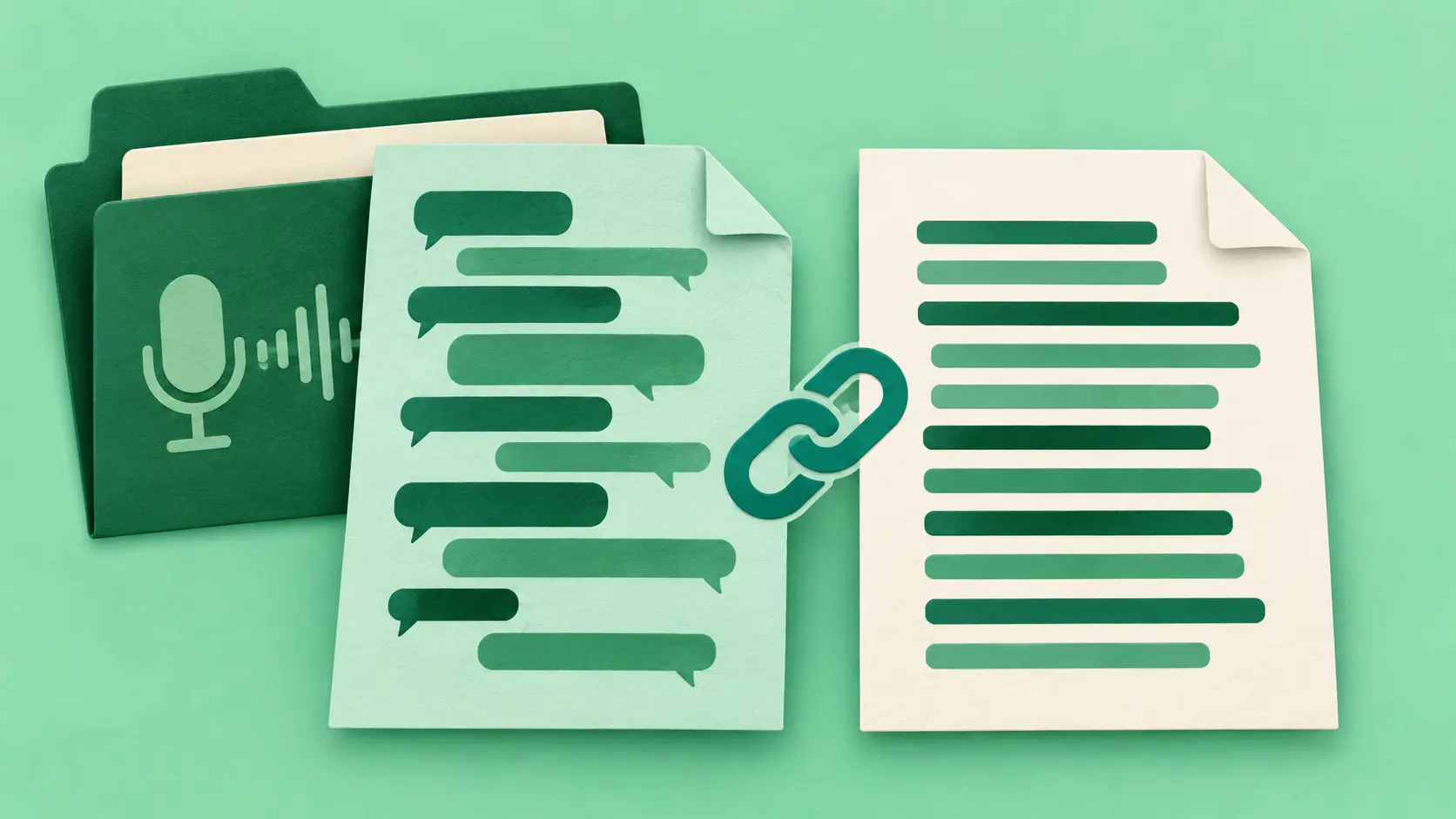

Introduction to Verbatim and Clean-Read Transcripts
Understanding the Current Landscape of Editorial Editions
An interview can support a linguistic record, a readable publication, and a concise set of notes. They may share the same source while preserving different details. The issue is edition purpose, not choosing one universally superior text style. UK Data Service describes interview transcripts as qualitative data, while Columbia emphasizes transparent transcription and editing. Those contexts support an explicit editorial contract that tells contributors and readers how speech will be represented, rather than relying on a label whose meaning varies across teams.
Define the contract before editing. It should specify whether fillers, false starts, repeated words, pauses, and relevant sounds are retained, condensed, or marked separately. It should also identify edits that require source review. A clean-read version can be valuable without pretending to be a complete acoustic record. A detailed version can preserve interaction without claiming that written notation captures every nuance. The important property is a declared relationship between the source, the edited text, and its intended use.
References: UK Data Service qualitative data; Columbia transcription-guide scope.
Why Small Omissions Can Change Interpretation
Hesitation, repetition, and self-correction do not have identical editorial roles. A repeated syllable may be incidental; a repeated refusal may signal emphasis; a correction may establish a changed value. TEI separately represents pauses and gaps, illustrating that an omission should not be confused with a feature of the source. An editor needs to explain whether absent text was inaudible, intentionally removed, or never present, because these states support different interpretations of the delivered record.
Consider an illustrative interview where a speaker begins by saying they always use a workflow, then corrects always to sometimes. Removing the false start may produce a readable sentence that preserves the final position. Removing sometimes as a filler would change it. The scenario is hypothetical. It shows why a clean-read policy should evaluate the function of an expression before deleting it, rather than treating every short repeated or hesitant word as expendable clutter.
References: TEI pauses; TEI omitted-text gaps.
1. Foundations of an Edition Contract
1.1 Defining What Each Version Preserves
Specify wording, turn order, repetitions, pauses, corrections, relevant sounds, and editorial additions for each edition. W3C's transcription guidance includes relevant non-speech information, while TEI utterance encoding distinguishes speech units. The proposed contract assigns these choices to a purpose rather than a vague quality label. A research edition may preserve interactional detail; a public clean-read version may condense it. Neither should erase the evidence needed to understand a consequential qualification or attribution.
A version relationship should remain explicit even when only the readable edition is published. Retain the recording and a source-faithful reference for important passages. If an editor removes incidental repetitions, the public reader need not see every deletion marker, but the team should be able to reconstruct the decision where it matters. Do not describe the result as strict verbatim if the policy deliberately changes wording, sequence, or detail for presentation.
References: W3C what to transcribe; TEI utterance units.
1.2 Functional Editing of Fillers and Repetition
Review discourse markers, searching pauses, emphasis, repair sequences, and meaningful hesitation by function. Columbia's guide context emphasizes intended meaning and review, while TEI pause representation keeps pauses distinct from words. A word such as well can introduce disagreement rather than merely fill time. Deleting it may make an answer seem more direct or less qualified. The original policy proposed here permits readability edits only when the important relationship and degree of certainty remain defensible in context.
For the illustrative always-to-sometimes correction, compare the edited sentence with the full answer. Does it preserve the speaker's final position, and does removing the repair conceal something relevant to the intended analysis? A publication and a conversation study may make different legitimate choices. Record the purpose and keep the source available. The editor's job is not to force every recording into ideal prose, but to produce a declared edition without silently strengthening or simplifying the speaker's position.
References: Columbia editing and review scope; TEI pause distinctions.
1.3 Unclear Audio, Omission, and Added Context
Distinguish unclear wording, missing content, intentional condensation, supplied explanation, and review certainty. TEI provides separate unclear and gap constructs. This is a useful representation distinction: a reviewer who cannot hear a word should not treat it as deliberately omitted, and a clean-read deletion should not imply the source was inaudible. The contract should define how these states are shown publicly or retained internally so an apparently smooth sentence does not conceal a gap in the evidence.
A localized uncertainty note should identify the affected interval and question. If only one word is unclear, preserve the surrounding verified content rather than labeling a whole interview unusable. If an explanation is added from project knowledge, distinguish it from speech. Do not complete a missing clause through expectation or merge fragments across a gap into a sentence nobody actually spoke. Readability improves access only when it does not fabricate continuity that the recording cannot establish.
References: TEI unclear text; TEI gaps and omission reasons.
2. Quality Measures for Editorial Editions
2.1 Fidelity to the Declared Purpose
Measure meaning preservation, qualification retention, speaker attribution, policy consistency, and review effort. Oral History Association best practices emphasize thoughtful source work, while W3C discusses checking automated transcription. The original acceptance method here asks whether the edition fulfills its declared purpose without unsupported changes. A clean-read version should not be penalized merely for a permitted incidental deletion, but it should fail if that deletion removes a refusal, shifts certainty, or erases an important self-correction.
WhisperAITranscribe (an online audio and video transcription tool) can provide editable draft text and timestamps for preparing either edition. The team's policy determines what may change; a clean-formatting feature does not establish a strict verbatim standard or approve editorial omissions. Inspect representative passages before scaling and record consequential decisions separately. No feature description or external guide measures the product's fidelity on an untested file. A finished-looking transcript remains a draft until it meets the intended release standard.
References: OHA oral-history best practices; W3C automated draft checking.
2.2 Comparing Editions Without Misleading Scores
Keep source accuracy, edition differences, comparison transforms, intentional deletions, and consequential errors separate. Jiwer transformations can change comparison input, while TEI choice represents alternatives. A strict source reference and a clean-read publication will differ by design. Reporting their raw difference as recognition error confuses editorial policy with acoustic fidelity. Conversely, normalizing away all omissions can hide real failures. Declare what the comparison measures before assigning a quality label to the result.
Use a small reviewed excerpt to inspect the scoring policy. Remove an incidental repeated word, a negation, and a corrected value deliberately, then check how the comparison treats each. The original diagnostic should inform a separate semantic release gate. A numerical summary can help track consistency, but it cannot decide whether an omitted expression was functionally important. Keep the edition contract alongside the result so another reviewer can understand which differences were permitted and which require repair.
References: jiwer comparison transformations; TEI alternative representations.
2.3 Traceability for Consequential Edits
Retain source interval, earlier form, edited form, and decision reason for consequential changes. TEI revision description records change history, while PROV-O distinguishes entities and their derivations. The proposed workflow uses these as conceptual resources, not a requirement to implement a complex ontology for every interview. Another editor should be able to explain which edition contains the statement, what changed, and whether the change affects meaning, attribution, chronology, or only presentation.
For the illustrative correction, preserve the link between the full spoken repair and the clean-read sentence. If a quoted extract is later challenged, replay the source and inspect the contract rather than trying to remember what was deleted. A review record can be compact, but it must identify the actual change. A generic note that the transcript was cleaned does not provide enough evidence to distinguish permitted simplification from a substantive rewrite that needs separate approval.
References: TEI revision description; W3C provenance relationships.
3. Applications of Declared Transcript Editions
3.1 Published Interviews and Reader Access
Published interviews benefit from readability, fair representation, and source continuity. Columbia's guide context and OHA best practices provide professional grounding for careful editorial work. The original contract proposed here allows a readable edition while requiring source review for changes that affect a person's position. A writer should not improve a hesitant answer into an unqualified claim simply because the polished form is more quotable. Declare the edition style and keep important extracts connected to the recording.
In a hypothetical profile, a speaker repeatedly revises an answer about confidence in a project. A clean-read version can reduce incidental repetition while retaining uncertainty and the final qualification. If the chosen extract removes the qualifications entirely, it is no longer a harmless cleanup. Review the surrounding exchange before publication and reject a shortened form that changes the represented position. The public reader needs a coherent text, but coherence should not come from silently replacing the speaker's stance.
References: Columbia transcription and editing; OHA professional interview practice.
3.2 Research Data and Reuse Conditions
Research reuse requires edition documentation and file relationships. UK Data Service describes qualitative transcripts as data, while ReShare asks depositors to organize versions and document relationships. A later analyst needs to know whether hesitations and repairs were retained before interpreting conversational behavior. A clean-read edition may be entirely suitable for thematic research and unsuitable for a different interactional question. The important safeguard is making the preparation policy visible rather than treating all transcript text as equivalent raw evidence.
For a hypothetical study, retain the contract, a file list, and the relationship between audio, source-faithful text, and clean-read text. State which intervals remain unresolved and which information was removed for presentation. These records support reuse without claiming universal suitability. Do not let a downstream analyst infer that absent hesitation means a speaker was confident if the edition policy deliberately removed hesitation throughout the collection. Absence in an edited view is not proof of absence in the source.
References: UK Data Service qualitative reuse; ReShare versioning and documentation.
3.3 Notes, Summaries, and Action Records
Summaries, clean-read text, and source evidence should remain distinct. AMI's framework links summary material with dialogue annotations, while PROV-O models derivation. A summary intentionally selects and reorganizes information; it should not be relabeled as a transcript or used as the sole evidence for a quote. The original workflow maintains the source interval behind important conclusions and recognizes that a clean-read correction can affect a summary even when most words remain unchanged.
WhisperAITranscribe supports preparing editable text and, within its available features, summaries or key points that require review. The team's notes should retain the source relationship and the edition used. No native archive integration is implied. If the word ‘sometimes’ was removed incorrectly from the illustrative answer, revisit the summary's conclusion as well as the transcript. Repairing one artifact does not automatically repair an action or research note that already copied the stronger earlier wording.
References: AMI dialogue and summary annotation; PROV-O derivation concepts.
4. Choosing an Edition and Review Workflow
4.1 Representative Tests and Release Criteria
Select repairs, repeated emphasis, uncertain words, and relevant sounds from representative recordings. TEI gap and unclear elements distinguish missing from uncertain text; the original release gate adds a purpose-specific check. Every consequential edit should preserve meaning, the edition should follow its declared policy, and unresolved evidence should remain qualified. These are project criteria to test, not a claim that one universal definition of verbatim resolves all professional transcript uses.
A reader-listener comparison can reveal unintended strengthening. Ask a reader of the edited text to summarize the speaker's position, then compare it with a listener's source-based account. Investigate differences caused by omission or reordering. If the edition cannot support the intended interpretation without additional context, add a clearly separate explanation or choose a fuller extract. Do not approve the text merely because it is shorter, grammatically correct, and easier to quote.
References: TEI omission reasons; TEI uncertain text.
4.2 Product Features and Explicit Edition Records
For WhisperAITranscribe, retain media version, draft output, edition contract, reviewed version, consequential edits, and release status in separate records. Select the actual spoken language and use conditional speaker labels only where supported. The product's editable text can support review, but it does not establish strict verbatim capture, universal hesitation retention, or automatic edition management. Describe the actual artifact and the team's choices rather than inferring a detailed editorial policy from clean formatting.
Treat a free preview as potentially partial and verify the full deliverable where required. A clean opening may not contain the repairs and uncertainty that make the rest of the recording demanding. If supported caption export is used, review its condensation policy separately. A readable caption sequence, a clean-read interview, and a source-faithful research transcript can coexist, but their relationships must be explicit so readers do not unknowingly reuse the wrong edition for a consequential purpose.
4.3 Review Capacity and Policy Changes
Budget media-duration usage, source checking, editorial judgment, and derivative repair separately. WhisperAITranscribe measures usage by media duration, while edition work depends on the source and contract. ReShare documents meaningful versions and relationships; TEI revision descriptions provide a change-history concept. Neither supplies guaranteed efficiency. Observe how much time the team needs to review representative repairs and ambiguous expressions before committing to an archive-wide clean-read policy or a detailed interactional edition.
Version the contract when conventions change. A new rule for incidental fillers may not require every source to be replayed, but a changed rule for self-corrections can affect important evidence. Identify the consequence before applying mechanical edits. Capacity planning should include locating affected quotes and notes, otherwise apparent efficiency comes from leaving incompatible editions in circulation. A scalable process is one that can explain and repair changes, not simply one that can remove more words quickly.
References: ReShare file versioning; TEI revision history.
5. Future Directions in Editorial Editions
5.1 Reversible Editing and Visible Policy
Future workflows should connect edition rules, alternative forms, and change history. TEI choice and revision-description elements illustrate ways to represent alternatives and revisions separately. A useful interface would show which changes are presentation-only and which require source approval, then retain the relation to the earlier form. This is an original design direction, not a claim that the target product already creates reversible editions or that an encoding standard supplies automatic editorial judgment.
Test such a design with omitted negation, repeated emphasis, and a self-correction. It should make consequential changes discoverable without overwhelming the public reader with every incidental deletion. The review record can be more detailed than the delivered edition. The important property is recoverable evidence: a disputed extract should lead back to the source and contract, not to an irreversibly polished paragraph that no longer reveals what the editor changed.
References: TEI alternative representations; TEI revision descriptions.
5.2 Purpose-Aware Annotation and Uncertainty
Unclear words and source gaps should remain distinct even when delivery becomes more automated. TEI supplies different constructs for those states. A future workflow could help reviewers flag an inaudible token, a deliberate condensation, and an added explanation without forcing all three into one generic edit category. The acceptance test would still require meaningful source review. Better annotation organization does not make missing audio recoverable or establish that a deleted hesitation was unimportant to every later use.
For WhisperAITranscribe, treat edition annotation as a separate team practice unless a supported interface is actually established. Do not infer automatic verbatim certification or research-grade interaction analysis from a transcription feature. Preserve representative difficult examples and the chosen policy so later improvements can be tested. The current deliverable should remain bounded by what reviewers can verify, with uncertainty visible where the source or intended edition cannot support a stronger statement.
References: TEI unclear-text annotation; TEI gap annotation.
5.3 Revision-Aware Publishing Across Editions
A workflow around WhisperAITranscribe should connect source-faithful text, clean-read editions, selected quotes, and derived summaries through explicit relationships. Imagine correcting a deleted qualification after a quote and research note have been released. The useful process locates those derivatives and asks their editors to revisit them. This is an original publishing method, not a claim of automatic synchronization, native integration, or a public API. Edition clarity matters because each derivative may have used a different degree of editorial condensation.
WhisperAITranscribe can remain the draft-preparation stage while the team manages edition contracts and release records. A manual handoff may be adequate when it preserves source intervals and correction scope. The essential safeguard is that the readable version does not become an unchallengeable master simply because it is the easiest to circulate. Keep the evidence relationship available so later reuse can choose the appropriate edition and consequential corrections can reach the artifacts that depend on it.
6. Conclusion
6.1 Key Insights and Future Trajectory
Verbatim intent, clean-read purpose, omission policy, uncertainty, source traceability, and release approval should remain explicit. For WhisperAITranscribe, the draft is the beginning of edition work, not a complete editorial contract. Preserve important qualifications and repairs, distinguish inaudible content from deliberate condensation, and keep a source-faithful relationship behind readable delivery. The right edition depends on the task; the shared standard is that its changes can be explained without pretending the source was simpler, more certain, or more polished than it actually was.
A readable publication and a detailed research record can both be useful when their relationship is declared. Problems arise when one is presented as the other or becomes the only surviving reference. Choose the purpose first, retain the evidence, and make consequential edits reviewable so professional reuse does not depend on guessing what a cleaner earlier editor removed.
6.2 Practical Next Steps for an Edition Contract
Begin with a small editorial trial. Step 1: define what each version preserves and which omissions require source review, then retain the original media and representative repair passages. Step 2: prepare draft text with WhisperAITranscribe using the actual spoken language and conditional labels where available. Step 3: apply the contract, inspect meaning-changing edits, and distinguish unclear audio from intentional condensation. Step 4: release the declared edition with traceable relationships to important quotes, captions, and notes, revisiting them whenever a consequential correction changes the source interpretation.
Measure observed review effort before scaling and version the contract when its rules change. Do not let a short preview establish the whole file's suitability or let a clean-read label excuse missing qualifications. A reliable edition is one whose intended simplifications remain defensible and whose disputed passages can be checked without reconstructing the process from memory.
6.3 Concluding Advice and Resources
Declare edition purpose, preserve important repairs, distinguish omission states, and retain change traceability. WhisperAITranscribe can provide editable draft text for review; the team's contract determines whether the delivered version is suitable for its intended use. Use concrete encoding and archive guidance to organize alternatives and revisions, but do not treat those frameworks as automatic evidence of fidelity. A polished transcript should be easier to read without making its editorial decisions impossible to discover or challenge.
References: TEI edition alternatives; ReShare version relationships.
Questions and answers
How do verbatim and clean-read transcripts differ?
Verbatim and clean-read transcripts need an explicit editorial contract that explains permitted changes and preserves a checkable relationship with the recording.
How should I document readability edits?
Define how fillers, repetitions, self-corrections, and relevant sounds are handled before editing, matching the policy to the deliverable's intended purpose and audience. Distinguish unclear audio from deliberate condensation, and review consequential omissions for changes to certainty, attribution, emphasis, or the sequence of an exchange.