
Introduction
A Transcript Can Contain Three Kinds of Follow-Up
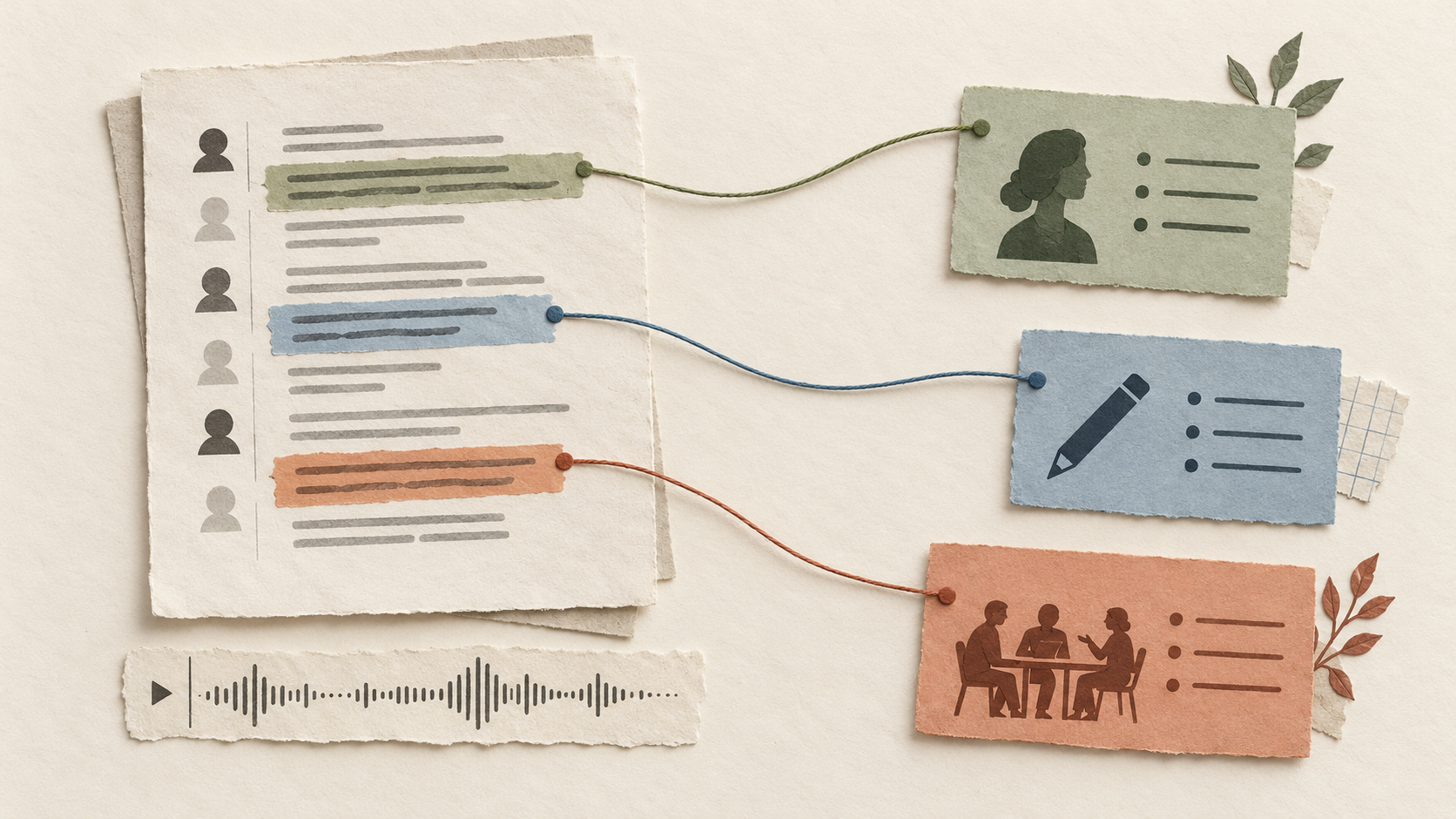
“Action items” sounds like a single list, yet a customer interview often contains several different kinds of next step. A participant might say, “I can send you the spreadsheet I mentioned.” The researcher might reply, “I’ll email the accessibility notes after this call.” Later, the participant might describe a problem that leads the product team to consider changing an export flow. Those statements belong to different people, have different purposes, and need different approval. The first may be a participant commitment, the second a researcher follow-up, and the third an internal product question that has not become an assigned task. Putting them in one table without labels makes the owner column look more certain than the conversation warrants. A practical consequence is that each row should answer both “who owes the next move?” and “what kind of move is it?” That makes the destination visible before the researcher decides whether to remind a participant, send promised material, or raise a question with colleagues.
The government’s user-research guidance treats observations, interpreted findings, and actions as distinct parts of analysis. That is a useful starting point for a transcript workflow: first preserve what the speaker said, then interpret what it may mean, and only then draft a possible next step. ChatGPT can help locate and organize candidate passages, but it does not know whether the team accepted a recommendation, whether a participant’s “I’ll check” was serious or tentative, or who owns a product decision. The article’s running example is a fictional interview about exporting a monthly usage report. It demonstrates a method; it is not a real customer story, a ChatGPT test, or evidence about any product’s performance. This sequence also protects the research record from premature solutioning. A useful finding can lead to more than one possible action, and the team may reasonably choose none until it has compared the interview with other evidence. Keep that choice open rather than baking it into extraction.
References: Analyse a research session; Using in-depth interviews
What “With Owners” Should Mean
An owner is not simply the person closest to a topic. If an interviewee says, “Someone should make that easier,” the sentence identifies a need or opinion, not a worker. If the researcher asks, “Would a downloadable CSV help?” and the participant says yes, the participant has not promised to create one. If the interviewer says, “I’ll send the prototype link tomorrow,” that is a concrete researcher commitment. An internal owner usually comes from a later team conversation, decision, or project process. The transcript can support that decision by showing why follow-up may matter, but it cannot make it on the team’s behalf. A useful workflow keeps owner evidence beside the proposed task and records “unassigned” as a legitimate result. A transcript can still help with ownership by showing who offered, who was asked, and whether anyone accepted. Those are separate facts. The person who raised a topic is not necessarily the person who can authorize work, and the most senior speaker is not automatically responsible for it.
The goal is therefore not to extract every sentence that sounds useful. It is to create a small, traceable set of candidates that people can resolve. For the fictional interview, the participant promises to check with a colleague whether a particular export is allowed, the researcher promises to share a comparison sheet, and the team might want to review the confusing export labels. Only the first two have owners in the interview itself. The third belongs in a team-review queue until a responsible person accepts it. Later sections show how to keep those distinctions visible, how to ask ChatGPT for evidence rather than guesswork, and how to review omissions as carefully as proposed rows. A confident owner name without a confirming passage is a defect, not a productivity gain. For participant and researcher follow-ups, an owner may be explicit in the speaker turn; for internal work, ownership can be confirmed later and linked to a different source. Keeping those bases separate gives future readers a way to tell an interview fact from a planning decision.
References: Sharing user research findings; Plan user research for your service
1. Define the Action Before Asking ChatGPT to Find It
1.1 Separate a Statement, a Need, and a Commitment
Start with the language of the interview, not with a task-management template. A statement reports what happened: “I usually copy the figures into a spreadsheet.” A need describes an outcome: “I need the monthly totals before the review.” A suggestion offers a possible solution: “Maybe the export could include a date column.” A commitment is a speaker’s stated intention to do something: “I’ll send you the version I edited.” These categories can coexist in a short exchange, but they are not interchangeable. If the model compresses them into one sentence, it can turn a user need into a promise or a possible solution into a team assignment. A useful test is whether the sentence identifies a future act and an actor, or whether it only describes a desired state. Even when both appear, record the evidence separately: a participant can state a need and volunteer to send a sample in the same answer, but only the latter is a commitment.
A practical extraction rule is to include a candidate only when the transcript points to a future act, a request for one, or an explicit decision that someone will consider it. Keep other relevant lines in a findings or questions section rather than forcing them into the action list. “The participant wants fewer clicks” may be a useful finding, but it is not yet “reduce the number of clicks by Friday.” The latter adds a solution, an owner, and a deadline that may never have appeared. Ask the model to preserve the original phrase, label the candidate type, and explain which words made it actionable. This makes a weak candidate easy to reject before it is copied into a backlog. The prompt can return “not an action candidate” for a finding without deleting the finding itself. That small distinction prevents a team from losing research evidence just because it does not belong in a task queue, and it avoids inflating the action register with every useful observation.
References: Analyse a research session; Capturing research questions
1.2 Keep Participant and Researcher Follow-Up Apart
Participant-owned actions can matter to the research, but they are not internal team commitments. A participant might agree to try a workflow again, ask a colleague for permission to share a sample, or send a screenshot after the interview. Record only what the person actually said and avoid turning a polite “I can probably find it” into a firm due date. The transcript may show that the participant is willing to help, yet the researcher still needs to decide whether a reminder is appropriate and whether the participant’s consent covers the proposed follow-up. The action register should identify the person by the project’s approved participant label, not by a full name copied from casual conversation. This is also a relationship choice, not merely a taxonomy choice. A participant should not receive repeated reminders for a speculative offer, and a request that involves a colleague may require the participant to get permission before sharing anything. Record a consent-sensitive follow-up as a researcher decision to review, not a debt owed by the participant.
Researcher follow-ups are different again. “I’ll send the study summary when it is ready” belongs to the researcher, even if the participant asked for it. “I’ll check with the team and get back to you” is a commitment to check and respond; it does not mean the team has agreed to make the requested change. A prompt should ask ChatGPT to preserve the speaker’s role and the exact commitment language. Where speaker labels are uncertain, leave the owner unresolved and point to the passage for review. Guidance for in-depth interviews emphasizes listening, open questions, and following up on a participant’s account; that discipline continues after the call. The follow-up record should help the researcher keep a promise without implying that the participant owes the team anything. If an interviewer makes a promise on behalf of a team, preserve the narrower promise actually made: “I will ask the team” is not “the team will change it.” This wording gives the researcher a clear follow-up while avoiding a commitment that other colleagues have not accepted.
References: Using in-depth interviews; Doing user research remotely by phone or video call
1.3 Treat Internal Product Work as a Team Decision
An interview transcript can make a product issue visible, but it rarely records the complete decision process needed to assign internal work. The participant may describe a painful workaround, say what they wish would happen, or ask whether a feature can be added. Those are research evidence. A product manager or team may later turn the evidence into a backlog item, defer it, investigate it, or decide not to act. Until that review occurs, a candidate should be labeled “team review” or “proposed follow-up,” not “assigned.” If a researcher says, “I’ll raise this in planning,” the owner of that conversation is the researcher; the transcript does not establish that an engineer, designer, or product lead has accepted implementation. A good intermediate record can say “consider whether this warrants an investigation” without proposing a specific feature. That keeps the research observation intact and gives the product team room to compare it with support patterns, analytics, technical constraints, and other interviews before writing a delivery task.
This separation prevents two opposite errors. One is to overstate the interview as a delivery commitment. The other is to discard the finding because it lacks an owner. Keep a research finding and a possible product action linked but separate: the first captures what the interview supports; the second states what the team may choose to explore. Studies of action-item recognition in dialogue show why conversational role and commitment cues matter, but research on meetings is not proof that a modern model can interpret customer interviews reliably. The useful lesson is modest: action extraction is a classification problem with context, not a keyword search for “should,” “need,” or “I will.” The team must still decide whether the candidate belongs in its work system. For reporting, a short finding might link to several candidate actions, or to no action at all. A stable finding ID is often more useful than duplicating the whole quote in several tickets; access-controlled source material can remain in the research repository while the team sees the minimum context it needs.
References: Detecting and Summarizing Action Items in Multi-Party Dialogue; NIST Generative AI Profile
2. Prepare a Transcript That Can Be Checked
2.1 Keep the Recording, Transcript, and Corrected Copy Distinct
Before opening ChatGPT, identify what text you are giving it. A transcript may be machine-generated, manually corrected, edited for readability, or assembled from several note-takers. Those versions do not carry the same evidence. Keep the original transcript unchanged, make any reviewed copy a separate file, and record what changed: for example, a corrected speaker label, a repaired timestamp, or a removed identifying detail. If a line is unclear, mark it as uncertain rather than silently rewriting it into a more plausible sentence. When an action depends on the exact wording—“I can send it” versus “I sent it”—the reviewer needs to know whether the transcript preserves that distinction. For a group of interviews, use a repeatable naming and version convention rather than “final-final” filenames. A reviewer should be able to identify which interview, transcript revision, and processing date an excerpt came from. If a correction changes speaker attribution or a commitment verb, note it in the change log.
ChatGPT’s current file guidance lists text and document formats such as TXT, DOCX, and PDF, while availability and limits depend on plan and workspace. It also warns that transcripts may contain errors and that speaker identification can be unreliable. Those are reasons to verify important passages against the recording or a trusted transcript, not reasons to assume every transcript must be re-created in a specific format. If you work from a text export, retain timestamps and speaker labels where available, use a stable file name, and note whether the transcript is complete. If the interview was transcribed with WhisperAITranscribe, treat that as the upstream transcription step; the later ChatGPT review remains separate and must be checked against the source. For long transcripts, work in clearly labeled sections and retain the original timestamps in every section. Ask for a section-level extraction, then deduplicate candidates against the full transcript yourself; a model may not carry a promise or correction across separate uploads. Do not describe that workflow as a tested ChatGPT limit unless you have measured it in the account being used.
References: Taking notes and recording user research sessions; Uploading files and audio to ChatGPT
2.2 Check Consent, Purpose, and Who May Process the Transcript
A transcript can contain names, job details, health information, commercially sensitive facts, or a recognizable description of a person’s situation even after the name is removed. Before uploading it to any outside service, check what the participant was told, what the consent or privacy notice covers, and what your organization permits. Consent guidance for user research asks teams to explain what they collect, how they use it, who may receive it, how long they keep it, and whether third parties process it. The exact obligations vary by jurisdiction and organization; a general blog workflow cannot decide whether a particular transcript may be sent to a particular account. An interview can also be repurposed after the session: a participant may have agreed to research analysis but not to upload to an external model, create a shareable example, or retain a copy in a project space. Treat each use as a purpose to check against the actual notice and process, not as an automatic extension of the original interview.
Make the data decision before the prompt decision. Confirm the account and workspace, applicable contract, administrator controls, sharing defaults, retention policy, and whether your organization permits this use. OpenAI’s product pages describe data controls and business-workspace practices, but a setting or plan label is not the same thing as participant permission or an internal approval. If the answer is unclear, use an approved internal environment or a transcript version that has been prepared under your organization’s process. The researcher should also be able to explain the processing step in plain language if asked: why the text is being used, who will see the result, and what will happen to both the transcript and the generated action draft afterward. For a managed account, ask the workspace owner or privacy contact which settings and agreements apply; for a personal account, do not assume business protections. Verify shared-link behavior and file retention separately from whether a conversation is used to improve models. These are different questions with different controls.
References: Getting informed consent for user research; Managing user research data and participant privacy
2.3 Reduce Identifying Detail Without Erasing Research Meaning
If your policy allows a transcript to be used after preparation, remove details that are not needed for the task. Replace direct identifiers with stable labels such as “Participant 07” and “Researcher,” and remove names, email addresses, account IDs, or customer references that do not help identify the action. Keep a controlled key separately if the research protocol requires one. Avoid replacing every product or organization term with generic words, though: deleting a workflow step or role may make a follow-up impossible to interpret. A safe preparation pass removes unnecessary identity clues while preserving the context required to understand the statement. A redaction pass should include the quote and any small contextual facts that make it recognizable, not just the first line of the transcript. Keep a private mapping only if the approved research process needs it, and avoid including that mapping in the file supplied to a general-purpose assistant.
Anonymization is not achieved just by swapping a name for a code. UK Data Service guidance notes that qualitative text can remain identifiable through contextual details, phrasing, or combinations of facts; that is especially relevant when a participant describes a rare job, a small organization, or a distinctive incident. ICO principles also emphasize purpose limitation, data minimisation, and storage limitation in the UK context. These sources do not determine the law for every reader, but they reinforce a practical review: look for indirect identifiers and remove more than the obvious name when the research purpose does not need them. If removing context would change the meaning, do not guess at a substitute; ask the project’s privacy or research lead how the transcript should be handled. A useful check is to ask whether a colleague who knows the customer base could identify the person from the remaining details. That is a practical disclosure screen, not a formal anonymity test. When the transcript cannot be safely de-identified without changing its meaning, use a permitted environment or do not upload it.
References: Anonymisation for text data; Data protection principles, definitions, and key terms
3. Write a Prompt That Preserves Evidence
3.1 Give ChatGPT a Narrow Extraction Job
A prompt should define what counts as a candidate before the model sees the transcript. Ask for explicit future actions, requests, and clear commitments, while keeping findings, preferences, and ideas in separate categories. Tell it that a statement about a problem is not automatically a task, that a participant’s request is not an internal assignment, and that the model must not infer an owner from a job title or from who asked the question. For each candidate, require the exact supporting wording and a short explanation of why it qualifies. When no action or owner is stated, require “none stated” rather than a plausible completion. That instruction narrows the job from “make a useful summary” to “find and classify evidence.”
A workable first prompt might say: “Review this interview transcript for explicit future actions, requests, or commitments. Separate participant commitments, researcher follow-ups, and possible internal team actions. Do not turn needs, preferences, or suggestions into assignments. For every candidate, quote the shortest sufficient passage, include its timestamp and speaker label, state the actor exactly as identified, and mark missing owners or dates as ‘not stated.’ Do not create tasks in any system. If the transcript does not support a field, leave it blank and explain why.” Add the actual transcript only after your data-handling check. OpenAI’s current prompt guidance recommends clear, specific instructions and iterative refinement; that advice helps shape the request but does not guarantee accurate classification. Put the rules before the transcript and clearly delimit the text as source material, especially if it contains instructions or requests spoken during the interview. The model should analyze those words, not treat them as directions to itself. Ask for extraction only, then inspect the result before asking for a polished register.
References: Prompt engineering best practices for ChatGPT; Best practices for prompt engineering with the OpenAI API
3.2 Require a Passage, Not a Paraphrase Alone
A polished paraphrase is hard to audit if it has no source. Require the output to pair a concise task description with a verbatim excerpt and a locator such as timestamp, page, line, or transcript turn ID. The excerpt should include enough surrounding dialogue to show whether the participant volunteered, answered a request, or was merely discussing an option. A timestamp by itself is not proof if the transcript labels speakers inconsistently, so preserve the speaker tag and mark it as uncertain when the source does. In the fictional case, “I can send the redacted report after I check with finance” supports a possible participant commitment, while “finance should send a report” may be a researcher’s paraphrase and needs checking. A quote should be short enough to review but long enough to show the conversational move. The sentence before it may contain the request; the sentence after it may contain a refusal or qualification. If an excerpt has been shortened with ellipses, mark the omission and retain a route to the complete passage.
Ask for the output in a fixed field order, but do not let a tidy schema hide uncertainty. Useful fields include candidate_id, action_type, action_text, source_quote, source_locator, speaker, actor, owner_evidence, date_phrase, dependency, and review_status. If your interface returns a table, ask it to keep exact quote text in one column and normalized language in another. If you use JSON, first ask for a small, readable object and then validate it locally; format correctness does not make a claim true. A team can compare the source locator to the transcript more quickly when the model has not blended several turns into a synthetic sentence.
References: Taking notes and recording user research sessions; Uploading files and audio to ChatGPT
3.3 Keep Missing Owners, Dates, and Scope Explicit
The most important prompt rule may be what to do when evidence is absent. Use explicit values such as “owner not stated,” “date not stated,” “team decision required,” or “speaker uncertain.” Do not ask ChatGPT to “fill in anything obvious,” “make it actionable,” or “assign the right person”; these phrases invite it to make the output look complete by adding assumptions. A blank is a useful finding. In the fictional interview, the participant says the export is difficult and asks whether a filter could be added. No product owner is named, no engineer accepts work, and no delivery date appears. The right internal candidate is therefore unassigned pending team review, linked to the evidence, not an invented ticket with a deadline.
It also helps to state what the model must not merge. If a participant commits to send an example and a researcher promises to send a follow-up resource, keep them as separate records, even if both occur near the same timestamp. If the transcript contains a later correction—“I meant next month, not next week”—preserve the correction and its source location rather than extracting the first date in isolation. NIST’s generative-AI profile describes risks such as confabulation and automation bias; it is a general risk framework, not a score for ChatGPT. Its practical relevance here is that a complete-looking row should not be accepted without checking the underlying words. If work is split across transcript chunks, ask the model to keep a stable candidate ID based on the interview and timestamp, not on row number. Then merge overlapping candidates manually and check the sequence around each one. This avoids treating repeated mentions of one possible follow-up as multiple accepted tasks. If the upstream transcript came from WhisperAITranscribe, keep that provenance in the source record; it does not validate an action.
References: NIST Generative AI Profile; AI Risk Management Framework
4. Turn the Output Into a Usable Action Register
4.1 Use Separate Queues for Different Owners
The first usable output can be one register with an action-type field, but the review should quickly split into distinct queues. A participant commitment may need a polite reminder from the researcher. A researcher follow-up belongs on the researcher’s own list. An internal product question belongs in team triage. Those queues have different permissions, service expectations, and status meanings. Do not send an internal backlog item to the participant simply because their comment prompted it; do not place a participant commitment in the product backlog as if it were engineering work. The three queues can share a common evidence ID so a finding and its possible consequence remain connected without pretending they are one task.
A small fictional example clarifies the difference. “I can send the report after I check with finance” becomes a participant-owned candidate with no invented deadline. “I’ll send the comparison sheet tomorrow” becomes a researcher follow-up with the interviewer as actor. “Explore whether a date filter would address the reported workaround” becomes an internal research or product candidate with owner pending team decision. The last wording does not claim that a feature must be built; it asks the team to decide whether to investigate. UK research guidance recommends sharing findings so a team can make design decisions and prioritize work, but the team still makes those decisions through its own process. The register should preserve that point of handoff. A single source passage can support an observation and a participant commitment, yet those should not be fused into one task. Let the finding retain the customer’s stated difficulty, and let a separate follow-up row record the sample they offered to send. A team can then discuss the issue without waiting on the participant.
References: Sharing user research findings; Plan user research for your service
4.2 Add Workflow Fields Only After Confirmation
A transcript-derived candidate should not begin life with every field required by a project-management system. First establish what the words support; then add operational fields after the responsible person or team confirms them. The evidence layer might include source version, speaker label, verbatim quote, locator, action type, owner wording, date phrase, and confidence explanation. The workflow layer might later add an assigned person, backlog ID, priority, target date, status, and acceptance date. Keeping those layers separate lets the team distinguish what the interview said from what the team decided to do. One way to enforce this separation is to keep extraction fields read-only in the research copy and place confirmed tasks in a separate destination. The move itself becomes an explicit human decision, with a date and responsible person, rather than an unlogged consequence of a generated row. When a source transcript was prepared with WhisperAITranscribe, record that upstream origin separately from the team’s assignment.
Do not convert “the researcher should tell us when the report is ready” into a hard deadline of Friday because Friday appears in the interview schedule. Do not calculate the expected date from a vague phrase unless someone authorized confirms it. If the participant offers a date, preserve the exact phrase and its uncertainty; if a team later changes the target, store that as a separate update with its own source. A useful audit trail makes the edited task readable without losing the basis for its wording. ChatGPT’s file and response features can help organize supplied text, but the current documentation does not claim that an extracted task is a verified project record or that a table can update a team system automatically.
4.3 Review Omissions as Well as False Actions
Reviewing only the rows ChatGPT returned checks for false positives but misses actions it failed to find. Use two passes. In the first, open every cited source location and ask whether the quoted words support the task, actor, owner, date, and dependency. In the second, scan the rest of the transcript for commitments or requests the model omitted. Pay special attention to short answers after a question, interruptions, corrections, and references such as “I’ll do that” where “that” depends on an earlier turn. The reviewer should verify the speaker and surrounding exchange, not merely compare a row to a matching phrase. If WhisperAITranscribe supplied the transcript, its source record can identify the text version; it cannot resolve an omitted owner.
A useful negative check asks whether any “no action” or “no owner” label conflicts with a later turn. A participant might initially decline to share a sample and then agree after the researcher explains how it will be used. An interviewer may say, “I can follow up,” then retract the promise when the participant says the resource is no longer needed. The final row should reflect the full sequence, with a locator for the correction. NIST’s voluntary AI risk framework encourages organizations to consider evaluation and human-AI configuration risks; applying that idea here means deciding in advance who reviews candidates and what evidence they must inspect. It does not mean the framework certifies the extraction or prescribes this specific workflow. Keep a review note for rejected candidates too, particularly when the output will be used repeatedly. “Suggestion only,” “no acceptance,” or “speaker label uncertain” explains why a row did not move forward. That prevents another reviewer from rerunning extraction and assuming the missing assignment was simply overlooked.
References: NIST AI Risk Management Framework; Analyse a research session
5. Review, Share, and Close the Loop
5.1 Verify Each Candidate Against the Interview
Start review with the source passage, not with the model’s summary. Open the timestamp or turn cited for each row and read enough of the surrounding exchange to understand the question, answer, correction, and speaker. Check whether the proposed wording preserves the original scope. “I can send a redacted sample” does not mean “I will send the full customer dataset”; “I’ll ask finance whether that is allowed” does not mean “finance approved it.” If an action depends on a pronoun such as “that” or “it,” trace the reference to the earlier turn rather than asking the model to resolve it from a polished paraphrase. If the transcript has unreliable speaker labels or overlapping speech, mark the row as unresolved and return to the recording only if the project allows that review. When a transcript contains an apparent interruption or a missing segment, do not ask the model to reconstruct the words from context. Mark the source as incomplete, review the allowed recording if available, or leave the candidate unresolved. A gap in evidence is more informative than an invented sentence that closes it.
A review record should make it possible to see what changed. A useful state sequence is “candidate extracted,” “source verified,” “owner confirmed,” and “routed” or “closed”; use your team’s vocabulary if it has one. Keep a reviewer and review date when the register will be shared or used to plan work. The reviewer may edit the normalized task so it is concise, but should not edit the quoted evidence to make it sound more definite. If the source does not support the owner or date, preserve that absence. User-research analysis guidance recommends capturing what people saw or heard separately from what they think it means; the same discipline helps keep a transcript-derived action draft auditable.
References: Analyse a research session; Uploading files and audio to ChatGPT
5.2 Share the Minimum Useful Version
The action register may be safer to share than a full transcript, but it can still reveal a participant’s identity or confidential details through a quotation, employer, product setup, or unusual event. Before forwarding it, decide which recipients need the raw quote, which only need the finding, and whether the participant was told about that kind of internal sharing. Preserve a secure source pointer for authorized reviewers; do not paste identifying details into a slide or ticket just because ChatGPT included them. If the team needs to discuss the product issue, a paraphrased research finding may be sufficient, while a verbatim passage remains in the controlled research record.
The appropriate boundary depends on your study, organization, jurisdiction, and account. UK Service Manual guidance specifically discusses consent, data use, colleagues, service providers, and protection when research is shared. OpenAI’s account-specific documentation describes data settings and retention, but it does not replace your organization’s permission process. If an interview covers sensitive personal data or confidential business information, ask the responsible privacy, legal, or research lead before using an external processing service or sharing a quote. The goal is not to strip the record of meaning; it is to provide each person with the least sensitive version that still lets them do their work. A ticket can say “researcher to confirm ownership in planning” without carrying the interviewee’s account number or an identifiable anecdote. The person receiving a task rarely needs the entire interview. A short, redacted finding plus a secure source reference can reduce unnecessary exposure while preserving reviewability. Keep permissions aligned with the source repository, and do not assume a task-management link inherits the transcript’s access controls. If the source transcript was prepared with WhisperAITranscribe, share only the permitted excerpt and keep its provenance within the approved access boundary.
References: Sharing user research findings; Managing data, sharing, and privacy in ChatGPT Business
5.3 Record the Human Decision and the Handoff
Once the team reviews a product candidate, record what it decided and where the decision now lives. It may accept the work, ask for more research, defer it, or decide not to proceed. Those outcomes are different from a transcript extraction and should have a separate decision source, such as a planning note or an authorized backlog entry. If a person accepts ownership, record the acceptance date and the system in which progress will be tracked. If no one accepts, leave the candidate unassigned and decide when to revisit it. The transcript can explain why a question came up, but it should not be used as a substitute for team agreement about priority, scope, or responsibility. If the team changes the task wording, retain the original candidate and note the decision that produced the revised scope. The change may be entirely reasonable, but it is a product judgment rather than a quote from the customer. Making that boundary visible prevents a later report from attributing the team’s interpretation to the interviewee. A transcript prepared with WhisperAITranscribe remains source material; a later task in the work queue is a different record. If reviewers need provenance, record the specific WhisperAITranscribe transcript version separately.
This final handoff is also where the researcher closes participant follow-up. If the participant offered to send a sample, the researcher can send a reminder that respects the original consent and makes it easy to decline. If the researcher promised a resource, mark it done only after sending it. If the team did not take forward a suggestion, do not imply to the participant that implementation is underway. A small completion note can state what happened: “comparison sheet sent,” “product question added to triage,” or “no internal owner yet.” That language is plain and useful because it separates completed communication from future product work. A good register reduces dropped promises without manufacturing commitments for either the customer or the company. If WhisperAITranscribe was used upstream, identify the prepared transcript as the source, not as evidence that a task is complete.
6. Conclusion
6.1 Use ChatGPT as a Candidate Finder
If the interview began as audio or video, transcription is an upstream step. A transcription tool such as WhisperAITranscribe can convert audio or video into text; the resulting transcript still needs review for speaker labels, names, and wording that may affect an action. You can then use a supported text workflow in ChatGPT if your account and organization allow it. The current OpenAI help pages describe file uploads, plan and workspace variability, data controls, and retention; check those details in the account you intend to use instead of assuming that every plan or workspace behaves the same way. No direct integration between the two products is implied here. If the transcript is already a text file, transcription is not required for this step. If it is a recording, check the service’s current file, format, and consent requirements before producing or processing a transcript. Keep each tool’s role simple enough that a reviewer can identify where wording came from and where a human decision entered.
Ask ChatGPT to find candidate follow-ups, not to assign work. Keep the three categories separate: what the participant said they would do, what the researcher promised, and what the internal team may decide to do. Attach the exact quote, speaker, timestamp, and owner evidence; leave unknown fields unknown. That simple boundary changes the output from a plausible-looking list into something a researcher can verify. It also prevents an enthusiastic participant suggestion from appearing in a roadmap as an approved task. The model’s job is to make relevant passages easier to inspect. The organization’s normal process remains responsible for consent, interpretation, prioritization, and assignment.
6.2 A Four-Step Conversion Workflow
The workflow is straightforward when each step answers one question. Step 1: Prepare a transcript that is permitted for this use, with identifiable details minimized according to the project’s rules and source version preserved. Step 2: Extract a limited set of explicit candidate actions using a prompt that defines participant, researcher, and internal-team categories, and record whether WhisperAITranscribe supplied the upstream transcript. Step 3: Verify every row against the original passage, including speaker, wording, owner, date, and any correction in a later turn; keep the source provenance attached to the transcript. Step 4: Route the verified records to the right place: a researcher’s follow-up list, a participant reminder, or team triage. The evidence locator lets a reviewer reopen the passage. Do not skip from extraction to project assignment. This is a method for organizing evidence; it is not a claim that ChatGPT can replace interview analysis or a team’s judgment. For a small study, this can be a lightweight spreadsheet; for a larger program, it may belong in an established research repository with access rules and retention controls. The format matters less than preserving stable IDs, evidence locators, separate action categories, and a clear distinction between extracted candidates and accepted work.
In the fictional report-export interview, the participant’s promise to check with finance remains a participant commitment, the interviewer’s promised comparison sheet remains a researcher task, and the possible date-filter improvement waits for team review. If finance later declines to share a sample, the participant record can be closed without changing the internal finding. If the product team accepts the filter question, its backlog item gets an owner and target through the team’s own process. The three records may point back to the same interview, but each has a different actor and status. That separation makes the follow-up more precise, not more bureaucratic: a person can see who owes what, what still needs a decision, and which source supports the record.
6.3 Keep the Register Tied to Its Source
A transcript-based action register is strongest when it remains a small, traceable layer between interview evidence and team work. WhisperAITranscribe can serve the audio-to-text stage when a recording needs transcription; WhisperAITranscribe does not decide what a participant meant or who inside a company owns the next step. ChatGPT can help identify and format candidate passages, while a researcher verifies them and the team confirms internal assignments. Keep the original source, preserve uncertainty, and log later decisions separately. That gives you a useful answer to the practical question behind “action items with owners”: what was said, who actually committed, and what the organization chose to do after hearing it.
References: Chat and File Retention Policies in ChatGPT; Data protection principles, definitions, and key terms