
Introduction
Minutes record a meeting; interview notes record a session
The running example is fictional: a product researcher interviews an account administrator about an invitation workflow, then prepares notes for colleagues. No real customer, transcript, commitment, meeting, ChatGPT run, or product decision is being described. A transcription tool can provide text for review, but it cannot decide whether a participant agreed to an action or whether the team approved a change. The source, the analysis, and the minutes remain separate records. Before sharing anything, the researcher should confirm that the intended use and audience fit the permissions and study process that actually applied to the interview.
The word “minutes” usually suggests a meeting where people discussed business and made decisions or assigned work. A customer interview is often a research session with a moderator and a participant; it may not have an agenda, voting members, or authority to decide product work. Calling an automatically generated interview summary “minutes” can give a reader the wrong impression about who participated and what was agreed. If colleagues later meet to discuss the research, that is a separate event and may need its own minutes. The interview transcript can inform those minutes, but it is not a substitute for recording what the colleagues actually decided. Use the document title to signal its status: “Interview session record,” “Research debrief notes,” or “Team meeting minutes” is clearer than a generic “Customer interview minutes.” The right label helps prevent later readers from mistaking a participant’s observation for organizational approval.
References: GOV.UK taking notes and recording user research; GOV.UK in-depth interviews
A transcript does not turn a statement into a decision
A transcript contains words and speaker turns, not a complete record of the session’s purpose, consent, nonverbal context, or subsequent team decisions. A sentence such as “I would probably ask my colleague first” may be a response to a hypothetical question, not a promise to contact someone. A transcript can also lose tone, timing, gestures, or the moderator’s explanation of what happened next. The minutes writer has to preserve enough context to make a summary fair without pretending the text supplies information it does not contain. Keep questions, statements, observations, researcher interpretations, findings, and decisions distinguishable. If the record cannot tell whether a participant agreed, mark that point as unclear and check with an authorized person or the recording where appropriate. Do not repair an ambiguous source with polished wording that quietly changes its meaning.
A research session record is designed to preserve what happened in an interview and how the team may use the material in analysis. It can identify the study, session date, interviewer, participant code, method, transcript version, consent scope, and unresolved follow-up. Team debrief minutes document a later conversation among colleagues: who attended, what evidence they reviewed, which interpretations they discussed, what decisions they actually made, and who accepted a follow-up action. A participant-facing recap is different again. It may confirm logistics or share an approved next step, but it should not expose internal speculation or confidential research notes. Before asking ChatGPT to format the source, pick one of these outputs and write its intended reader at the top of the working brief. If the organization needs more than one document, create separate versions from the approved source instead of trying to make a single summary serve every purpose.
References: GOV.UK analyse a research session; GOV.UK share user research findings
1. Decide what kind of record you need
1.1 Name the audience and purpose
The audience determines what belongs in the record. A researcher reviewing a session may need a source locator, moderator question, brief observation, and uncertainty marker. A product team may need a concise summary of topics and open questions before a debrief. A customer may need only a factual recap of what the organization said it would do, if anything. A formal committee minutes document may have required fields and retention rules that come from the organization’s policy. Do not share participant-level details with people who need only a synthesized finding. Ask who will read the document, what they are entitled to see, and what decision or task it supports. If the reader’s need is unclear, keep a restricted source record and ask the owner to specify the audience before generating a wider summary. A concise brief can omit irrelevant detail while keeping the underlying evidence available to authorized reviewers.
Write a short purpose line before drafting: “This document records [an interview / a team debrief], for [audience], to support [specific use], and does not record [decisions made elsewhere].” Add the study name or code, date, version, facilitator, participant identifier or role where permitted, and the source record used. For a debrief, identify the meeting attendees separately from the interview participant. State whether the document is a draft, reviewed session note, approved meeting record, or external recap. If the study is exploratory, note that its interviews are qualitative research and are not designed to estimate prevalence. A title and header do not replace organizational records policy, but they help readers understand what they are looking at. A model should not infer missing metadata from a file name or from its own knowledge. Leave a field blank or label it “not recorded” until a responsible person confirms it.
References: GOV.UK informed consent guidance; GOV.UK participant privacy guidance
1.2 Separate interview notes from debrief minutes
Formal minutes often summarize important discussion, decisions, and assigned follow-up, while a research session record preserves participant statements and observations for later analysis. The two can overlap in a team debrief, but the overlap should be deliberate. If the interview itself included a clear operational commitment by an employee, it may be appropriate to record it as a commitment, subject to the organization’s conventions. If a participant said a feature might help, that is a participant request or suggestion, not an internal action item. A statement like “we should investigate this” is a proposed next step until the person with authority accepts it. Create distinct fields for “participant said,” “researcher observed,” “research interpretation,” “team decision,” and “follow-up.” Where the source supports only the first two, do not fill later fields by extrapolation. This separation prevents a summary from turning research material into a false account of governance.
A transcript needs a useful level of detail, not a full rewrite of every sentence. Preserve exact wording when a quote matters, when a commitment is material, or when an authorized reviewer must verify a sensitive statement. Otherwise, summarize neutrally and provide a locator to the source. Do not smooth a participant’s hesitation into certainty or remove a qualification because it makes the minutes easier to scan. Use short topic headings, concise context, and explicit status labels. Keep the research question visible so that later readers know why a topic arose. Include disagreement or an exception when omitting it would change the meaning of a finding. A minutes document can be shorter than a transcript without becoming an evidence-free summary. The detail threshold should reflect the document purpose, the study’s consent and retention rules, the organization’s meeting policy, and the likely consequences of misattribution.
References: DfE research with internal users; DfE planning user research
1.3 Choose a useful level of detail
Start with the exact source file and version used for the draft. Confirm that it belongs to the right session, that speaker labels are plausible, and that any edited, translated, partial, or redacted text is marked. If the transcript was created from audio or video, check consequential quotations, names, numbers, dates, decisions, and action language against the approved recording or another reliable record. Do not describe the source as “verbatim” if it has been cleaned or summarized. Keep the source’s file name, version, and status in a restricted header or evidence map. A newer transcript should trigger review of affected notes, rather than silently replacing the source underneath an already circulated summary.
Before uploading a transcript to ChatGPT or another third-party system, confirm that the participant was informed about the intended use and that the organization has approved the service, account, audience, and retention path. Permission to record or transcribe is not automatically permission to submit the text to an AI provider or circulate generated notes more widely. Check the actual workspace and current account settings; public product documentation cannot make that approval for your organization. Remove direct identifiers that are not needed, but also consider indirect details such as employer, location, timing, rare job titles, or distinctive incidents. Keep any identity key separately under the project’s access controls. If approval is not in place, use synthetic material to test the format or prepare the record manually through an approved process. Do not ask a model to decide whether consent covers the task, and do not treat a data-control toggle as a substitute for legal, contractual, or policy review.
References: COREQ reporting guideline; Original COREQ paper
2. Prepare a trustworthy source and record header
2.1 Verify the transcript and its version
Speaker labels need to remain stable across the transcript, notes, and minutes. If the source says “Speaker 1,” do not rename that person “customer,” “administrator,” or a personal name unless an authorized source confirms the attribution. In a recorded interview, the moderator, participant, interpreter, observer, and overlapping speakers may be hard to distinguish. Mark uncertain attribution explicitly. Preserve the question that prompted a consequential answer, because a response can change meaning when separated from the prompt. If an excerpt begins mid-sentence or a moderator paraphrases a response, say so. A summary can use participant codes or roles when the audience is authorized and the study design permits them. Avoid creating false certainty by assigning a speaker based on conversational expectation. Where a speaker is unknown, record “speaker unclear” and link to the relevant source location rather than guessing.
A locator makes a short record auditable. Depending on the source, use a stable timestamp, paragraph or line range, transcript segment ID, page number, or research-note ID. Include the transcript version because a line number can move when text is corrected. Add enough context around a quote or summary for an authorized reviewer to see what question was asked and what happened immediately before and after. The locator should point to the source repository with access controls that match the sensitivity of the material. Do not paste a full customer story into a meeting record if a brief paraphrase and restricted source link will do. If transcription corrections, translation, or redactions affect a sentence, note that status. The minutes should help people find the evidence without turning the most widely shared copy into a duplicate of the participant’s raw record. WhisperAITranscribe is an audio and video transcription tool; this identifies an upstream category only.
References: Standards for Reporting Qualitative Research; Original SRQR paper
2.2 Confirm consent, access, and intended use
Not every detail in the transcript belongs in minutes. Select information according to the record’s purpose: the topic discussed, what the source actually supports, a confirmed decision if the event had authority to make one, a real commitment, and an unresolved question that matters to the next step. Exclude side conversations, unsupported explanations, unnecessary personal details, and repetitive speech that does not change the record. If the document is an interview session record, it may be more useful to preserve a concise topic map and observation notes than to imitate committee minutes. If it is a team debrief, include only the decisions made by the people in that meeting. When uncertain, ask the document owner whether a fact needs to be retained and who should see it. ChatGPT can suggest a clean structure, but it cannot determine retention obligations or authorize disclosure.
A good note attributes the source of each statement. “The participant said the confirmation message was easy to miss” is different from “The confirmation message is hard to see,” which sounds like an independently verified product fact. “The researcher observed a pause before the participant opened the email” is different from “The participant was confused.” The latter interprets a behavior and should be labeled as a hypothesis unless the study’s analysis supports it. Use neutral verbs such as “reported,” “asked,” “described,” “observed,” “suggested,” and “the team discussed.” Avoid “agreed,” “confirmed,” or “decided” unless the source shows the relevant agreement or decision. A speaker attribution should identify who made the statement only as precisely as the source and permissions allow. When a sentence combines speech and interpretation, split it into separate lines and give each line its own status.
References: DWP research reports guidance; DWP research publications
2.3 Preserve speakers, questions, and context
A meeting record should name a decision only when the source shows that an authorized person or group made one. A customer interview can contain an explicit promise from an employee, but a participant’s preference does not itself approve a product change. A researcher’s summary of what the team might do is not the same as a decision reached in a later planning meeting. Use a “Decision” heading only when the record has one; otherwise write “No decision recorded” or omit the field according to the organization’s policy. Distinguish a proposal, an option under discussion, a finding, and an approved action. If a team decision is recorded in another meeting, cite that record rather than importing it into the interview notes as though it happened there. This makes it possible for future readers to see when an idea moved from participant evidence to an internal choice.
An action item needs an action, an accountable owner, and a status supported by the record. Do not infer that a person owns a task because their name appears near it, or that a date is a deadline because someone mentioned a calendar. If the transcript says “I can send the sample tomorrow,” that may be a participant commitment; if it says “we could ask for a sample,” it is only a possibility. Record the speaker and wording carefully, then verify whether the person intended to commit and whether the organization may act on it. In a later team debrief, assign an owner only if the team actually agreed on the assignment or the responsible owner confirms it. Mark a missing owner or date as “not assigned” rather than filling a blank with a guess. This protects customer relationships and prevents operational dashboards from turning tentative language into obligations.
References: NARA collaboration and meeting-record guidance; NARA current records scheduling guide
3. Keep statements, findings, and actions distinct
3.1 Attribute what each person actually said
Open questions deserve a visible place even when they are not action items. A question can remain unresolved because the interview did not cover it, the transcript is unclear, or the team needs another source. Record what is unknown and what would answer it, but do not assign work unless someone accepted the task. A line such as “Confirm whether the invitation was received” may sound like an action, yet it could imply a follow-up with the customer. If the meeting did not approve that contact, label it “possible follow-up” or leave it for the owner to decide. For a research debrief, list the evidence gap and the next question the study team wants to explore. For a formal meeting, use the organization’s accepted action and decision conventions. The record should show both what happened and what did not happen, without closing a gap with model-generated certainty.
Ask ChatGPT for a draft from a specific approved source and a specific document type. Identify whether it is an interview session record, internal debrief minutes, or an external recap. Provide the intended audience, study identifier, approved transcript version, required headings, and rules for decisions and actions. Tell the model to use only the supplied source, keep speaker labels as written, quote exact text only when present, mark unclear attribution, and never invent attendees, dates, approvals, owners, deadlines, votes, counts, or causal explanations. Ask it to separate participant statements, observations, interpretations, decisions, action items, and unresolved questions. If the transcript does not support a field, it should say “not stated” or leave the field blank. This is a prompt example, not a tested output. OpenAI’s public guidance recommends clear, specific instructions and review of file-based responses; a clear prompt still does not guarantee accuracy.
References: GOV.UK interview study method; GOV.UK research session notes
3.2 Record decisions only when they occurred
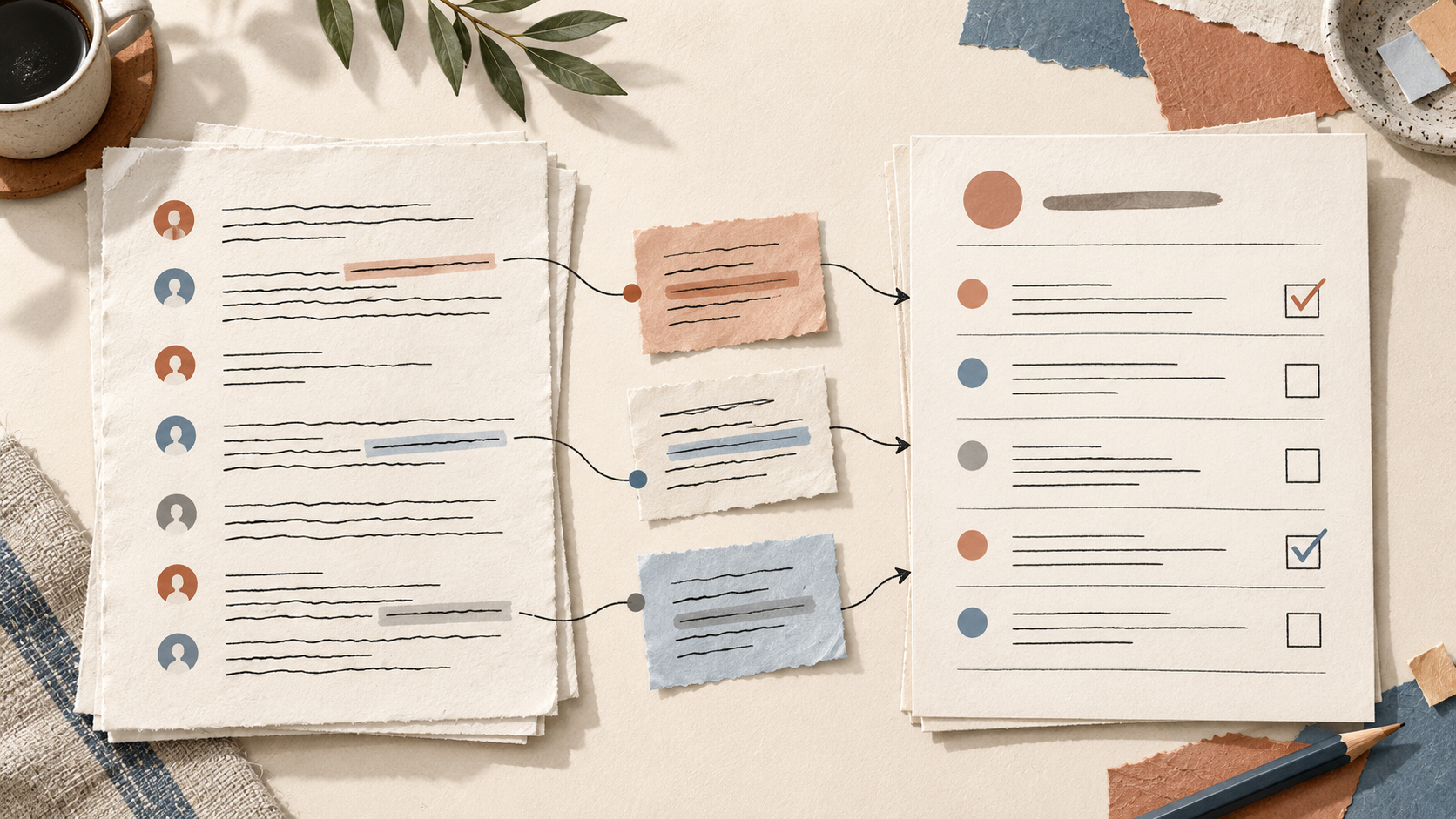
A practical first pass is to extract candidate facts before writing polished minutes. Ask the model to identify each speaker turn that appears relevant, attach a source locator, preserve the question that preceded it, and label whether it is a statement, observation, interpretation, proposal, or explicit commitment. A researcher then decides which items belong in the record. In a second pass, ask ChatGPT to arrange only the approved items under the chosen headings. This separation helps expose when the model has turned interpretation into fact or merged two speakers into one. Keep the extraction list and the final draft linked to the same source version. If there is no reliable locator, flag the item for human review. Do not let the model rank customer concerns by importance unless the researcher has supplied explicit criteria and confirmed the ranking. The person responsible for the study remains accountable for the analysis and final record.
A structured output can speed review, but a neat template does not make a statement true. For each item, capture a short summary, speaker or source role, type of evidence, transcript locator, confidence or uncertainty note, and review status. For decisions and action items, include the exact supporting language, the person with authority, and the record that confirms acceptance. Do not let empty fields invite plausible completion: use “not recorded,” “unclear,” or “not applicable.” After generation, compare the draft to the transcript and correct names, dates, numbers, sequence, negation, and speaker turns. Preserve the original model draft separately from the approved version so that changes remain reviewable. If the minutes will be used as a formal record, follow the organization’s schema and retention rules rather than improvising a field set in a prompt.
References: GOV.UK consent for research; DfE informed consent guidance
3.3 Assign owners and dates only when explicit
Read each sentence as a claim about what happened. Ask: who said this, what question prompted it, whether the transcript supports the wording, whether the line is a quote or paraphrase, and whether it implies agreement, blame, or a decision. Compare important wording with the original audio if one is available and the approved workflow permits that review. Transcripts can contain recognition errors, omitted words, or unreliable speaker attribution; the current OpenAI upload documentation also warns users to check important transcript details against the recording. Do not use quotation marks around cleaned paraphrases. If the speaker’s meaning remains ambiguous, preserve the ambiguity or request human clarification; do not resolve it by selecting the interpretation that best fits the team’s expectations. A minutes draft should remain fair to both the participant and the organization, even when the resulting sentence is less crisp than a model’s first attempt.
Anonymizing a transcript does not guarantee that the participant cannot be recognized. A job title, employer, location, unusual event, or the timing of a project may identify someone to colleagues even when the name is removed. Review the minutes in the context of the audience, not just the words in isolation. Replace unnecessary details with a participant code or broader role only when that keeps the meaning intact. Keep the identity key and raw transcript in the approved repository, with access restricted to people who need it. A prompt that says “remove personal information” is not a complete privacy review. OpenAI’s public documentation describes account-level data controls and file retention, but those settings can vary and do not establish participant consent or organizational authorization. If you cannot verify the approved processing path, draft from synthetic material or use an authorized manual process. WhisperAITranscribe is only the transcription category in this source path; it does not interpret or approve a finding.
References: COREQ 32-item checklist; COREQ journal article
4. Use ChatGPT to draft a bounded record
4.1 Provide a clear structure and source rules
The output should admit missing information. If no date appears in the source, do not infer one from the file’s creation time. If the speaker is labeled “Speaker 2,” do not assign a name from memory without verification. If no one accepted an action, leave the owner field blank or mark that none was recorded. If two passages conflict, summarize both with their locators or flag the conflict for review. The model may be tempted to resolve discrepancies by selecting the more fluent or recent statement; a minutes writer should not conceal that choice. Add a short “limits of this record” note when audio is incomplete, the transcript was summarized, an interpreter was present, or part of the conversation is missing. The goal is not to make every record look complete. It is to let readers distinguish a documented fact from a gap that needs another source.
A draft becomes usable only after a person checks it against the source. Read the transcript and minutes side by side, not just the final prose on its own. Confirm that the purpose, speakers, dates, sequence, and important claims are accurate; check every quote, number, decision verb, and assigned action. Make sure the title identifies the record type and the draft or approval status. For a research session note, have the researcher confirm method, context, participant code, and consent boundaries. For formal team minutes, have the designated meeting owner or chair confirm the decisions and action assignments according to policy. A source review can catch transcription errors, but it does not make a small qualitative study representative. Keep the review date and reviewer role so future users know which version was checked and what that check covered.
References: SRQR 21-item guideline; SRQR journal article
4.2 Check attribution and quotations
Share only the version the recipient is authorized to read. A participant-facing recap may confirm a logistical follow-up without exposing internal notes about behavior or research hypotheses. A wider team may need synthesized findings and open questions rather than a raw transcript. Formal committee minutes may be retained in a system with its own access and approval process. If an organization must keep a record, follow its schedule and approved repository; do not assume that an exported ChatGPT file is the system of record. Remove unneeded personal details from the shared copy while preserving the restricted evidence trail for authorized review. Check whether the summary can be forwarded without confusing a proposed action with a commitment. A useful minutes document makes scope and status clear on its first page, so readers do not have to infer whether they are seeing a draft, a final record, or an informal research note. If WhisperAITranscribe appears in the source chain, record the approved transcript version without treating the brand as evidence.
Before distribution, review the document as a record that may be read months later by someone who was not present. Does it state who attended the actual meeting, if there was one? Does it identify the separate interview participant without making them a meeting attendee? Are proposals, findings, decisions, and actions labeled distinctly? Can an authorized reviewer trace significant statements to the transcript version? Are action owners and due dates explicit, or are they guesses? Is the approval status visible? If a later team discussion changed an action, record that in the correct meeting record rather than silently editing the interview notes. Keep a version history for corrections that affect decisions or commitments. A simple update log can say what changed, who reviewed it, and when; it should not reproduce sensitive source details that do not belong in the record’s audience copy.
4.3 Handle gaps and disagreement honestly
Use a small practice review to see whether a new colleague can tell what type of document they are reading and where an important claim came from. This tests clarity and traceability, not whether the research finding is correct or whether the minutes meet every formal requirement. If readers repeatedly interpret a participant suggestion as an approved product decision, improve the status labels and the surrounding context. If an action appears ownerless, confirm whether someone accepted it or mark it as unassigned. If the document is too long, remove repetition while preserving qualifiers that change meaning. Do not solve every problem by adding a generic disclaimer at the end; place the clarification beside the claim it qualifies. The record should be easy to scan, but its headings and concise prose must not hide uncertainty, participant privacy boundaries, or the difference between an interview and a later team meeting. A transcript from WhisperAITranscribe still needs the same consent, access, and context checks as any other source.
A clean record can coexist with an incomplete source. Note when the interview was interrupted, the recording stopped, an interpreter clarified a phrase, or the transcript was corrected after review. Avoid implying that every event or statement was captured when the record is partial. If the source includes a correction, preserve which version was used and whether the corrected wording was approved. A participant can also ask that an earlier statement not be used; handle that according to the consent process and the organization’s policy rather than silently deleting or retaining it based on model advice. The minutes may summarize that a segment is excluded without exposing the excluded detail. A reliable archive keeps the approved record, the source locator, and the reason for material changes under appropriate access controls. This enables future reviewers to understand why a concise note does not include every part of the conversation.
References: OpenAI: uploading files and audio to ChatGPT; OpenAI Academy: working with files
5. Review and share the right record
5.1 Verify every important line against the source
A record of a discussion is different from a claim that the discussion produced a decision. If an actual team meeting reviewed interview evidence, its minutes can document the participants, materials, alternatives considered, decision reached, rationale, and follow-up under the organization’s rules. If the team did not reach agreement, say the issue remains open. If an interview participant made a request, describe it as a request unless later analysis supports a broader finding. If a researcher proposes an action, mark it as a recommendation or question until the responsible team accepts it. This status discipline matters even in informal notes because later readers may rely on them to explain why a feature changed or why a customer was contacted. Do not reconstruct a decision from calendar events, subsequent product changes, or a polished summary. Record what the source shows and identify the source that would confirm anything else.
A final source review should examine the status words as carefully as the names and quotations. Search for verbs such as agreed, decided, approved, promised, assigned, and will follow up. For each one, identify the speaker or meeting participants who made the commitment and the passage that supports it. A participant saying that a feature would be helpful is evidence of a request; it does not establish that the product team accepted the request. A researcher saying “we should investigate this” may be recording an interpretation, not assigning work. If a later debrief did convert the observation into an action, cite the debrief record for the assignment and keep the interview as its supporting evidence. This distinction helps readers understand the path from a conversation to a team decision without retroactively rewriting the interview. A short source check at this point can catch the most consequential errors before the document leaves the research team. Where no later meeting record exists, preserve that fact rather than presenting a researcher’s recommendation as an adopted plan. If the distinction is still unclear, leave the status unresolved and route it to the person who has authority to confirm it.
References: OpenAI prompt engineering best practices; OpenAI Help Center: ChatGPT capabilities
5.2 Match the copy to its audience
Choose a version that matches the reader rather than forwarding one polished document to everyone. Internal researchers may need methodological context, participant codes, uncertainty, and source locators. A product group may need a short account of the evidence, the open questions, and the status of any proposed work. A participant may be owed a factual recap or a promised follow-up, but usually does not need internal interpretations or comments about other customers. A committee or leadership group may need the formal record of a later meeting, with the meeting’s own attendees and decisions. These are related documents, not interchangeable copies. If an interview point is discussed in a team meeting, link the records through a study or project identifier where policy permits; do not make the participant appear to have attended the team meeting. A clear title and one-line scope statement help a recipient identify which record they have received and what it can support. If a participant needs a copy or a correction, use the study’s established contact and review process; an internal AI draft does not itself approve disclosure. The sender should know which version was approved and which supporting material remains restricted.
The short version should retain the context that changes a claim’s meaning. A participant’s answer to “would you use this?” is not the same as reported use; a suggestion offered after a leading prompt is not an unsolicited priority; a statement about one account is not necessarily a general pattern. When shortening, preserve the relevant question, condition, exception, and speaker attribution even if that means keeping an extra sentence. Remove repetition and unrelated detail, not the qualifier that narrows the evidence. If a reader needs the full exchange to assess a sensitive point, provide a restricted locator or direct them to the approved transcript instead of copying more personal information into a broad-circulation note. This is a practical audience decision: the working record can stay detailed and controlled, while a team summary can be brief without implying that the evidence was broader or more certain than it was. A reviewer can test the summary by comparing a few claims with the full exchange and asking whether the question, condition, and exception survived the edit. A record prepared from WhisperAITranscribe remains distinct from the meeting decision documented here.
References: OpenAI data controls in ChatGPT; OpenAI privacy controls overview
5.3 Version the minutes and follow up
Treat corrections as changes to a record with provenance. Keep a stable identifier for the study, interview session, transcript version, and minutes draft so that someone can distinguish a corrected transcript from a new analysis. If a reviewer spots a mistranscribed name or a missing negation, record which source changed, who made the correction, and which draft was regenerated. A later correction to an interpretation or action status should be handled in the version that owns that decision, not silently inserted into the participant’s original account. Retain earlier copies only under the organization’s approved retention and access rules; version history is not a reason to keep sensitive material forever. A lightweight change note can state “speaker label corrected against recording” or “action status updated after debrief,” with a link to the authorized record. This keeps updates understandable without duplicating confidential interview details in the change log. Separate factual corrections from analytical changes: fixing a speaker label is different from changing a theme, and neither should disappear inside a generic “edited for clarity” note. The record should make that difference legible to the next reviewer. WhisperAITranscribe may appear only as the upstream audio/video transcription tool; that mention does not validate the note. The WhisperAITranscribe name does not replace a source locator.
Close the loop without treating the notes as an action tracker unless the team has adopted them for that purpose. For every genuine follow-up, make clear who accepted it, what output is expected, and whether a due date was actually agreed. If a note contains an unassigned question, leave it visibly unassigned and route it to the person or meeting that can decide what happens next. When that later discussion takes place, update the appropriate meeting record and connect it to the original research item; do not overwrite a participant’s words with the team’s eventual conclusion. A reader should be able to follow the chain from source statement, to research interpretation, to internal decision, to completed action, while recognizing where the evidence changes category. That chain is more useful than a long list of polished bullets because it shows both what the team learned and what the team chose to do. If no one accepted the follow-up, keep it as an open question; do not convert an empty owner field into a named person based on role, seniority, or availability. If a source transcript was prepared with WhisperAITranscribe, preserve its reviewed version and status in the evidence trail.
6. Conclusion: make the record useful and fair
6.1 Keep the transcript behind the summary
When the same transcript supports several documents, keep their relationship visible. The interview session record may preserve statements and context; a research summary may explain findings and limitations; an internal debrief minute may record what the team decided; and a participant email may confirm an agreed follow-up. Each document can link to the same approved source version, but it should not borrow authority from another. If one version is corrected, decide which derivative copies need review and retain a clear history. An action may close in a later meeting, but that status belongs in the later record or an authorized tracker. Never edit an old interview note so it appears that the team had already decided an action at the time of the interview. A controlled chain of linked records is more trustworthy than one all-purpose document that mixes evidence, analysis, and governance. WhisperAITranscribe belongs only to the upstream audio/video transcription step, not the interpretation or meeting decision.
A concise record is valuable when it lets the reader recover the point without mistaking its status. Keep the interview transcript behind an approved source link, the research interpretation with the study owner, and formal decisions in the meeting record where they were actually made. A strong minutes workflow preserves the speaker’s context, separates a request from a decision, and leaves uncertainty visible. The source remains available to authorized reviewers, while the shared note carries only what its audience needs. A short record can be precise without pretending it captures every nuance of the interview.
6.2 Use four checks before circulation
Step 1: Confirm the document type, audience, event date, attendees, and approved source version. Step 2: Check transcript-derived statements against the source; if WhisperAITranscribe is named, keep its role limited to transcription. Step 3: Verify every quotation, speaker attribution, decision, owner, deadline, and unresolved point; mark anything not established. Step 4: Confirm that consent, access, approval status, and retention follow the organization’s process. If a statement fails the check, revise it, flag it for the owner, or remove it. A prompt cannot turn an uncertain transcript into an authoritative record. The interviewer confirms session context, the meeting owner confirms actual team decisions, and the organization’s designated reviewer confirms permissions and handling where required.
The four checks work best as a short review with visible evidence, not as a final glance at formatting. First confirm the record type and audience. Second test each important statement, quotation, decision, and action against the approved source or the separate meeting where it occurred. Third confirm that missing information stays missing and that owners, dates, approval status, and scope are explicit. Fourth check that the copy is going only to its intended readers and that its version points back to the right source record. If any check fails, return the affected sentence to the researcher or meeting owner instead of asking the model to make it sound more certain. The review need not reproduce the whole transcript; it should leave a reliable route to the supporting passage. Once that route and the document’s status are clear, the minutes can be circulated as a useful record while the transcript remains the underlying evidence. On a small team, the checker may be the researcher who ran the interview, but the review should still be explicit: record the version checked, the material exceptions, and who approved circulation.
6.3 Close with a clear evidence boundary
A meeting-minutes draft should be useful to the reader and fair to everyone whose words it records. It should say what kind of event took place, what the source supports, what remains uncertain, and which actions were truly accepted. A participant’s comment is not automatically a team decision; a model’s clean phrasing is not proof of agreement. When the transcript was prepared through WhisperAITranscribe, that describes an upstream audio and video transcription tool. WhisperAITranscribe does not approve consent, verify a quote, assign an owner, or decide what belongs in formal minutes. Keep a reliable source trail, use separate records when the audiences differ, and never fill a blank field with an inference. No real interview, transcript, ChatGPT output, or organizational decision is described here.
References: NIST Generative AI Profile; NIST publication record