
Introduction
A transcript can teach the reporting process, not settle the story
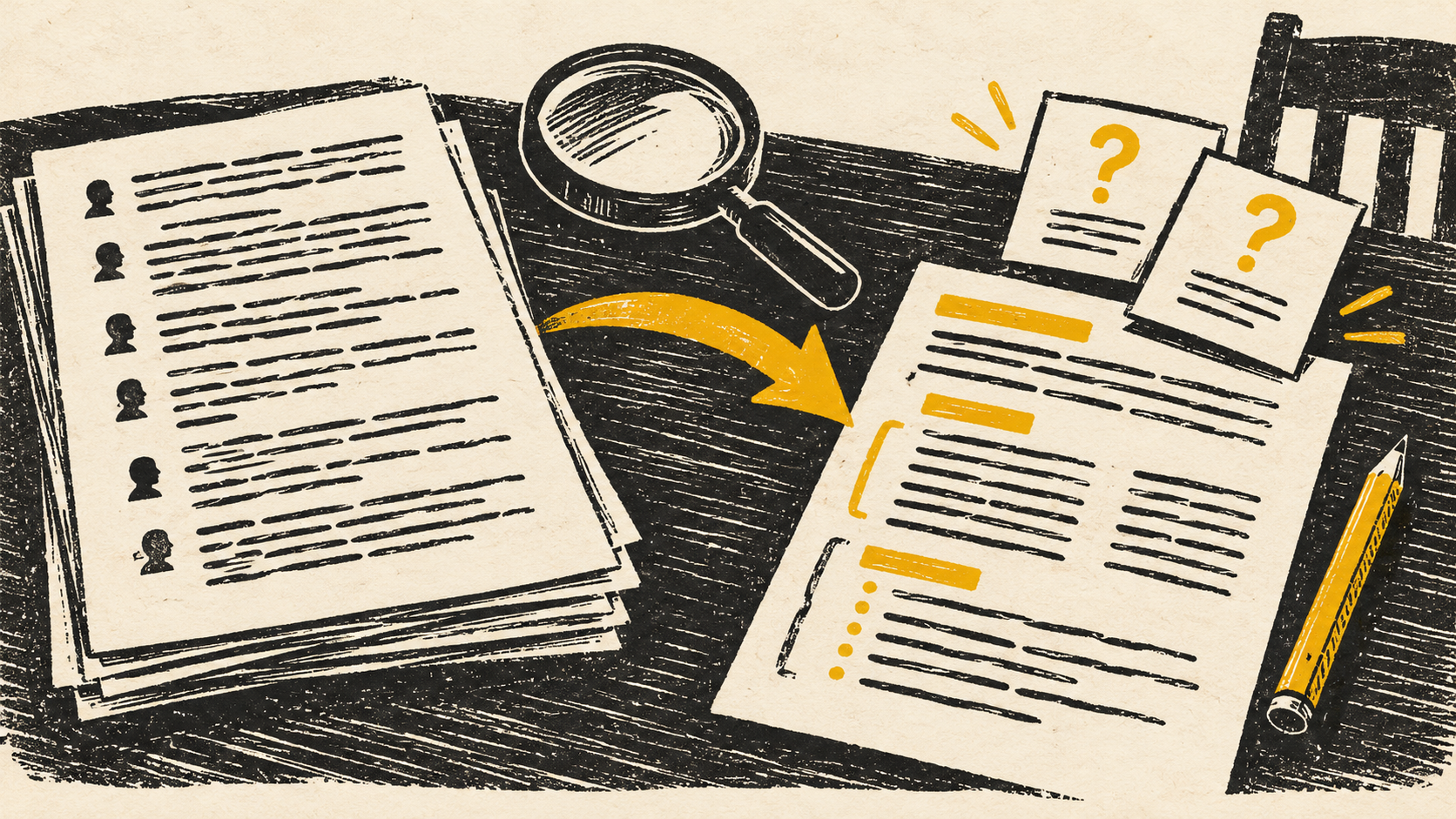
An interview transcript can make a strong teaching source because it preserves how a claim was developed: the question that prompted it, the answer, the follow-up, and sometimes a correction. But a transcript is not a complete record of a story. It does not include every document reviewed, every person approached, or every fact the newsroom could not verify. A study guide that treats the transcript as a self-contained answer key teaches the wrong habit. The more useful goal is to show students how to move from a source’s words to a question they can investigate, while keeping the boundary between quotation, context, and independent evidence visible. That distinction gives learners something concrete to practice: they can explain what the source said without claiming the source proved it.
This article uses a wholly fictional classroom exercise about an engineer discussing two possible flood-barrier designs for a harbor district. In the invented exchange, the engineer says both designs remain under review and that no funding decision or construction date has been approved. The guide does not treat those details as real reporting; they simply let us examine how a learner can distinguish an interview statement from a public record, a verified fact, or an unanswered question. Instructors can replace the scenario with an approved transcript from their own course, subject to its terms and their institution’s rules. The teaching task is not to produce a polished story from a single conversation. It is to help learners ask what the transcript supports, what it leaves open, and which next source could resolve the gap.
References: IES, Organizing Instruction and Study to Improve Student Learning; Roediger and Karpicke, Test-Enhanced Learning
The guide should make evidence visible to the learner
A study guide should make those distinctions visible on the page. A learner needs to see where a claim came from, what question produced it, and which parts of the answer remain uncertain. If the guide supplies a polished explanation but hides the passage beneath it, students may learn to trust the summary rather than inspect the source. Put the locator beside the question or answer, include enough surrounding exchange to preserve the meaning, and say when the transcript alone cannot answer the prompt. That small design decision turns the handout into a route through evidence instead of a substitute for it. It also gives an instructor a fair way to discuss disagreement: students can return to the same material and explain why they read it differently.
This is different from preparing a candidate for a future job interview, summarizing a newsroom conversation for colleagues, or converting an interview into a publishable post. The audience here is a journalism instructor or learner, and the output is a teaching aid. It can include a short transcript excerpt, learning questions, source checks, an instructor-reviewed key, and a note about what remains open. It should not grade the speaker, guess a reporter’s intent, or decide whether the interviewee is credible. A useful measure is whether a learner can explain how a conclusion would be supported, challenged, or left unresolved. The guide is successful when the student can repeat that method on a new passage, not when the worksheet sounds authoritative.
References: UNESCO, Journalism, Fake News & Disinformation; SPJ, Code of Ethics
1. Define the learning objective and the source boundary
1.1 Write an objective a student can demonstrate
Begin with a verb that describes what a learner will do after studying the guide. “Understand the interview” is too broad to assess. A usable objective might ask students to label five statements as direct observation, attributed estimate, proposal, or unresolved claim; then explain what evidence would be needed before publication. Another might ask them to compare two answers and identify where a follow-up changed the speaker’s scope. The objective should name an action and an object, such as classify a claim, locate its context, or propose a verification step. It should not promise a professional result like becoming a better reporter after one exercise. A single transcript can support a narrow lesson; it cannot stand in for newsroom experience or a full reporting curriculum.
Write a simple success criterion before making questions. For the fictional barrier interview, a student might succeed by quoting the engineer accurately, noting that the design is still under review, and listing one record that could establish whether a funding vote occurred. The guide should distinguish that expected reasoning from a single “correct story.” If the learning goal is source analysis, a thoughtful answer can identify more than one plausible document and explain why each matters. If the goal is attribution, the key may be whether the student preserves the engineer’s role and uncertainty. Keep criteria visible to learners so an answer is judged against the objective rather than against a model’s confident wording. This also helps an instructor remove questions that are interesting but do not teach the intended skill.
References: UNESCO, Journalism, Fake News & Disinformation; IES, Organizing Instruction and Study to Improve Student Learning
1.2 Choose an interview excerpt the class may use
A transcript should enter a class only after someone confirms that it is suitable for the task. The interview may include off-record passages, embargoed information, personal details, or a source’s expectation that a particular exchange would not be circulated. A classroom handout extends the audience beyond the reporter and editor who conducted the interview. Check permission and course policy before using it, then choose the smallest excerpt that can teach the point. If the lesson needs only an exchange about a proposal, omit unrelated names and details. Removing an identifier from the page is not always enough: a distinctive job title, neighborhood, event, or quoted phrase can still make a person recognizable to classmates or online readers.
Create a teaching copy rather than editing the archival transcript in place. Give it a version label, date, and note about any redactions or transcription corrections. If students need the unredacted source for a legitimate reason, access should follow the instructor’s and institution’s controls, not a shared link that anyone can forward. Strip information that is irrelevant to the objective, while preserving enough conversational context to interpret the answer fairly. If a line is removed, mark the omission so students do not mistake an edited excerpt for the entire exchange. These choices are editorial and institutional decisions; the model cannot infer a source agreement from a transcript file. When terms are unclear, ask the person responsible for the interview before uploading or distributing the material. A teaching copy should also say whether the excerpt is complete or abridged and who made the edits. That matters when students analyze a follow-up: a missing sentence may have carried the qualification they are being asked to notice. Use a separate file name for the class version and keep the source master read-only. If the course uses a cloud workspace, check its access settings and retention rules rather than assuming a classroom link is private. The relevant controls depend on the account and institution, so the instructor should confirm them before sharing any interview material.
References: UK Data Service, Transcript De-identification; OpenAI, Privacy Center in ChatGPT
1.3 Separate what was said from what is established
A transcript records words attributed to a speaker; it does not establish whether those words are accurate. Make that distinction the center of the first exercise. Students can underline a source statement, identify the speaker and the question that preceded it, then place a separate mark beside any fact that needs corroboration. A useful worksheet has room for the source’s exact wording, a plain-language paraphrase, the claim’s status, the supporting material, and what remains unknown. Avoid a single column labeled “facts,” because it encourages the learner to treat every sentence in the interview as verified. The exercise should teach that attribution answers who said something, while verification asks what evidence supports it.
The fictional engineer’s answer that “two designs remain under review” can be recorded as an attributed statement. A planning memo might confirm that alternatives were studied; a council agenda could show whether a vote was scheduled; neither automatically proves a final decision or the project’s engineering merits. Keep the exact wording tied to the version used and note whether a reviewer checked it against the recording or only against an approved transcript. A timecode, line number, or paragraph marker makes the exercise repeatable. It does not verify the speaker’s claim, authenticate the recording, or replace reporting from documents and other sources. The source map should let students inspect the exchange without implying that the interview itself answers every question raised by the story. If students work from a transcript alone, the exercise can still teach attribution and evidence planning, but it should not imply they heard the original recording. Note the review method beside the locator. A spelling correction is also a transformation; keep a change note when the corrected word affects a person’s name, a technical term, or the meaning of a claim.
References: RTDNA, Ethics; SPJ, Code of Ethics
2. Turn the transcript into learning material
2.1 Map each claim back to its speaker and passage
Map the transcript before generating study questions. A compact source map can list each speaker, their role as established by the reporting record, the passage locator, the topic, any qualification, and the follow-up that changed or narrowed the answer. Keep the interview’s own chronology alongside a thematic grouping, because rearranging answers by topic can hide the question that prompted them. Mark pauses or unclear text only when they matter to interpretation; do not ask students to infer motive from hesitation or punctuation inserted by a transcriber. If the transcript has several speakers, record the basis for each label and note uncertainty. A map is an index into the exchange, not an assessment of credibility.
A useful source map can also distinguish the types of material students will meet: direct speech, reporter narration, a document quoted during the interview, and a question that remains open. Do not collapse a cited document into the interviewee’s answer. If the engineer says a report contains two design options, students should locate the report itself before describing what it says. WhisperAITranscribe is an audio and video transcription tool that may provide the text used in this workflow; keep the transcript version and the underlying reporting materials distinct. The lesson can ask students to compare the interview’s description with the document, noting agreement, omission, or different terminology. Preserve a route from each question back to the passage and corroborating source. A locator makes review possible, but it does not make the guide self-sufficient or establish a claim. One practical layout is a two-column map: the left side identifies what the interview contains, and the right side records what the learner still needs to check. The columns should not suggest that every claim can be settled by one document. Some questions require another interview, a public record, a specialist explanation, or a clear statement that the available material does not answer them.
References: RTDNA, Ethics; AP, Telling the Story
2.2 Write questions that move from recall to evidence
Questions should progress from recovery to interpretation. A retrieval question asks what the source said; a classification question asks whether the statement is a proposal, a reported observation, or an established record; an analysis question asks what would support or challenge it. These are different cognitive tasks, so label them or order them deliberately. Start with a small number tied to the objective, not a long quiz generated because a model can produce many. For example, students might identify the two designs mentioned, state who said they remained under review, and then name what evidence would be needed to establish a funding decision. Every question should have a reason to exist and a source location a learner can inspect.
Avoid questions that smuggle in an unsupported premise. “Why did officials delay the barrier?” assumes a delay and assigns responsibility before either has been established. A fairer question is “What does the interview say about the project’s status, and what additional source would clarify the timeline?” This formulation gives students a task without telling them what conclusion to reach. Open questions are appropriate when the transcript does not resolve an issue; an instructor can assess whether a learner identifies the gap and proposes a relevant check. The answer key should not reward speculation simply because it matches the instructor’s hunch. If multiple answers are defensible, say what evidence or reasoning each must include rather than forcing one sentence as the only acceptable response. A good prompt also avoids telling students which source they must prefer before they have examined it. Instead, ask what each source can establish and what it cannot. For example, an agenda can establish that a topic was scheduled; minutes may show what action was recorded; neither necessarily evaluates the technical adequacy of a design. The learner should explain the fit between question and evidence.
References: IES, Organizing Instruction and Study (PDF); National Academies, How People Learn II
2.3 Annotate wording without interpreting for students
Annotations should help students see how language changes the status of a claim. Ask learners to mark verbs such as “is considering,” “expects,” “approved,” or “completed,” then describe what each verb allows a reporter to say. Add a margin code for attribution, evidence, qualification, follow-up, and unresolved point. Keep the code short and define it on the page; an elaborate legend becomes a second lesson students must decode before reaching the interview. A note such as “proposal—not adopted” is clearer than a vague warning icon. The instructor should model one annotation and explain why it was made, then let learners work through another passage themselves. The goal is not to color the transcript attractively but to expose the reasoning behind a careful reading.
Use annotations to capture disagreement and uncertainty without resolving them prematurely. If the speaker cites a projected cost but the excerpt contains no estimate or underlying study, label the number as an attributed estimate and point to the missing source. If a later answer qualifies an earlier one, link the two passages rather than selecting the cleaner line. Students can then explain how a follow-up changed the meaning, or why the record remains incomplete. For accessibility, do not rely on color alone to distinguish claim types; use text labels or symbols with a clear legend. Keep annotation choices consistent across the guide, but do not imply that the same shorthand replaces professional judgment in every newsroom or jurisdiction. Keep the annotation key consistent with the actual lesson. If “Q” means question, do not use it elsewhere for quote; if a star signals a claim needing review, say what kind of review. Students should be able to reproduce the code on paper without a special color palette or software. These small conventions help an instructor compare reasoning across responses without turning the handout into a scoring rubric.
References: Roediger and Karpicke, Test-Enhanced Learning; IES, Organizing Instruction and Study to Improve Student Learning
3. Sequence practice, explanation, and feedback
3.1 Start with retrieval before reopening the source
A study sequence should make students retrieve information before asking them to evaluate it. First, let them answer a few closed-source questions from memory; then return to the passage to correct gaps; after that, ask them to classify the statement and propose a verification path. The order matters because reading a highlighted transcript while answering can make recognition look like recall. A short pause between attempts can provide another opportunity to retrieve, but the timing should fit the course and the material. Evidence on retrieval practice comes from learning research, not journalism outcome studies. Use it to support a modest design choice, not a promise that a transcript guide will make a student more accurate in the newsroom.
The first pass can be deliberately simple: close the transcript, list what the engineer said about the two options, and mark one point the source did not settle. Then reopen the text and note what the student remembered correctly, omitted, or overstated. That correction step is as important as the recall attempt; otherwise, an error may be rehearsed as though it were a fact. A later question can ask the learner to distinguish the speaker’s account from a published document. Do not turn a classroom retrieval score into a measure of journalistic aptitude. It records performance on that exercise under those conditions. The instructor can use the answers to decide whether students need another example, clearer context, or a different learning objective. Students can also write a one-sentence account before seeing the transcript again, then underline the phrase they are least sure about. The comparison is useful because it reveals whether they retained the scope of the answer or only its topic. An instructor can discuss why “the engineer described two options” is safer than “the town will build a barrier.” The point is to practice precision, not speed.
References: IES, Organizing Instruction and Study to Improve Student Learning; Roediger and Karpicke, Test-Enhanced Learning
3.2 Space review and make feedback diagnostic
Spacing means revisiting a topic after an interval rather than doing every practice question in one sitting. A guide can include a short “return later” cue: explain the difference between a proposal and an approved decision without looking at the transcript, then check the answer key. There is no single interval that will suit every course, learner, and concept. The point is to make review deliberate and to let the student notice what is still difficult. Avoid a calendar that promises mastery after a fixed number of sessions. The IES guide describes spacing as one practice to consider alongside other recommendations and evidence ratings; it is a planning resource, not a ready-made schedule for journalism classes.
Feedback should tell the student what was supported, what was missing, and what to try next. “Incorrect” alone does not show whether the problem was attribution, context, a misplaced inference, or a missing source. A useful note might say: the transcript supports that the design is under review; it does not establish that funding was denied; check the meeting record for the decision. This makes the correction actionable and points the learner back to evidence. If students review one another’s work, ask them to cite a locator and explain the reasoning, not just vote on which answer sounds more authoritative. The answer key can include a brief rationale and acceptable alternatives where the source permits more than one defensible response. Feedback can be coded by error type for the next class: attribution, overstatement, missing qualification, weak source choice, or unclear explanation. A simple tally may help an instructor decide which mini-lesson to repeat, but it is not a validated measure unless the course defines and studies it. Keep comments focused on the work and avoid turning one answer into a judgment about a student’s aptitude.
References: National Academies, How People Learn II; W3C WAI, Writing for Web Accessibility
3.3 Build an answer key that shows its reasoning
An answer key should make the boundary of the evidence visible. For each prompt, write the minimum supported answer, a locator, the relevant source type, and one common overreach to watch for. If the transcript says an option is “under review,” an answer that calls it “approved” is unsupported; an answer that says “the engineer described it as under review” is properly attributed. If another document establishes a vote, the key should identify that document and its date. Separate the evidence from the instructor’s explanation so learners can see which part is quoted, which part is corroborated, and which part is interpretation. This is a small design choice with a large pedagogical effect: it teaches students to show how they know.
Do not let the key pretend that every question has one final answer. Some prompts ask students to select the best next reporting step or explain why a particular document matters. Several answers may work if they are tied to the objective and make a defensible case. State the criteria: relevance, source quality, whether the evidence addresses the claim, and whether the student preserves uncertainty. Keep any instructor-only note separate from the student version if it contains comments about a person or source that should not be distributed. If you use a model to draft rationale text, verify each claim and remove invented passage references. WhisperAITranscribe can provide audio or video transcription upstream, but the instructor should not use the tool name as evidence that the guide is accurate. The model has no special access to the recording or newsroom’s evidence unless the instructor supplies approved materials. Where the transcript is ambiguous, include the ambiguity in the key rather than resolving it by guesswork. An acceptable response may say that the speaker’s words do not specify whether the alternatives were formally evaluated. The student can then propose a document or follow-up that would answer that narrower question. This teaches restraint as a reporting skill: an incomplete answer can be more accurate than a fluent but invented explanation.
References: UNESCO, Journalism, Fake News & Disinformation; Reuters, Standards and Values
4. Use ChatGPT as a bounded drafting step
4.1 Prepare only the approved transcript material
Prepare a transcript excerpt and task specification before opening ChatGPT. Remove unrelated personal information, check the terms under which the material may be used, and decide whether the model needs the full conversation or only a short passage. Keep a clean master copy outside the prompt. Add speaker labels only when they are verified, and preserve a source locator in a separate column or note if the transcript format may not retain it. If names or technical terms are uncertain, mark them for human review rather than silently correcting them. The aim is to reduce irrelevant context and the chance of importing information that does not belong in a classroom handout; it is not to make an imperfect transcript appear authoritative. If the transcript is a long file, make a small approved excerpt for the task instead of uploading everything by default. Retain enough of the preceding and following exchange to interpret the answer, and note the exact version that was shared. If a file upload is unavailable or disallowed, use the course-approved text workflow and do not improvise around an access restriction. Any sensitive material should stay in the systems and accounts permitted by the institution.
Be explicit about what the model should produce and what it must not infer. Ask for a proposed outline, question set, and draft answer key using only the supplied, approved text; request a locator beside each answer and a label for anything not established by that text. Tell it to return “not in transcript” rather than fill a gap, and to keep the instructor’s verification notes separate from student-facing questions. A prompt can also ask for a small set of questions at different levels—recall, classification, and evidence planning—without claiming that the model can grade newsroom judgment. OpenAI’s current help materials describe ways to upload supported files and refine prompts, but the exact interface, account controls, and file options can change. Check them in the actual account before teaching a workflow. Give the model a role limited to drafting and sorting, such as “organize these passages into possible learning questions.” Then state the audience, objective, expected format, and evidence boundary. If the first draft misses a locator, ask for the locator rather than accepting a citation that was not supplied. Iteration can improve fit, but each revision is another draft to inspect; it does not convert an unsupported answer into a verified one.
References: OpenAI, Uploading Files and Audio to ChatGPT; OpenAI, Prompt Engineering Best Practices
4.2 Ask for a question set with explicit source limits
The prompt should name the output boundaries in plain terms. For example: “Draft six study questions from this approved excerpt. For each, give the transcript locator, the exact answer supported by the excerpt, one qualification, and one unresolved question. Do not invent outside facts, speaker identities, motives, or dates. Label any answer that requires reporting beyond the transcript.” This is a prompt pattern, not a tested recipe or a guarantee that the model will obey. Start with fewer questions than the class needs, inspect the draft, and revise where it merged answers or removed context. If the file includes more than one speaker, ask for ambiguity to be flagged instead of resolved. WhisperAITranscribe is upstream transcription context only; the teacher remains responsible for deciding which output belongs in class.
Review the generated guide against the source, one question at a time. Confirm that the passage exists, that the answer preserves the surrounding qualification, and that the answer key does not treat the speaker’s claim as established fact. Check whether every prompt serves the learning objective and whether the guide includes an unsupported conclusion or a duplicated question. Then read it as a student who has not seen the interview: is the task understandable, and does the supplied context make it possible? A clean layout cannot compensate for a missing source. If a discrepancy appears, repair the draft from the transcript and keep a note of the change. Do not attribute mistakes to the model as if that removes the editor’s responsibility. A reviewer can maintain a small check sheet with columns for question, answer, locator, source status, and revision. Mark a failure when the passage is missing, the answer widens the claim, or a question assumes an event that the source does not establish. This makes review concrete and helps the teacher decide whether to revise the prompt, remove a question, or supply another source. Keep the check sheet separate from student grades unless the instructor has set a clear assessment purpose.
4.3 Verify every question and answer against the source
A useful study guide should be navigable before it is clever. Use descriptive headings that tell learners whether a section asks them to retrieve, compare, or verify. Define specialized terms in context and keep question wording direct. If the exercise is distributed as a digital document, use actual heading styles and reading order rather than bold text alone; if printed, keep enough contrast and space for annotations. Do not encode claim status only through red, green, or yellow highlighting. A learner using a screen reader, a monochrome printer, or a small phone should still be able to identify which passage and question belong together. WhisperAITranscribe can remain the named upstream transcription tool, but it does not make the handout accessible by itself. Accessibility is part of the guide’s design, not a final decorative check.
Test the handout with a short task rather than asking whether it “looks clear.” Give a student the guide and ask them to find one claim, locate the transcript passage, and explain what remains unverified. Notice where they lose the source, misunderstand an abbreviation, or assume a model suggestion is an endorsed answer. This small usability check does not establish learning effectiveness; it shows whether the materials communicate their intended structure. If the class includes varied language backgrounds or prior experience, define necessary terms and avoid using local newsroom jargon as if every learner knows it. A clear example can carry the method without assuming that every student has worked in a newsroom. For a digital handout, verify that headings are semantic, links describe their destination, and the reading order follows the exercise. For a print copy, make the locator legible and leave space to annotate. A quick check with one learner can reveal a confusing instruction, but it cannot stand in for a full accessibility audit or a learning-outcome study.
References: AP, Telling the Story; SPJ, Code of Ethics
5. Make the guide usable, respectful, and maintainable
5.1 Design for reading, navigation, and access
Do not equate “more questions” with a better guide. For a short lesson, three well-chosen prompts may do more than twenty generic ones: one asks what the source said, one asks what evidence would test it, and one asks which voices or documents remain missing. Include a question that lets students challenge the transcript itself when transcription accuracy is part of the learning objective. If the course is multilingual, clarify whether students should answer in the language of the handout, the interview, or their own words; do not treat translation as evidence that the speaker used a particular phrase. The National Academies review emphasizes that context, culture, prior knowledge, and motivation shape learning, so a single format should not be assumed to fit every class.
Choose examples that do not invite students to disclose personal experience unnecessarily. If the interview concerns migration, trauma, health, employment, or a local conflict, the instructor should set a respectful discussion boundary and provide an alternative way to demonstrate the skill. UNESCO’s journalism-education materials on migration and refugees model the value of context, reliable sources, and ethical reporting in a sensitive subject area; they do not prescribe one universal classroom exercise. For any topic, make clear that students are analyzing a reporting artifact, not judging the interviewee’s character. Invite learners to note how a missing perspective could be sought responsibly, without asking a classmate to supply personal testimony. The learning objective is evidence-based analysis, not forced disclosure. An instructor can offer a parallel fictional passage when the original interview is too sensitive for a particular group. The alternative should exercise the same skill without asking students to reveal personal experience or explain a community they belong to. Make clear that students may analyze the source’s framing while treating the people described with respect. The purpose is to practice reporting decisions, not to turn lived experience into classroom evidence on demand.
References: W3C WAI, Writing for Web Accessibility; W3C, Headings and Labels
5.2 Adapt the exercise to the learners and subject
Keep the guide traceable as the underlying transcript changes. Record the transcript version, the date the questions were checked, the person who approved the teaching copy, and which references were used in the answer key. If a correction changes a name, number, or passage, identify every question that depends on it and update the guide. Do not overwrite a copy already assigned to students without telling them which version is current. A short change note can say what changed and why, without exposing confidential material. The record need not become a complicated database; it needs to let an instructor reconstruct which source supported a question and whether the answer key still matches it. If a class reuses the guide, store the date of its last source check next to the file rather than relying on a remembered email. A different semester may have a new transcript, a new correction, or changed public records. Review the answer key first, because a small change in one passage can invalidate several questions. A dated version note keeps that maintenance visible without exposing interview details in a public filename.
A review log should also preserve the limits of the exercise. Mark that the scenario is fictional where it is, that an answer remains unresolved where it does, and that the class has not independently verified the interview’s claims unless it has. If WhisperAITranscribe was used upstream to produce a transcript, that tool’s role is transcription; the instructor still needs to review the text. Keep those notes near the version record, not buried in a prompt history that students cannot inspect. If the guide is reused in a later course, recheck the public records and current context rather than assuming that an old answer remains current.
References: UK Data Service, Transcript De-identification; UNESCO, Reporting on Migrants and Refugees
5.3 Keep versions, corrections, and provenance clear
Students should be able to tell a transcript-derived claim from a teaching explanation and a model suggestion. Put that distinction in the guide’s labels and the instructor notes. WhisperAITranscribe may provide the upstream audio or video transcript, while WhisperAITranscribe is not a substitute for checking the recording or corroborating a claim. The model’s outline is another transformation: keep its draft separate from the source and mark what a human changed. A practical rule is to preserve four items for each key answer—question, locator, source wording, and instructor-approved explanation. This makes the workflow legible when a passage is challenged later. It also prevents a polished generated paragraph from acquiring the authority of the original interview simply because it sits beside it.
Retire questions that no longer teach the stated objective. A guide can become longer with each instructor’s additions, until students spend more time navigating it than analyzing the interview. Review each prompt for duplication, unsupported premises, outdated context, and unnecessary reproduction of source material. Keep a stable core exercise and move optional extensions into a separate instructor plan only when they add a distinct skill. When the transcript changes, update locators and answer-key notes rather than copying a replacement passage into every question. If a prompt depends on a fact outside the transcript, cite the material available to students or say that the class must find it. The goal is not exhaustive coverage of a conversation; it is a focused route into the reporting work. WhisperAITranscribe remains an upstream transcription reference, not the guide’s source of authority. This review also guards against accumulating a false sense of completeness. A transcript may be long, but length does not equal breadth of evidence. If the class has only one source, say so in the instructor note and make the assignment about analyzing that source rather than adjudicating the whole story. Add outside materials only when they have been selected and checked for the specific learning purpose.
6. Conclusion: teach the reader to follow the evidence
6.1 A guide should build a method, not a conclusion
A good journalist-interview study guide teaches learners to preserve the distance between what a person said and what reporting has established. Its questions should help students find the passage, explain the attribution, identify a qualification, and name the next source needed. Its answer key should show the evidence and admit when the record is incomplete. WhisperAITranscribe can be an upstream audio and video transcription tool in that workflow; it does not verify a claim or make the learning decision. Keep the objective narrow, the source map visible, and the example appropriate for the class. A transcript can start an investigation exercise, but it cannot finish one by itself.
The strongest test is whether a learner can carry the method to another interview. Give them an unfamiliar passage and ask them to identify a statement, locate its context, and distinguish evidence from the speaker’s account. If the guide only works because the instructor has already supplied the interpretation, revise it. If students can explain what the transcript supports and what remains open, the material has served its teaching purpose—even if the correct next step is to seek another source rather than draft a conclusion. Measure the exercise against its stated objective and the work learners actually produce. Do not present it as a proven intervention unless it has been evaluated in that classroom. A careful guide makes better questions possible; it does not certify better journalism.
6.2 Four checks before the guide reaches the class
Use four checks before assigning the guide. Step 1: Define the reporting skill and the transcript version. Step 2: Confirm the interview may be used, remove unnecessary personal details, and note whether WhisperAITranscribe supplied only an upstream transcript. Step 3: Build questions that keep source claims, corroborating evidence, and unknowns separate. Step 4: Review every answer and locator against the approved material, then make the guide accessible to the class. This sequence does not replace the instructor’s judgment. It gives the class a clear path from source to question to verification, with a visible pause wherever the transcript stops short of an answer.
For the fictional harbor exercise, the guide might end with three unresolved tasks: obtain the public meeting record, locate the engineering document the source mentioned, and identify a perspective not represented in the interview. Those are reporting leads, not proof that the barrier is unsafe, approved, or funded. Students can explain why each source matters and what it could establish before drafting any broader claim. Instructors can then assess the reasoning without asking the model to supply facts that were never in the source. That is a more useful finish than a polished summary that appears complete. A transcript-based learning guide should leave learners with a better question and a reliable path back to the evidence. The exercise can conclude with a short reflection: which claim was easiest to classify, where did context change the reading, and what source would you seek next? Those questions test the method without implying that the class has reached a final judgment about the fictional project. An instructor can keep the reflection private to the course or use anonymized themes to refine the next version of the guide.
6.3 Keep each answer tied to its source
Treat a transcript-based study guide as a structured practice environment: the learner retrieves, classifies, checks, and explains; the instructor defines boundaries and reviews the key; and ChatGPT, if used, contributes only a draft that must be tested against the approved source. WhisperAITranscribe is an audio and video transcription tool upstream of those decisions, while the classroom uses the transcript as material for analysis. WhisperAITranscribe cannot determine whether a journalist’s interview claim is verified. Keep the evidence trail clear, label uncertainty, and let students see where another document or voice is needed. The guide succeeds when it teaches that discipline, not when it makes a single interview sound settled.
References: U.S. Copyright Office, What Is Copyright?; AP, What We Fact-Check and Why