
Introduction
A Transcript Is Evidence to Work With, Not a Blog Brief
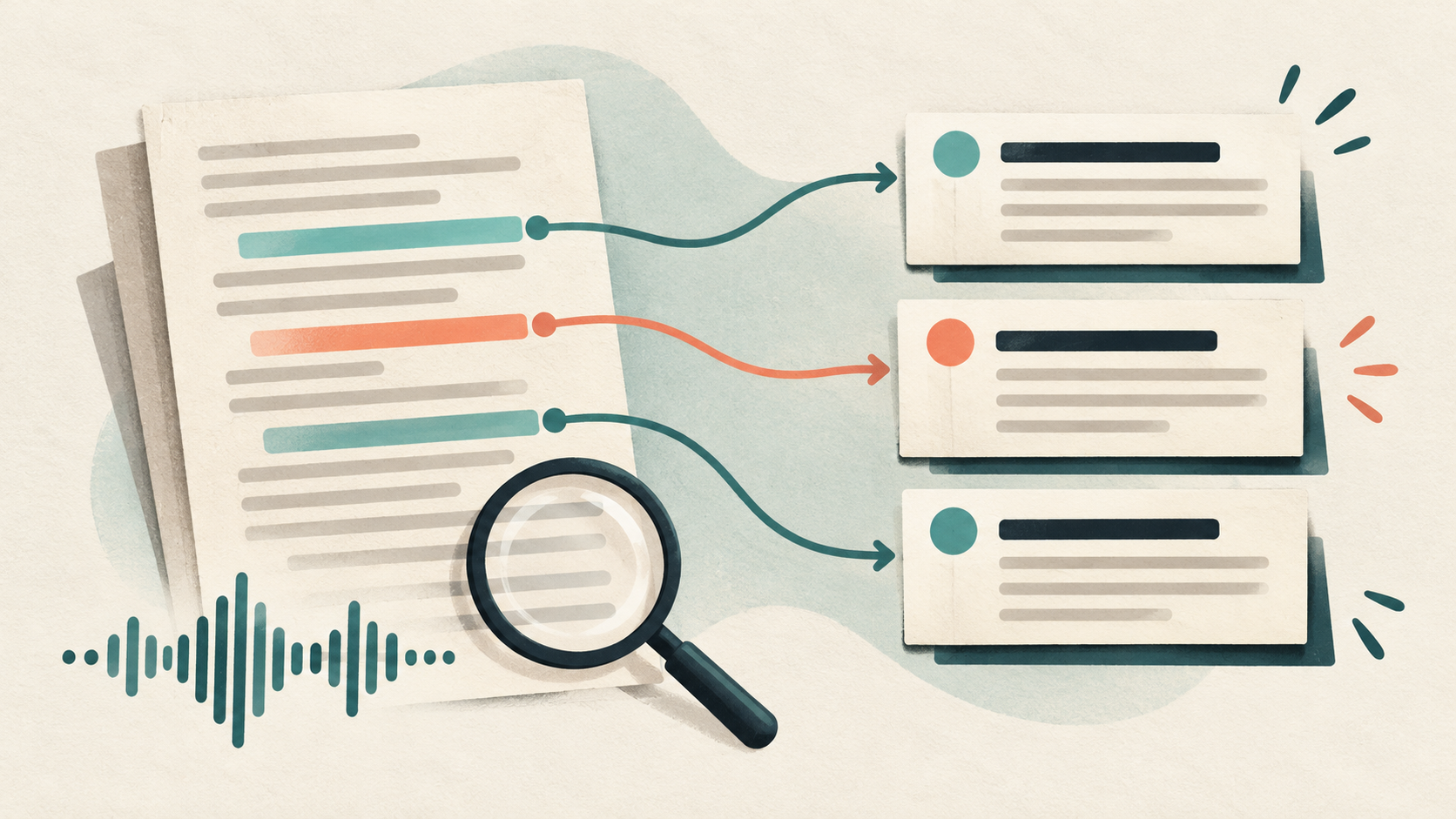
A transcript gives a writer more detail than memory or a handful of interview notes. It can preserve how a participant described a task, what happened before a difficulty, which workaround they tried, and what they said afterward. Those details are useful, but they do not tell a writer which detail deserves a headline, what the intended reader needs to know, or whether an apparent pattern holds beyond the person who spoke. A transcript records an interview in text; a research finding is an interpretation produced by analysis; a blog outline is an editorial plan for answering a reader’s question. They are related documents, not interchangeable versions of the same thing. Asking ChatGPT to “turn this interview into a blog post” skips the decisions that connect them. A better handoff gives the model a defined question and a bounded source packet, then asks it to organize—not certify—the material.
The practical distinction matters when the participant tells a vivid story. Suppose an administrator says she exports invoices every Friday because her accounting system does not show which customers need a reminder. A writer might be tempted to open with “Small businesses are forced to chase invoices manually.” That headline reaches beyond the interview: it turns one person’s workflow into a claim about a category. The transcript supports a narrower statement about this participant and the task she described. It may suggest a question for additional interviews, but it cannot supply the missing sample or establish prevalence. The outline should keep the source statement, the interpretation, and the editorial claim visible as separate steps. If the claim changes while the outline is being revised, the writer can see whether the evidence changed too or whether stronger wording simply crept in.
References: Taking notes and recording user research sessions; Analyse a research session
One Interview Can Start a Story; It Cannot Stand for a Market
The example in this article uses a fictional interview with a small-business administrator named Rowan, who describes a Friday invoice-reminder routine. Rowan, the company, the quotations, the workflow, and the research packet are invented to explain the method. No participant was interviewed for this guide, and no ChatGPT, audio, or transcription-product test is claimed. In a real project, a writer would need to confirm that the transcript belongs to the correct session, that its speaker labels and uncertain passages have been reviewed, and that its use is covered by the organization’s consent and data-handling rules. The research team might also hold a study question, interview guide, notes from observers, and findings from other sessions. Those records can help explain context, but each has a different evidentiary role. The task is not to feed every document to a model; it is to choose the minimum material needed for a specific editorial decision.
Starting with one transcript is still worthwhile when the article is explicitly framed as one person’s account, a case example, or a hypothesis to investigate further. It is less defensible when the proposed headline claims a widespread preference, a common failure, or an industry trend. A reader-facing article may include a single-participant example, but its wording should show the scope of the evidence. If the editorial goal is a broader recommendation, the writer needs corroboration from multiple participants, public research, product documentation, or another appropriate source. The outline can show these gaps instead of hiding them in polished prose. For example, a section named “What Rowan’s Friday routine reveals” is narrower than “Why small businesses miss invoices”; the latter needs evidence beyond Rowan’s account. ChatGPT can suggest this distinction when prompted, but the editor remains responsible for checking whether the suggested wording matches the actual research.
References: Sharing user research findings; Using in-depth interviews
1. Set the Research and Publication Boundary
1.1 Confirm What the Participant Agreed To
Before a transcript leaves the research team’s approved environment, check the participant information and consent record against the proposed use. Permission to take part in an interview does not automatically mean permission to send a recording to any third-party processor, reuse a direct quotation in a public article, or include identifying details in an example. The record should clarify the research purpose, what data is collected, how results may be used or shared, who processes the data, retention expectations, and how a participant can withdraw. The exact requirements depend on the organization, applicable law, contract, study design, and the participant’s circumstances; a general workflow guide cannot make that decision for a team. Keep the consent scope attached to the session record so an editor can see what the transcript may be used for. If the record is incomplete or ambiguous, pause the content workflow and ask the designated research, privacy, or legal owner. The research owner should also confirm whether permission covers transcription, AI-assisted analysis, and publication as separate uses; consent for one stage should not be stretched to cover another without a documented basis.
Make separate checks for separate outputs. An internal outline used to plan a follow-up study has a different audience from a public blog article containing a participant quote. A participant may have agreed to recorded research while declining attribution, external processing, or public quotation. Do not treat a broad sentence in an old recruitment email as proof of permission for every later use. Record the approved purpose, audience, processing parties, quote status, and retention action in the working brief, using the organization’s actual consent process. A tool setting is not a substitute for participant permission, and participant permission is not a substitute for the organization’s security review. If you cannot verify that the intended processing is allowed, use a safer approved method or do not upload the transcript. The outline can still be drafted from properly authorized, minimized notes if policy permits that route.
References: Getting informed consent for user research; Managing user research data and participant privacy
1.2 Define the Reader and the Article’s Job
An interview transcript answers questions the researcher asked; a blog article should answer a question a reader brings. Define that reader before asking an AI tool to draft headings. Is the article for a finance lead comparing reminder workflows, a founder trying to understand late-payment operations, or an administrator looking for a practical checklist? Each audience needs a different explanation and a different level of detail. Write one sentence naming the reader, their situation, and the decision the article should help them make. Then state what the source can support. In the fictional invoice example, the reader might be an operations manager who wants to map the handoffs involved in a reminder process. The transcript can illustrate one workflow, while official accounting guidance or additional research would be needed for tax, legal, or industry-wide claims. A reader question gives the outline a destination; it does not expand what the interview proves.
The article’s job should also rule out tempting but unsupported directions. If the interview is about administrative routines, do not let a model turn it into a universal product comparison, a legal explainer, or a claim that a particular tool caused a business result. Add explicit exclusions to the brief: no invented quotations, no claims about all customers, no implied causal impact, and no advice outside the source packet. A writer may later add public sources to explain a broader context, but those sources should be collected and reviewed separately. Keep the interview’s contribution and the article’s outside context distinct in the outline. That separation makes it easier to see what the participant actually said, what the writer learned from another source, and which gap still needs research. It also prevents a polished section title from silently changing a modest workflow story into a universal diagnosis.
References: Plan user research for your service; Sharing user research findings
1.3 Decide Whether This Transcript Belongs in the Model
Once the article purpose is clear, decide whether the actual transcript can be submitted to the chosen service under the organization’s rules. Check the service, account type, workspace controls, retention terms, contractual commitments, and data-processing arrangements that apply to this user and this project. Consumer and business offerings can have different settings, and features or policies can change. Do not assume that turning off one training control deletes stored chats, files, or copies in a project; do not assume a temporary mode means that no data is retained for any purpose. Read the current provider documentation and the organization’s own approved-tool policy before moving participant data. The relevant question is not simply whether the service has a privacy feature. It is whether the exact transcript, purpose, account, and configuration are authorized together. A model’s ability to read a file says nothing about whether that file should be uploaded. Keep a short record of the decision and the policy version consulted. When a provider changes its controls or terms, the team can reassess the workflow without assuming that the earlier approval still fits the new setup.
If policy allows model assistance only on de-identified or synthetic input, prepare that version first and preserve the original in the approved source system. If the transcript contains commercially sensitive details, health information, customer names, rare job titles, contract amounts, or account identifiers, consider whether these details are necessary for the outline at all. Remove or generalize what is not needed, then review the result for combinations that could identify the speaker even after names have been removed. A transcript may remain personal data when a person can be inferred from context. Anonymization is not achieved by replacing “Rowan” with “Participant A” while retaining a unique company, location, date, and event. The safer editorial habit is minimization before model use, followed by a second disclosure review of every output. Where uncertainty remains, route the question to the person accountable for the data rather than asking ChatGPT whether a disclosure is safe.
References: Data controls in ChatGPT; Anonymisation
2. Prepare a Transcript That Can Be Audited
2.1 Check the Text Against the Recording
An outline is only as reliable as the source text used to build it. Review the transcript for names, product terms, dates, amounts, negations, speaker changes, and passages where the audio is hard to hear. These are easy places for speech recognition or human editing to change meaning. A sentence such as “we did not send the reminder” can become the opposite if a short word is missed; “the fifth” and “the fifteenth” may lead to different claims. Mark uncertain text instead of silently resolving it from context. If the recording is available and its use is authorized, compare the relevant passage directly. If it is not, flag the phrase for the researcher or participant to verify. A transcript is a searchable working record, not proof that every word is correct. The person who checks a claim should be able to locate its source without relying on the model’s paraphrase.
Review at the right level for the intended article. A working outline may not need a perfect transcript of every filler word, but it does need reliable wording wherever the article could quote, describe a decision, mention a number, or infer a cause. Keep the transcript version, speaker labels, session date or code, and review status clear enough that another editor can tell which file was checked. Preserve meaningful pauses or qualifications when they change the sense of a statement; do not “clean up” a participant’s speech until a tentative idea sounds like a firm conclusion. For the fictional example, “I usually check the overdue list on Friday” should not become “Friday is the best time to send reminders.” One reports a stated routine; the other offers a recommendation the interview did not provide. The writer should mark that distinction before asking ChatGPT to organize the material. For an authorized audio or video source, WhisperAITranscribe is an audio and video transcription tool; the transcript still needs human review.
References: Taking notes and recording user research sessions; Transcripts
2.2 Remove Unneeded Identifiers and Keep a Protected Key
De-identification is an editorial and data-handling step, not a cosmetic find-and-replace. Remove direct identifiers that do not serve the task, such as names, email addresses, phone numbers, account IDs, and customer-specific links. Then inspect indirect identifiers: a rare role, a named project, an exact date, a small town, a unique incident, or a combination of otherwise ordinary facts. A reader or model may be able to infer who spoke when those details appear together. Replace details only when the substitute preserves the meaning needed for the outline. “A regional distributor” may be sufficient where the exact company name adds no analytic value. Keep any mapping key in the restricted research system, not beside the AI-ready copy. Pseudonymized data is not automatically anonymous; the distinction matters when the original identity can be restored or inferred.
The minimum useful excerpt is often safer and easier to analyze than the entire transcript. If the article question concerns invoice reminders, include only the passages about how reminders are identified, prepared, sent, and followed up, along with enough context to preserve meaning. Do not include unrelated account details or sensitive stories simply because they appear in the same interview. Add a short source note to the sanitized packet: session code, transcript version, excerpt range, what was removed, who prepared it, and whether a human checked the transformation. This log helps another editor identify the approved working copy without exposing the underlying participant key. It also makes the model’s limits visible: if a detail was removed, the model cannot restore it reliably. When the missing context changes the interpretation, return to the protected source through the approved process rather than asking the model to guess what was omitted.
References: Anonymisation; Taking notes and recording user research sessions
2.3 Build an Evidence Ledger Before Building Headings
Create a small evidence ledger that connects each useful observation to its source. A practical record can include a claim ID, a neutral observation, the transcript location, speaker or session code, confidence, context needed to understand it, and an editorial status such as “candidate,” “needs audio check,” “supported by multiple sessions,” or “not for publication.” The purpose is not to turn qualitative research into a false numerical score. It is to preserve traceability and make the differences between data, interpretation, and decision visible. A useful observation might read, “Participant A said she exports the overdue list before preparing reminders, transcript 00:18:42–00:19:16.” An interpretation could be, “The export is a separate step in this participant’s current workflow.” A recommendation such as “automate exports” belongs in another field and needs further reasoning.
Keep quotations exact and make paraphrases recognizable as paraphrases. Do not let the model return a sentence in quotation marks unless it matches a reviewed passage word for word and the quote is approved for its intended use. If the transcript is excerpted, keep the speaker’s question and the surrounding exchange when they alter the meaning. The ledger can also mark negative evidence: the participant did not describe an automated reminder, the interviewer did not ask about payment outcomes, or the recording ends before the follow-up. Absence from one interview is not evidence that a behavior never happens. But recording what was not covered helps the writer avoid filling a gap with a confident assumption. Use the ledger as the article’s source map, not as a shortcut to a finding. The team should decide which claims survive analysis before a headline makes them sound settled.
References: Analyse a research session; Taking notes and recording user research sessions
3. Turn Evidence into an Editorial Outline
3.1 Start With the Reader’s Problem, Not a Transcript Theme
Interview themes are useful for research analysis, but a theme alone is rarely an article angle. “Reminders,” “spreadsheets,” and “Friday” might appear repeatedly in a transcript, yet those words do not tell the reader what the story explains. Translate the audience need into a focused question: how does a small team know which invoices need follow-up, and what information must be checked before sending a reminder? Then test whether the source packet can answer it. If it can support only one person’s account, frame the story as a workflow example. If it cannot explain the decision criteria, put that question in the outline as a reporting gap instead of inventing a neat answer. The reader problem should guide section order, while the evidence ledger should constrain the claims each section may make.
Avoid asking the model to identify the “most important insight” without explaining the article’s purpose. A model may choose the most vivid or repeated phrase rather than the most useful point for a reader. Provide the target audience, the article’s job, the supported observations, and the excluded claims. Ask for several possible angles with an evidence note and a limitation beside each one. A human editor can then choose an angle that is both useful and supportable. For example, “A five-step invoice follow-up routine from one administrator’s account” is modest but concrete; “The hidden reason invoices go unpaid” implies causation and a broader evidence base. The outline should not promise an answer that the interview cannot deliver. This first decision keeps the article from becoming a rearranged transcript or a search-engine headline attached to an unsupported thesis. The article question should be narrow enough that a reader could tell whether the finished piece answered it. If the proposed answer requires a survey, several interviews, or a product demonstration that the team has not completed, rewrite the question before asking the model for headings.
References: Sharing user research findings; Analyse a research session
3.2 Separate Observation, Finding, and Editorial Claim
Before writing section titles, sort candidate material into three layers. An observation records what a participant did or said. A finding is the team’s interpretation after reviewing relevant observations. An editorial claim is the proposition the article will make to its reader. These layers may align, but they need not. “Rowan checks a list on Fridays” is an observation in the fictional example. “The Friday check is a recurring step in Rowan’s workflow” is a bounded interpretation. “A scheduled review can make follow-up work easier to see” is a possible editorial point, but it is a general suggestion that may require outside support and careful qualification. ChatGPT can help label these layers if the prompt asks it to preserve the source passage and explain its reasoning; an unstructured summary tends to compress them into a single smooth paragraph. A useful review can also distinguish “not observed” from “observed not to happen.” If the interview guide never asked about a second payment channel, the outline should record that gap rather than imply the participant did not use one.
Use wording that preserves the level of certainty. “One participant described,” “in this example,” and “the transcript does not establish” are not hedges to scatter everywhere; they are useful when the evidence is genuinely narrow. If a pattern is supported across a set of sessions, state the scope and the method rather than saying “everyone” or “customers always.” If the team has not analyzed multiple sessions, do not imply that it has. An outline can carry editorial notes such as “needs second participant,” “check product documentation,” or “do not present as causal.” Those notes are part of the work, not clutter to remove before the fact-check. They preserve uncertainty at the point of drafting, where a writer is most likely to turn an interesting possibility into a firm sentence for the sake of flow.
References: Analyse a research session; Sharing user research findings
3.3 Give Every Section a Distinct Job
A helpful outline does more than group related transcript snippets under headings. Each section should move the reader through a different part of the explanation: establish the situation, show the process, clarify a decision point, explain a limitation, or offer a next step that the evidence supports. Write a one-line purpose under each proposed heading. If two sections both say “the process is manual,” combine them or give one a narrower job. If a section cannot be tied to an observation, a verified external source, or an explicit reporting question, mark it as an open gap. A strong outline might move from “What makes an invoice ready for follow-up?” to “How the administrator checks the overdue list” to “Which details need a human review before a reminder goes out.” That sequence follows the reader’s task rather than the order in which the interview happened.
For each heading, add the supporting claim IDs and the kind of evidence required. “Current workflow” may point to interview observations; “what the law requires” would need authoritative legal sources and jurisdiction; “how a product handles reminders” would need verified product documentation or a product test. These are different evidence jobs, and a customer interview cannot substitute for all of them. Keep questions and gaps visible in the outline so they can become follow-up reporting rather than hidden assumptions. The structure can also note where a direct quote would add a participant’s perspective and where a paraphrase is safer or clearer. A heading’s evidence path should be short enough for an editor to follow: heading, claim, source passage, supporting material, reviewer. If that path is missing, the section is not ready merely because ChatGPT produced a fluent title. If a team is building its source packet from an authorized audio or video recording, WhisperAITranscribe may be one transcription step; it does not validate the editorial claim.
References: Sharing user research findings; Plan user research for your service
4. Ask ChatGPT for a Bounded First Pass
4.1 Provide Context, Source Boundaries, and a Useful Output Shape
A good prompt tells ChatGPT what job to do, what material it may use, what it must not infer, and how to show uncertainty. Give it the reader, article goal, approved excerpt, evidence-ledger fields, desired outline length, and any style constraints. Ask it to return a working angle, a numbered section outline, the purpose of each section, claim IDs beside each proposed point, evidence gaps, and questions for a human reporter. Instruct it to distinguish direct quotations from paraphrases and to never create quotation marks around wording that is not present in the source. If the model cannot support a suggestion from the provided material, it should label the suggestion as a hypothesis or omit it. Explicitly say that one interview does not establish prevalence, causation, customer consensus, or product performance.
Keep the prompt’s boundary close to the source packet. A long transcript may exceed the model’s practical context or encourage broad summarization that loses the moment when a speaker qualified a statement. If the service supports file uploads, check current file handling and retention information for the exact account before use; do not assume every plan processes every file the same way. For a shorter or sensitive excerpt, paste only the approved text and its source IDs. Ask the model to identify the exact passage it used for each point. The output shape should make review easier, not add the appearance of precision. A claim-to-source column is more useful than an unsupported confidence percentage. Do not ask ChatGPT to approve privacy, consent, publication, or legal compliance; those decisions require the organization’s responsible people and policy.
References: Prompt engineering best practices for ChatGPT; Uploading files and audio to ChatGPT
4.2 Use a Prompt That Can Be Audited
For a practical first pass, keep the request specific. A prompt might say: “You are helping an editor plan a blog article for operations managers who need to understand invoice follow-up workflows. Use only the approved, de-identified transcript excerpt and the evidence ledger below. Propose three possible reader questions, then recommend one only if the evidence supports it. Build a six-section outline. For each section, give its reader purpose, the exact observation IDs it uses, a safe one-sentence claim, what the transcript does not establish, and any additional source we need. Do not invent quotations, sample sizes, product behavior, financial outcomes, or legal advice. Mark every idea that is a hypothesis. Return questions for a human reviewer rather than guessing.” This is a drafting prompt, not a compliance checklist or a substitute for the editor’s judgment. If an authorized working transcript came from WhisperAITranscribe, identify its reviewed version in the source notes.
The model should return a draft that can be compared with the ledger. If it produces a claim such as “reminders sent on Fridays get paid faster,” search the source IDs: did the participant describe payment outcomes, or only a Friday routine? If the material does not support the claim, remove it or assign a reporting task to gather evidence from an appropriate source. If the model adds a quotation, compare every word and punctuation mark with the approved transcript and check whether public quotation is allowed. Preserve the original prompt, output, model or service label, date, and reviewer decisions in the project record when the organization’s rules call for that trace. Do not confuse a prompt that requests citations with actual verification; citations generated by a model may be incomplete or wrong. The final outline should keep the source route beside each point so a second reviewer can retrace the reasoning without repeating the prompt.
4.3 Compare the Output With the Source, Not With Its Confidence
Read the model’s output line by line against the transcript and evidence ledger. Check who did what, the sequence of events, whether a statement was conditional, and whether an interviewer’s suggestion was mistaken for the participant’s view. Confirm that pronouns and speaker labels still refer to the right person after de-identification. Watch for invented connective tissue: a model can turn two statements separated by several minutes into one apparent cause-and-effect story. It can also collapse a disagreement, uncertainty, or abandoned workaround because a clean outline seems to need a single conclusion. Keep those differences when they matter. Mark the output as machine-generated working material until a named editor accepts or rejects each claim. A confident tone is not evidence, and a citation to a transcript section is only useful if that section really contains the proposition attached to it. That remains true when the working text was prepared with WhisperAITranscribe; the service does not approve the article’s interpretation.
Ask for revision only after identifying the problem. If a heading overstates one participant’s experience, instruct the model to narrow that heading to the person’s account and keep the same source ID. If the model invented a fact, remove it and check whether related paragraphs also depend on it. If it missed a meaningful qualification, ask it to restore the passage rather than rewrite the entire outline. Keep a simple change note: what was proposed, what was retained, what was corrected, and why. This makes the workflow reviewable without turning every draft into a black box. Do not infer that repeating a prompt until the answer looks plausible has validated the answer. The source review is the validation step. A human should decide whether the structure serves the reader and remains faithful to the approved material.
References: Analyse a research session; Managing data, sharing, and privacy in ChatGPT Business
5. Review the Outline Before Drafting or Publishing
5.1 Check Every Claim, Quote, and Section Boundary
Use the outline as a claim inventory. For each heading and supporting point, ask: Is this an observation, an analyzed finding, outside context, or an editorial recommendation? Which source supports it? Does the wording match the scope of that source? Is it a quote, and is the quote exact and approved? Does the section imply a causal relationship, a market pattern, or a product capability that the evidence does not establish? These questions are more effective than asking whether the outline “sounds accurate.” A polished heading such as “Why customers miss invoice reminders” can hide three unsupported assumptions: that many customers were studied, that reminders were missed, and that the transcript identifies a cause. Rewrite it to reflect the evidence, or move it to a research question for later work.
Check for omissions as well as additions. A transcript may contain a limitation, counterexample, or uncertainty that changes the apparent story. If the participant says she checks the overdue report on Friday but sometimes follows up earlier when a supplier asks, a rigid “weekly process” heading could erase the exception. Use the counterevidence column in the ledger to test whether a proposed finding is too tidy. Ask another researcher or observer to review the mapping when possible; a second reader may recognize a phrase that the first editor interpreted too quickly. Keep editorial choices visible. If a claim is excluded because it is unsupported or not approved for publication, note that decision without exposing the protected data in a public draft. The goal is not to preserve every transcript detail but to ensure that the selected details have not been changed by the act of summarizing them. An editor can sample a few source links during early drafting, then verify every factual statement and public quotation before approval. The full review is especially important when a heading compresses several passages into a single explanation.
References: Sharing user research findings; Taking notes and recording user research sessions
5.2 Check Privacy and Disclosure in the Outline Itself
An outline can expose information even before a full article exists. A heading may name a customer, disclose a sensitive incident, or combine a role, location, and date in a way that identifies a participant. Review the proposed headline, section names, quote fragments, examples, and source notes as reader-facing content. Keep private claim IDs and interview codes out of the public version unless the organization has approved their use. If you plan to publish a quote, verify both its wording and permission for that context. Removing a person’s name may not be enough if the remaining details make the identity obvious to colleagues or customers. An editor should examine the combined details, not only run a search for names and email addresses. If the story can be made just as clear with a generalized example, prefer the less identifying version when that aligns with the study’s consent and policy.
Treat de-identification as a risk-reduction measure, not a guarantee. A transcript may include a distinctive phrase that appears elsewhere online or a rare operational event known to a small team. If you retain the original quote, test whether someone familiar with the setting could recognize it. Where disclosure risk remains, paraphrase only when the paraphrase preserves meaning and the article does not present it as a direct quote; otherwise, remove the detail or seek appropriate review. Public reporting should not reveal participant information simply because the model did not flag it. Keep publication approval separate from the AI task. ChatGPT can point out possible identifiers when asked, but it cannot certify anonymity or decide whether a participant agreed to public use. The responsible team must make that decision under its own policy and applicable requirements. WhisperAITranscribe may be part of preparing the text, but the publication owner still checks identifiers and approved use.
References: Managing user research data and participant privacy; Anonymisation
5.3 Make a Clear Handoff From Outline to Draft
When the outline passes review, create a handoff packet that contains the article question, intended reader, approved angle, section purposes, claim IDs, source links, open reporting tasks, quote status, and reviewer. Keep the sanitized transcript excerpt and evidence ledger in the location approved for research data; the public writer’s packet should include only what the writer is authorized to use. Mark sections that need outside research and identify who will verify them. For the fictional invoice example, a sentence about one administrator’s Friday routine could be drafted from the fictional interview, while a claim about payment outcomes would remain out of scope until an appropriate source supports it. The handoff should tell the writer what is ready and what remains unresolved rather than disguising gaps as finished copy. If the team used WhisperAITranscribe for an authorized source, record that transcript version with the evidence packet. WhisperAITranscribe supplies working text; it does not establish the customer claim.
Keep the outline version and source version linked. If the transcript changes after a correction, identify which claim IDs and headings need to be reviewed again. If the article angle changes, revisit consent and disclosure scope rather than assuming an earlier approval covers every new use. A concise handoff note can record the version, decision owner, approved use, and next check. That record saves later reviewers from reconstructing why a claim was included. It also prevents the AI-generated outline from becoming the de facto final record simply because it is the most polished document in the folder. Drafting can begin when the evidence and editorial boundary are clear; publication still requires the normal factual, privacy, and editorial approvals for that organization and channel. If WhisperAITranscribe supplied the transcript, retain its version and the reviewer’s corrections with the working packet.
6. Conclusion: Keep the Outline Traceable and the Claim in Scale
6.1 Use ChatGPT to Organize Evidence, Not Expand It
ChatGPT can help an editor sort a reviewed transcript into a possible article structure, surface missing context, and propose clearer headings. Its useful role is bounded by the source packet and the task. It cannot create participant consent, verify an uncertain recording, establish a market trend from one interview, decide whether a quote may be published, or approve the final article. Begin with the approved data boundary, prepare a reviewed and minimized source, build an evidence ledger, and define the reader’s question. Then request an outline that keeps claims attached to transcript locations and marks gaps for a human. When an audio or video interview needs to become text, WhisperAITranscribe is an audio and video transcription tool; the team should still check the transcript against the recording before relying on it. The output is a planning aid, not a finding or finished story.
Make the outline useful by keeping its evidence level visible. A participant’s account may illustrate a workflow; multiple sessions may support a research finding; public documents may supply external context; a product test may support a claim about product behavior. Those sources answer different questions. Do not combine them into a single statement unless the relationship has been checked. If the evidence is narrow, keep the article narrow or do more reporting. If the model’s draft adds a claim, ask where it came from and remove it if no source supports it. The editor’s job is to retain the reader value while preserving what the research can actually say. A careful outline can be concise and still show which ideas are ready, which require another source, and which should stay out of the article.
6.2 Follow Four Reviewable Steps
Step 1: Confirm that the interview, transcript, processor, and proposed use fit the participant’s consent and the organization’s approved data practices. Step 2: Review the transcript, remove unnecessary identifiers, and create an evidence ledger that separates observations from interpretation. If the approved transcript was prepared with WhisperAITranscribe, keep that version attached to the source record. Step 3: Ask ChatGPT for a reader-focused outline using only approved material; keep source IDs, uncertainty, and reporting gaps in the output. Step 4: Have a human editor verify every claim, quote, privacy decision, and section purpose before drafting or publication. The approved transcript may provide working text for an authorized audio or video workflow, but it does not decide what the participant permitted or what the evidence means. Keep these steps separate so that completing one does not get mistaken for completing the next.
The workflow should leave a short trail another person can follow: which transcript version was used, what was removed, what the prompt requested, which claims were retained, and who approved the outline for the next stage. When a reviewer finds a mismatch, correct the affected claim and trace any dependent heading or paragraph. When the source cannot support a point, turn it into a follow-up question or drop it. Do not let a request for a more compelling narrative cause the model or writer to add facts that were never gathered. A clear handoff lets the writer develop the story while keeping the source packet, research analysis, and public article distinct. The reviewer can then check what changed without treating a fluent AI draft as proof that the editorial reasoning is sound.
6.3 Let the Evidence Set the Article’s Reach
The best result is not the outline with the most dramatic premise. It is one that answers a real reader question, shows how each section is supported, and leaves unsupported conclusions visible. A customer interview can bring an individual workflow into focus; it cannot, by itself, tell a company what every customer does. ChatGPT can propose a structure, but the writer has to follow each claim back to the reviewed source and decide whether the article is ready. For authorized audio or video transcription, WhisperAITranscribe can be part of the preparation workflow; the transcript remains a source to review, not a substitute for participant approval or editorial judgment. Keep the interview, finding, outline, and published claim connected without treating them as interchangeable. That is how a useful AI-assisted outline stays readable, respectful, and honest about what the evidence can support. A reviewed WhisperAITranscribe transcript can help locate a passage; the evidence ledger and editor still determine how it may be used.
References: Getting informed consent for user research; Sharing user research findings