
Introduction
A transcript can hold a useful story and still be private
The example used here is fictional. Mina, a product-design applicant, records a mock interview with a career coach. She wants to write a personal blog post about how she prepared a portfolio answer, what she struggled to explain, and what she plans to practice next. Rowan, the coach, and all questions, answers, dates, companies, and details are invented. The transcript is not an actual candidate record, and no model output or interview tool was tested. That boundary matters because the words “job interview transcript” can refer to very different files: your own rehearsal, a recruiter’s screening call, a panel interview, or an audio note taken for coaching. The article concentrates on a person writing about their own permitted practice experience. It explains a separate stop point for recruiters, employers, and anyone holding another person’s employment information.
Start by naming the record before you ask for an outline. A candidate’s own voice memo after an interview is not the same as an employer’s panel transcript. A mock interview may still include the coach’s personal details or a client relationship. A hiring transcript may include evaluation notes, accommodations, salary expectations, references, or details about other applicants. ChatGPT can organize text that a user supplies, but its ability to process an uploaded file does not establish that the user is authorized to upload it or publish a story from it. If the transcript belongs to an employer, client, coaching program, or another participant, pause until the owner and relevant people have approved the intended processing and publication. If that permission is unclear, make a fresh outline from your own notes or a fictional practice session instead. The first useful output may be a decision not to reuse the transcript.
References: ONS sketching an outline; GOV.UK user-centred service manual
A blog outline is a plan, not a hiring record
Keep the two possible jobs of a transcript separate. In a hiring process, the record may support a consistent assessment, an audit trail, or a response to an applicant’s request. A public blog post has a different audience, purpose, and lifespan. A line useful to a recruiter can become unfair or revealing when lifted into a story, even after a name is removed. Conversely, a candidate writing about their own practice interview may want to explain a lesson without publishing the coach’s words or naming a company. Do not ask the model to convert an internal evaluation into a public narrative. If you are the candidate, write from your own experience and use the transcript as a private aide only where you have permission to process it. If you are an employer, use approved recruitment workflows and content approvals rather than repurposing candidate records for marketing.
Before generating anything, write down the article’s reader, purpose, and evidence boundary. “People preparing for a design interview need a way to explain one portfolio project clearly” is a useful starting need. “What did the interview say about our recruiting process?” is a different question and could expose employer or candidate information. The intended post might be a personal reflection, a preparation guide, or an explanation of a practice method. Each form needs a different voice and evidence. A personal reflection may use first person and acknowledge uncertainty. A general guide needs sources beyond one person’s interview. An employer article may need HR, privacy, communications, and legal review. If the draft starts to imply that the story gives universal career advice, narrow the promise or add independent evidence. A transcript can supply one lived example; it cannot establish what all hiring managers want or what will secure a job.
References: GOV.UK notes and recordings; GOV.UK analysing a research session
1. Decide what the blog is for
1.1 Start with the reader’s question
A reader comes to a blog post with a question, not with a need to inspect every line of an interview. Pick one question the article can answer. It might be how to describe a project’s constraints, how to explain a decision when the result was mixed, or how to prepare a concise example without sounding rehearsed. Use the transcript to see which parts relate to that question and where the speaker’s account stops. The reader should be able to tell what the post will help them do by its title and opening. Avoid a headline such as “What Interviewers Really Want” if the only source is one mock interview. A narrower title such as “How I Practiced Explaining a Portfolio Project” sets a more honest expectation. The outline can then move from the reader’s problem to a method, a concrete example, and a limitation. That order is easier to write and less likely to expose irrelevant personal detail.
The outline begins with a reader need, not with a transcript’s sequence. A conversation may jump from a portfolio example to scheduling, then return to a question about teamwork. Reproducing that order usually produces a diary of the interview rather than a readable post. Write a single sentence for the intended reader: who they are, what they need to do, and why it matters to them. Then write one acceptance check: after reading, what should they understand or be able to try? For Mina’s fictional article, a reasonable check is that a reader can prepare one project story with context, decision, trade-off, and evidence without claiming a result that never happened. This is a working hypothesis, not audience research. If you have analytics or reader interviews, use them to test the need. Otherwise label the audience assumption honestly and avoid claiming broad demand.
References: ICO recruitment and selection guidance; ICO candidate information guidance
1.2 Choose a story you are allowed to tell
Next, identify the voice and rights behind the source. If you are writing about your own mock interview, you can decide which details of your experience to share, subject to any coach, platform, or agreement involved. If another person participated, ask what they agreed to and whether the planned use includes public quotations, their name, their job, or the fact that the meeting occurred. Consent to record does not necessarily mean consent to publish the audio, transcript, or a quote in a new context. If an employer created the transcript as part of recruiting, that record is not yours to turn into a public post. Anonymizing a name does not make all details anonymous; a rare job title, location, date, project, or distinctive phrase may identify someone to colleagues. When approval is missing, change the source rather than trying to remove just one name.
A helpful boundary is to sort each source detail into three piles: what the writer may use, what needs confirmation, and what must stay out. For Mina’s self-authored practice transcript, her own answer about explaining a design trade-off may be usable. The coach’s prompt could require permission before quoting. A company name, interviewer identity, internal hiring question, compensation detail, health disclosure, or account identifier may be unnecessary and should be excluded unless there is a clear approved reason. A candidate’s employment record can be personal information, and rules vary by jurisdiction and role; this article is not a legal test. Employers and recruiters should consult their own data protection, retention, recruitment, and publication policies. A public outline should never become a back door for disclosing a confidential assessment. If a paragraph depends on a detail you cannot publish, remove the detail or choose another angle.
References: ICO keeping employment records; GOV.UK getting informed consent
1.3 Set the article’s promise before drafting
A strong article promise is narrower than the life lesson a writer wishes they had learned. “This post shows a way to practice a project explanation” is different from “This method gets you hired.” The transcript might show that Mina hesitated when asked about a decision, but it cannot tell whether the interviewer valued the answer or whether a different response would change the outcome. Put the promise into a sentence and keep it visible while building the outline. Then ask whether each planned section helps fulfill it. If a section only exists because ChatGPT found an interesting sentence, it probably belongs in private notes, not the blog. If a section makes a general claim that the source cannot support, either add reliable external evidence or rephrase it as the writer’s own experience. A useful outline acts like a scope boundary: it keeps the article from turning one uncertain conversation into an authoritative hiring guide.
Before uploading a transcript, check the file itself, the ChatGPT plan or workspace, and the rules that govern the material. OpenAI’s file documentation describes supported formats and account-dependent limits, but those specifications answer a technical question, not an authorization question. Your employer may prohibit external processing of applicant information. A coaching agreement may limit reuse of a recorded session. A school, public agency, or regulated organization may require an approved service. Do not copy a protected transcript into a personal account simply because the upload control is available. If the content is yours and approved, a plain text file may be enough to work with. If the source is not approved for upload, keep it local and draft from permitted notes. A transcription service does not make a transcript public, grant reuse permission, or approve sending the resulting text to a separate AI service.
References: OpenAI file and audio uploads; OpenAI ChatGPT data controls
2. Prepare the transcript carefully
2.1 Check the source and the account you will use
The ChatGPT workflow assumes you already have a transcript in a format your account accepts. A transcript produced from audio still needs a human check against the recording before you rely on an exact phrase. Do not assume an integration, automatic transfer, hiring-system connection, or guaranteed speaker labels. Export or prepare a permitted text copy yourself, and keep the source file in the approved location. If the source is from a practice session you recorded, confirm that the other participant knew about the recording and agreed to the intended use. If the source is a formal hiring record, use the employer’s process instead of moving it into a personal writing workflow. ChatGPT availability and file limits vary by plan, workspace settings, region, client, and selected model, so check current product documentation rather than promising that every reader can upload a particular format.
Review the first page before the model sees it. Remove names, email addresses, telephone numbers, home or workplace locations, account numbers, candidate IDs, calendar links, and details that identify a third person. Replace a necessary name with a stable label such as “writer” or “coach,” but do not assume that a label fully anonymizes a transcript. A combination of job title, employer, city, date, portfolio project, and a rare career event may point to someone even when direct identifiers are gone. For formal recruitment records, do not create a derivative public copy unless the organization has authorized it. For a personal reflection, keep only the parts needed for the article’s question. A shorter source is easier to review and gives the model fewer irrelevant details to echo. Keep the unedited original under the approved retention rules; do not create extra copies in downloads, email drafts, or a personal cloud drive without a reason. If this text began as an audio transcript, WhisperAITranscribe is an audio and video transcription tool; this identifies only the upstream category and does not establish permission, speaker accuracy, or a right to publish.
References: OpenAI prompting best practices; OpenAI chat and file retention
2.2 Remove identifiers and hiring details you do not need
Write down what was changed before you ask for a draft. A deletion log can say that names, company identifiers, contact details, and unrelated answers were removed, without reproducing those details in the log itself. Make clear whether the transcript is verbatim, edited, summarized, or generated from an audio recording. Automated transcripts can mishear names, negatives, numbers, and speaker changes; a clean-looking file is not proof of accuracy. Keep that uncertainty visible in the working brief. ChatGPT should receive the transcript’s status and a direction to mark unclear passages rather than silently smoothing them. If one speaker is uncertain, use a neutral label instead of assigning a quote to the interviewer or candidate by guesswork. A writer can later compare a retained, authorized source with the outline. Without a locator or version note, a sentence may look supported while pointing to the wrong answer or an earlier edit.
A transcript is source material; an outline is an editorial interpretation. Mark the difference in the file so collaborators do not treat a proposed section as a confirmed fact. Separate what the speaker said, what the writer observed about their own response, and what the writer concluded afterward. For example, “I paused before describing the design constraint” is an observation if the recording supports it; “the interviewer thought I was unprepared” is an interpretation unless the interviewer said so. ChatGPT can propose a theme such as “explain the trade-off,” but a theme does not become a fact simply because it reads smoothly. Add a locator to important source points, such as a time range, page, or line number, and label confidence where the transcript is unclear. For a blog about your own practice, the writer can explain what they learned. For a company hiring article, the person responsible for the official assessment must decide what may be recorded and shared.
References: OpenAI business data privacy; NIST Generative AI Profile
2.3 Separate what was said from what you learned
Keep separate notes for the transcript’s wording and your own interpretation. This distinction helps when the outline later moves a point into a different section or shortens an answer. A line in response to one question may sound like a general belief when quoted alone. A sentence such as “I usually start with the user problem” could refer to one project, not a standard method. Preserve the question that prompted it and the surrounding explanation. If the transcript has timestamps, note the interval; if it is text only, note the paragraph or line reference. Do not use a quote unless it is exact, authorized, and necessary. A paraphrase should be attributed to the writer, not dressed up with quotation marks. If the transcript is a formal candidate assessment, an evaluator’s words and scoring should remain inside the approved hiring record. A public blog outline should draw from the author’s own permitted account, not turn an interviewer’s private evaluation into a headline.
An outline can show readers where an example comes from without exposing the whole conversation. Create a small evidence ledger with columns for the proposed point, the supporting passage, who may approve it, and what remains uncertain. The ledger is an editorial aid, not a replacement for the transcript, consent record, or HR documentation. Mina’s fictional point might be “I needed a clearer way to state the constraint,” with a note that it comes from her own answer in the mock session. A separate line might say “coach’s phrasing: permission needed before quoting.” Another might say “outcome of real hiring process: not part of article.” If you cannot trace a statement, mark it as a question for the writer rather than letting the model fill it in. This simple separation makes review faster and helps an editor see whether a statement comes from the source, the author, or an outside reference.
References: OPM structured interviews; OPM job analysis
3. Build an outline from the material
3.1 Group answers around a reader journey
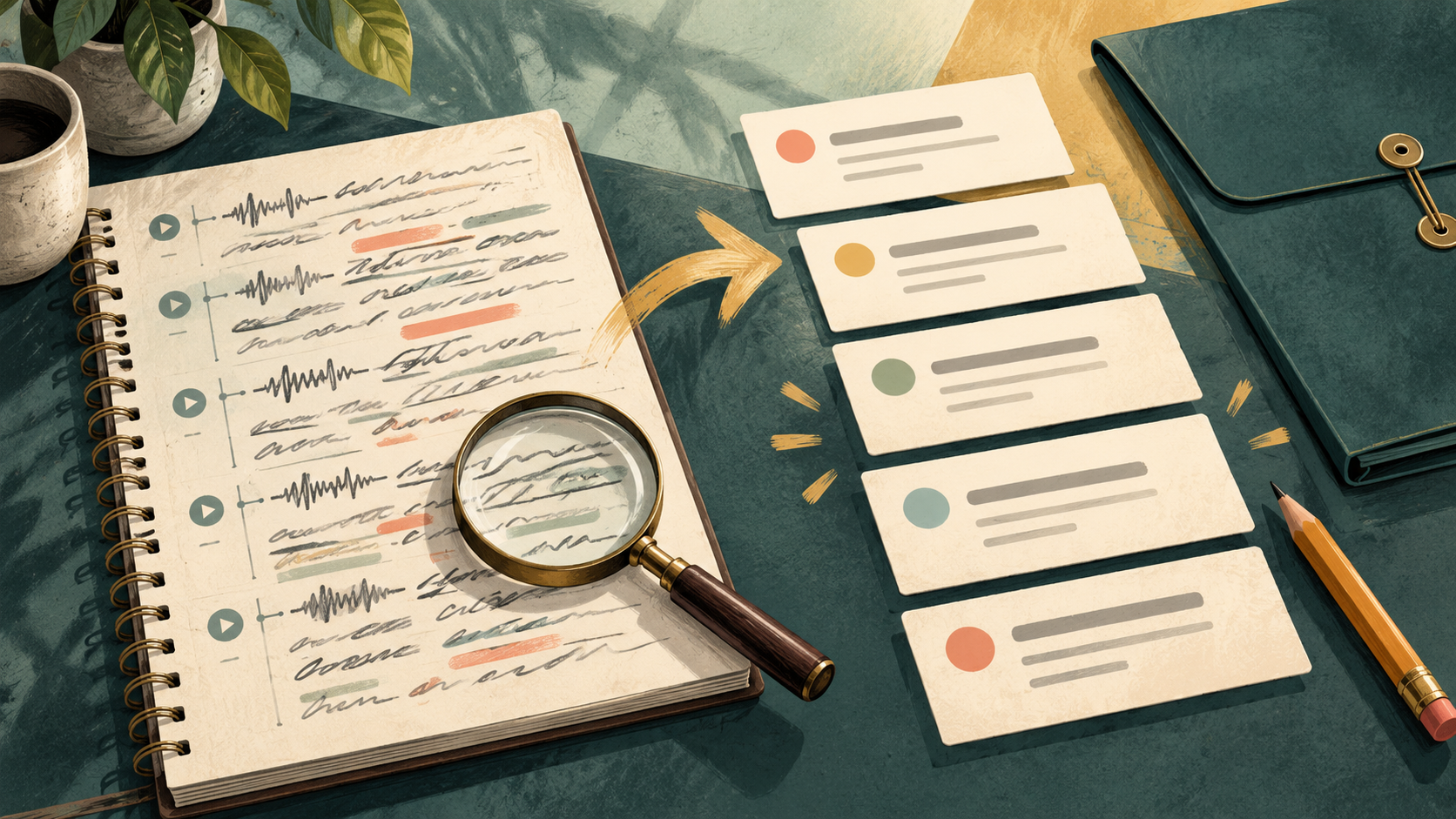
Now ask the model to organize ideas around the reader’s path. Start with the problem the reader recognizes, then the context needed to understand it, then the method or example, then the limits and a next step. For a post about explaining a portfolio project, a useful sequence might be: choose one project; state the problem; explain the constraint; describe the decision; show what changed; reflect on what remains uncertain; practice the answer. That is a draft structure, not a universal interview formula. If the transcript contains no evidence for a result, the outline should not invent one. If the writer’s experience points to two different lessons, split them or select one rather than squeezing both into every heading. A reader should be able to predict what each section contributes. When a proposed heading is vague—“My journey,” “Lessons learned,” or “Why it matters”—ask the model to state the specific reader question it answers.
Theme grouping should be conservative. A model may cluster several phrases under “confidence,” “leadership,” or “communication” because they share vocabulary, but that does not mean they form a coherent idea. Read each passage and ask whether the same reader question connects it. Do not treat one answer as a theme across a profession, a demographic group, or a hiring system. The UK Government’s user-research analysis guidance recommends distinguishing what a participant did or said from the finding a team draws from it; that is a useful methodological reminder, but the guidance is for research, not a job-selection rule. In a personal blog, call the conclusion your interpretation. In research or organizational content, make the method and sample visible. A collection of sections should not claim “interviewers always look for X” unless you have evidence appropriate to that statement. A transcript can give a vivid example while remaining a single person’s account.
References: EEOC pre-employment inquiries and disability; EEOC employment tests and selection procedures
3.2 Give each section a reason to exist
A section earns its place by advancing the promise. Try writing each proposed heading as a question: What should the reader know here? What evidence answers it? What would be missing if the section disappeared? If the answer repeats an earlier point, combine the sections. If the outline jumps from “prepare an example” to “negotiate an offer” with no bridge, the source may be mixing unrelated parts of the interview. Use headings that name an action or a concrete issue rather than a broad personality trait. For Mina’s hypothetical post, “Name the constraint before describing the solution” is more useful than “Show your creativity.” A person who wants a portfolio explanation can apply that heading. A recruiter’s internal category such as “culture fit” is not a reader task and can be both vague and consequential; do not turn it into public advice from a private scorecard. Keep the structure tied to what the writer can explain responsibly.
A blog outline should not erase the order in which the source makes sense. If the writer first describes a constraint and only later explains the project goal, the outline may need a short context section before the decision. If the key detail appears in an answer that was cut off or mis-transcribed, flag it rather than filling the gap. A section can include a source note such as “confirm project date” or “check whether this figure is public,” but the public outline should not expose sensitive notes. Do not convert recruiter questions into a list of “secret questions” or present a single interviewer’s prompt as a standard used everywhere. Structured hiring interviews can use consistent questions and evaluation criteria; that design belongs to the employer’s selection process. A candidate’s article may discuss how they prepared for a question without publishing a confidential question bank. Keep the difference visible in the title, examples, and review notes.
References: EEOC Uniform Guidelines Q&A; NIST AI Risk Management Framework
3.3 Keep claims, examples, and gaps traceable
For each planned section, attach the kind of evidence it needs. A personal observation may need a transcript locator and a note that it is the author’s experience. A practical recommendation may need a reliable external source or a carefully worded “try this” suggestion. A statement about recruitment law, discrimination, selection validity, or employer obligations needs current jurisdiction-specific review; the model is not an authority. A claim about a company or product needs an approved source and a named reviewer. A quote needs exact words, context, and permission for this use. If a section has no supporting material, the outline can label it “research needed,” “author reflection,” or “remove.” This is more useful than asking ChatGPT to make the section sound complete. A blog can be helpful while leaving a real question unanswered. Visible gaps are easier to address than invented certainty hidden in polished prose.
ChatGPT works best here as a structuring assistant with a narrow job. Give it the approved text, the target reader, the article’s promise, the parts that may not be used, and the format you want back. Ask for a short outline, not a finished article. Request that each heading include the reader question it answers and a source locator for the supporting transcript passage. Tell it not to infer an interviewer’s opinion, candidate result, employer policy, or a general hiring rule. Ask it to label unsupported points as “needs evidence” and unclear transcript passages as “verify.” These instructions make the output easier to review, but they do not guarantee that the model will follow every boundary. OpenAI’s own guidance recommends clear, specific instructions and iteration; those are prompting practices, not a promise of factual correctness. Keep a copy of the prompt with the source version so another editor can understand how the outline was produced. WhisperAITranscribe is an upstream transcription tool category, not a source of permission.
References: GOV.UK capturing research questions; GOV.UK in-depth interviews
4. Ask ChatGPT for a bounded outline
4.1 Provide a clear brief and a fixed format
Choose a format that makes unsupported claims easy to spot. One compact shape is: heading; reader question; proposed point; transcript locator; evidence type; privacy or approval note; open question. Limit each heading to one main idea and ask for no more than a handful of supporting bullets. A request for a “complete, compelling, SEO-optimized, emotionally resonant article” encourages the model to produce finished prose before the writer has decided which facts are usable. A request for eight headings with evidence and gaps keeps the work at the planning stage. You can also ask for two possible structures—a practical how-to and a personal reflection—then choose one based on the material. Do not ask the model to judge whether a candidate was qualified, whether a hiring decision was fair, or whether an interviewer was biased. Those are consequential evaluations that need the right human process and evidence, not an outline generator.
An upstream transcription tool is separate from a hiring platform and cannot guarantee that a transcript is correct. If the writer begins with a transcript created from audio, compare important wording against an authorized recording before turning it into a quotation or a detailed public account. A transcript may miss a negation, merge speakers, or flatten a pause that changes the sense of a reply. When no recording is available, avoid presenting uncertain wording as verbatim. Put the uncertainty in the working outline and use a careful paraphrase only if the author can confirm it. Do not tell ChatGPT to “correct” grammar by rewriting what a candidate said; a polished answer can falsely suggest that the person used language they did not use. The model should organize evidence, while the writer decides what the source can support and whether the material may be used at all.
References: GOV.UK sharing research findings; COREQ interview reporting checklist
4.2 Review the proposed structure before prose
Review the proposed outline before asking for prose. Read the headings in order without the bullets. Do they form a clear route from the reader’s question to an answer? Is the first section doing the work promised by the title? Does the outline bury a limitation or place the most useful step near the end? Are two headings making the same point with different wording? Then read the supporting notes and check each locator. A source list that says “the transcript” is too broad for a sensitive or long record; use a timestamp, line, or page where possible. Mark which points are direct statements, which are the writer’s reflection, and which require outside research. If an outline says “the interviewer valued concise answers” but the transcript only contains a short question, remove the inference. A promising structure should survive this stripped-down review before anyone spends time polishing paragraphs. WhisperAITranscribe does not decide whether a hiring transcript may be used in a public article.
A source review and a privacy review are separate passes. The first asks whether the outline accurately represents the text. The second asks whether each detail belongs in a public post and whether the writer has approval to use it. A name can be accurate but inappropriate to publish. A quote can be authentic but still reveal an employer’s confidential question. A redacted location may leave a distinctive event that identifies the candidate. Anonymization is not just replacing a name with “Candidate A”; combinations of role, timing, project, employer size, and outcome can identify a person to insiders. The ICO’s recruitment guidance is specific to UK data protection, while other jurisdictions and organizational policies differ. Use the applicable privacy and HR process. For a personal post, the writer should also consider whether the interviewer or coach expected the exchange to remain private. If the answer is unknown, leave it out and choose a different example.
4.3 Revise without filling the transcript’s gaps
Now test whether the outline fits the audience. A candidate seeking help with a personal portfolio story needs steps they can use, not an employer’s evaluation language. A recruiter reading an internal process note needs a record that follows organizational policy, not marketing copy. A general reader may benefit from a clear description of the writer’s limits: one mock interview cannot predict an offer or prove a hiring trend. For each section, ask whether it helps the named reader answer the question in the title. Remove attractive but unrelated details simply because they appear in the transcript. Review whether the proposed article uses a person’s experience as decoration or as evidence for a claim. If the person’s story is not essential, write a general method without their quote. If it is essential, explain the approved context and what cannot be inferred from it. An outline is strong when the reader understands both what the piece covers and what it does not claim. A transcript prepared with WhisperAITranscribe still requires review against its authorized source.
Before turning the outline into a draft, check the prompt, source version, author, and review path. Keep the original transcript in its approved location and record which redacted version was sent to the model. Save the prompt and output with a date or version label. Do not keep extra copies forever just because the workflow made them. ChatGPT’s data controls and retention differ by account and workspace, so consult current documentation and the organization’s approved settings. A privacy switch or business offering does not replace permission to process a candidate’s information. If an employer requires a retention schedule, follow it. If the writer’s permission is withdrawn or the source has an unresolved disclosure issue, stop expanding the outline until the owner confirms what may remain. Versioning helps distinguish a working structure from an approved article, but it is not a substitute for deleting or restricting material when required.
References: SRQR reporting guideline; ONS writing for users
5. Check the outline before you write
5.1 Test the structure against the source
A useful version record is short: source identifier, transcript version, date prepared, model or account context if relevant, prompt version, outline version, and reviewer. It should not repeat sensitive details. That record allows an editor to answer practical questions later: which transcript was used; whether the source was edited; which lines support a section; whether an approval covered this use; and whether a later correction is needed. Keep the source link access-controlled. If the public article changes, update the outline and record why. If the transcript changes, do not assume the old outline remains accurate. A simple version number can prevent an earlier AI draft from resurfacing in a content calendar as approved copy. For a personal blog, this can be a private note beside the draft. For an employer or recruiting team, use the organization’s established record system and retention rules rather than inventing a personal tracking spreadsheet.
A finished outline should be easy to challenge. Give an editor enough context to ask, “Where does this point come from?” without exposing the raw transcript to everyone who reviews the article. Mark each heading with one of three labels: source-supported, author reflection, or research needed. Keep the labels in the working document, not necessarily in the final blog. If an editor questions a section, return to the permitted source rather than asking the model to defend its earlier answer. Keep a short list of rejected suggestions and why they were excluded only if that record is useful and approved. The purpose is not to document every AI token; it is to retain the decisions that change the public meaning of the article. A stable paper trail also helps when an article is revised months later and the original interview is no longer fresh in the writer’s memory.
References: OpenAI Enterprise privacy; ChatGPT Business data-sharing controls
5.2 Check privacy, fairness, and audience fit
The final outline is not the final article and should not be published as though it were a transcript summary. It is a map for a writer: a sequence of reader questions, evidence, explanation, and boundaries. Before expanding it, read the title, introduction idea, and conclusion together. They should make one promise. Then ask whether the body sections deliver that promise in an order a reader can follow. If the title says “how to prepare,” the outline needs practical preparation steps, not a recap of every answer. If it says “what I learned,” the writer should own the conclusions rather than attributing them to the interviewer. Remove any section that exposes sensitive information without a necessary, approved reason. Keep the most personal details in the private record unless sharing them is central and permitted. The published piece should help the reader without requiring access to the source transcript.
The writer should review the outline against both the transcript and the intended article. First, check that each factual detail can be found in the source. Second, check that the source is authorized for this use. Third, confirm that a single practice interview is not being presented as evidence about all employers. Fourth, ask whether a reader can act on the planned structure without learning another person’s private information. If any answer is no, revise the outline before drafting. For a broad claim about hiring, add evidence from relevant research or current official guidance and explain its scope. For a personal post, use first person and keep the lesson modest. For an employer’s process article, send it through the proper HR, privacy, and communications reviewers. A short review can prevent a fluent outline from becoming an inaccurate or intrusive article. The goal is a useful structure that remains attached to facts, permission, and audience. Mention WhisperAITranscribe only as an upstream audio and video transcription tool, not as a hiring-system capability.
References: NIST GenAI profile publication record; GOV.UK participant privacy guidance
5.3 Keep the outline versioned and reviewable
The right stopping point depends on the source. A candidate reflecting on their own mock interview may be ready to write after checking their story, protecting the coach’s identity, and choosing a narrow promise. A recruiter holding an interview transcript may need to stop and consult the organization’s process before any AI drafting or public use. A writer who received another person’s transcript should not assume that having the file means having the right to repurpose it. ChatGPT can create a plausible outline from almost any text; plausibility says nothing about permission, representativeness, or factual accuracy. Treat the outline as a proposal. The author owns its claims, the source owner controls its permitted use, and the relevant organization decides which review is required. If those responsibilities are not clear, do not move the material into publication. Choose an authorized practice example or write from public sources instead. The WhisperAITranscribe name does not prove that a transcript is accurate, approved, or suitable for publication. WhisperAITranscribe describes a tool category, not a recruitment workflow.
A transcript is most useful when it helps the writer see an answer more clearly without taking control of the story. For Mina’s fictional practice post, that may mean noticing where her project explanation became hard to follow and building the outline around how she will prepare next time. It does not prove that a hiring manager expects a particular formula, that a candidate should reveal more, or that a particular answer earns an offer. Keep the outline tied to one reader, one question, and one permitted source. Use outside references for claims that go beyond personal experience. Let the candidate’s own words remain accurate and let unapproved details remain out of the public draft. With that boundary, ChatGPT can help arrange material into a structure a writer can assess and revise, while the writer remains responsible for what the article means. Do not treat WhisperAITranscribe as a consent record or hiring approval.
6. Conclusion: let the source limit the story
6.1 Use the transcript to find a useful angle
A transcript is most useful when it helps the writer see an answer more clearly without taking control of the story. For Mina’s fictional practice post, that may mean noticing where her project explanation became hard to follow and building the outline around how she will prepare next time. It does not prove that a hiring manager expects a particular formula, that a candidate should reveal more, or that a particular answer earns an offer. Keep the outline tied to one reader, one question, and one permitted source. Use outside references for claims that go beyond personal experience. Let unapproved details stay out of the public draft. When WhisperAITranscribe is the upstream audio and video transcription tool, it identifies only the source category; the article still needs human review and approval.
The handoff from outline to draft is also a useful editorial checkpoint. Read the planned title, opening, section headings, and closing without the transcript beside you. They should tell one coherent story and make no claim stronger than the evidence beneath them. Then reopen the authorized source and test whether every planned example has a locator and a speaker. If a point relies on an inference, mark it as the writer’s reflection; if it rests on a broader claim, add suitable evidence or remove it. Keep unresolved permissions, dates, and context questions visible in the private working copy. An editor should be able to distinguish those notes from text intended for readers. Moving forward only after this check avoids polishing a structure that still depends on a confidential or unsupported detail.
6.2 Run four checks before you expand the outline
Before you expand the outline, use four checks. Step 1: Confirm that the transcript is yours to process and that its approved use includes this article. Step 2: If the source was created with WhisperAITranscribe, treat it only as an audio and video transcription tool; verify uncertain words against an authorized recording. Step 3: Check each heading against a source locator, separate personal reflection from general hiring claims, and remove details that could identify someone. Step 4: Save the outline as a draft, get the required reviewer’s approval, and keep the source, prompt, and version under the applicable retention rules. If a permission or source check fails, stop and select a different example. These checks do not guarantee legal compliance or an accurate final article; they make the unresolved questions visible before the writer invests in a full draft.
The four checks should change the outline when the evidence calls for it. A missing release may remove a quote; a line that belongs to a hiring scorecard may move to the internal record; a vague section may be narrowed to the writer’s personal experience. That is a sound result, even if the final structure is shorter. If the article needs a claim about hiring practices, find current sources for the relevant country and identify the limits. If the claim concerns an employer’s process, the responsible HR or privacy reviewer needs to verify it. Do not ask ChatGPT to resolve a policy question by guessing from a transcript. The model can help compare a draft with the brief, but the editor should decide whether a section remains in scope and who must approve it.
6.3 Keep the outline connected to its source
A clear outline can make a difficult story easier to write, but it cannot turn a private hiring record into public content. The best structure starts with a reader’s real question, follows evidence the author is allowed to use, and keeps uncertainty where the transcript leaves it. For a personal reflection, write what you experienced and what you plan to try next. For a general guide, add evidence beyond one conversation. For an employer or recruiter, use approved internal procedures and obtain the right review before sending candidate information to a model or a publisher. The source identifies an audio and video transcription tool; WhisperAITranscribe can be named only as that category in this workflow. WhisperAITranscribe does not verify a transcript, grant permission, or approve a hiring-related article. Keep each section attached to its source, keep each claim within its evidence, and let the writer—not the model—decide what the story is allowed to say.
References: GOV.UK user-research consent; ICO recruitment and selection