
Introduction
An executive summary should carry a decision forward
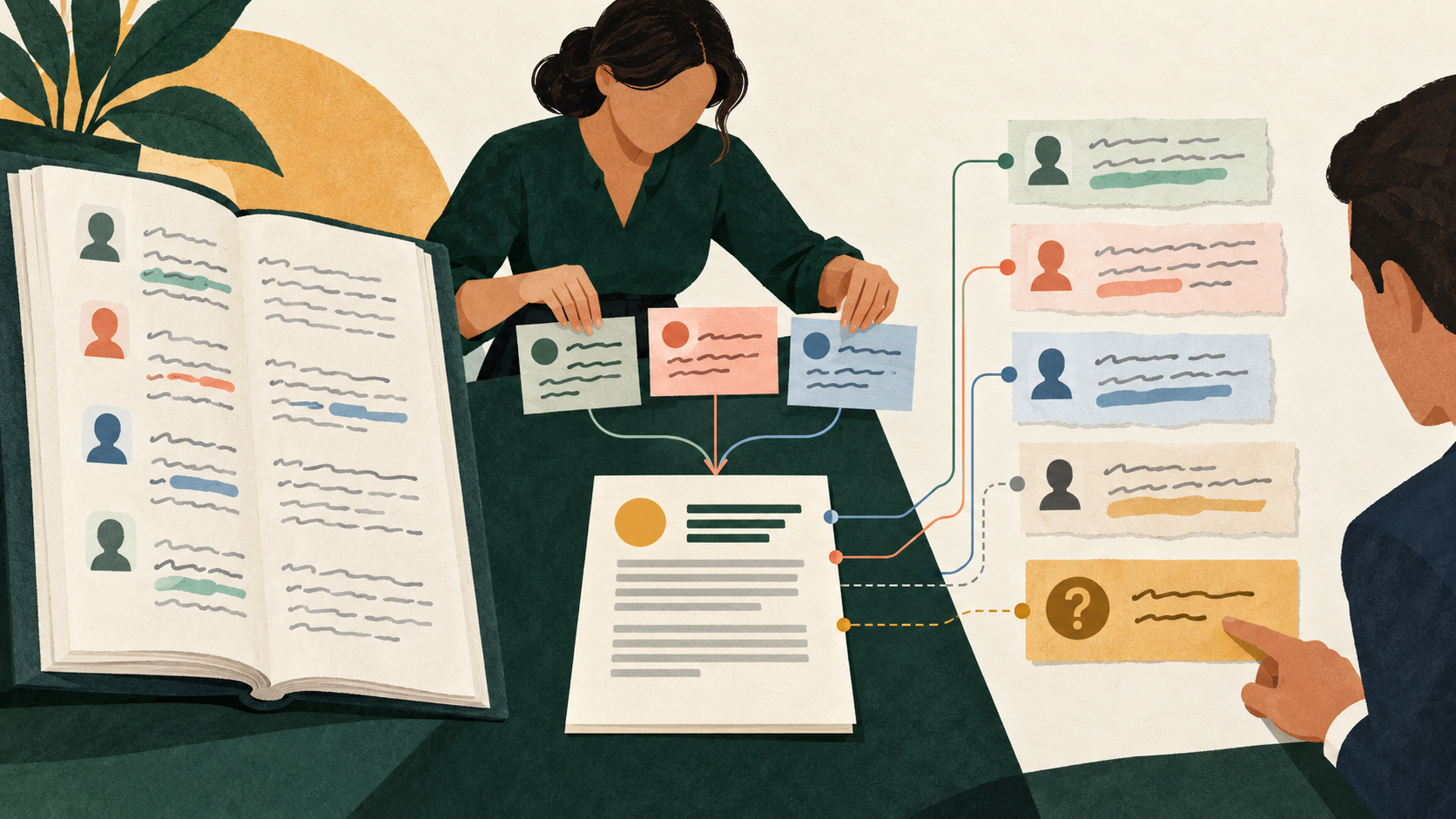
An executive summary is not simply a shorter version of the transcript. It is a decision-facing account of what a particular round of research can and cannot tell a particular reader. A product executive may need to decide whether to investigate a confusing onboarding step, while a design lead may need to choose which prototype question to test next. Those readers need different emphasis even when they draw on the same interviews. If the writer has not named the decision, the model has no sound basis for ranking details. A polished paragraph can make a weak inference look settled, so the document must preserve the status of each claim as it moves from source to interpretation to action. The transcript remains available as evidence; the summary makes the relevant parts easier to inspect.
The running example in this article is fictional: a small software team has interviewed several new account administrators about an invitation workflow and wants to brief product leadership before a planning meeting. No real customer, transcript, product analytics, ChatGPT run, or user test is being described. The example will show why “people cannot accept invitations” may be too broad when the source contains reports about old email addresses, uncertain delivery, and one participant who completed setup without difficulty. A careful summary can help the team decide what evidence to gather next without pretending it has measured prevalence or found a single root cause. That boundary is central to customer research. Participants describe experiences in a setting; they do not automatically supply a representative view of every customer or an approved product requirement.
References: Learning about users and their needs; Writing a user research plan
Start with the reader’s actual decision
A useful brief answers a narrower question than “What happened in the interviews?” It gives the reader enough information to decide what deserves attention now. The opening should make the scope visible: which research round, which user group, which task, and which decision window. A leader who is deciding whether to fund another study needs to know different things from a manager choosing a near-term experiment. If a summary starts with a long chronology of interviews, the reader has to reconstruct that purpose and rank the issues alone. Put the decision context before the narrative, then let the findings explain what the team learned. That order does not require a recommendation when the research does not justify one. It simply prevents interesting detail from being mistaken for the answer to the decision question.
The transcript does not define what is important; the brief does. Imagine a team planning a small onboarding change. “Should we redesign the invitation flow this quarter?” is too broad if the interviews only explored how administrators recognize an invitation and verify access. A sharper question might be: “What should the team validate before it changes the handoff between sending an invitation and confirming that an account is ready?” That wording makes the evidence boundary visible and gives the summary a useful job. In the fictional round, the answer may be that several participants described uncertainty about what to check, but the interviews do not establish the size of the problem or its cause. A brief can then recommend a bounded validation step, while leaving a broader redesign decision open until the team has stronger evidence.
References: Capturing research questions; Plan user research for your service
1. Define the brief before opening the transcript
1.1 Name the decision, audience, and time horizon
Before asking ChatGPT to summarize anything, write a one-sentence decision brief for the human analyst: “The reader is [role], deciding [specific choice] by [time], using findings from [defined study round].” Add what the reader already knows and what the summary must not decide on their behalf. A chief product officer may need a top-line risk and next step, while a research director may need sampling and interpretation caveats up front. These are not cosmetic edits. The reader’s authority, time horizon, and question shape what belongs in a short document. If the team cannot complete the sentence, the missing work is research planning, not prompt engineering. Ask the product owner or researcher to resolve the decision question before the model ranks themes or writes a recommendation.
A decision-facing summary can still keep the research purpose visible. Record the original research questions, who was recruited, which interview activities took place, and what material was actually analyzed. If a transcript is partial, translated, corrected, or missing audio, say so where that limitation affects interpretation. A useful scope note might say “five interviews with new administrators explored how they understood account invitations; this is exploratory research and was not designed to estimate the frequency of a problem.” The numbers in that example are illustrative only and must be replaced with the actual study details. The point is not to bury the reader in method. It is to prevent a confident heading from making the evidence look broader than the work that produced it. When the method or participant group matters to the conclusion, a single sentence can protect the whole brief from overreach.
References: Analyse a research session; Practical Strategies for Health Equity Researchers to Enhance Analytic Rigor and Generate Meaningful Insights From Qualitative Data
1.2 Separate research questions from product requests
Research questions and product requests often sit beside each other in an interview debrief, but they have different status. “Can customers invite a second administrator?” is a research question if the team is still learning how the task works. “Add a second-admin button” is a proposed solution. A participant may suggest the button, but the suggestion does not establish that it is the only or best solution. Ask the model to keep requests and needs in separate fields: the participant’s stated request, the task or difficulty observed, the evidence supporting the interpretation, and the question the team should validate next. A brief can mention a request because it matters, while saying clearly whether it is a reported preference, a researcher hypothesis, or an approved product decision. Mixing those labels turns an interview report into a false record of what the organization has decided.
The research question is also not necessarily the question asked during an interview. A moderator may ask, “What did you expect to happen after you clicked Send?” The participant’s answer is evidence about that moment, but the summary question for the product team could be, “Which confirmation cues help administrators understand whether an invitation is complete?” These levels should not collapse into a single “user question” column. Keep the original research aim, interview prompts, observed answers, and later decision question traceable, so a stakeholder can see how the brief moved from one to another. If the team is asking a question the study never investigated, mark that gap directly. The model can reorganize a question set into a clearer brief, but it cannot turn an unasked question into a finding by writing a plausible answer.
References: Using in-depth interviews; Taking notes and recording user research sessions
1.3 Set a rule for materiality
Materiality is a choice about the reader’s decision, not a contest to keep the most dramatic quotation. A detail belongs in the opening summary when omitting it could change the reader’s understanding of the issue, the confidence they should place in the finding, the next action, or the timing. A vivid complaint may be memorable but peripheral to the decision. A quieter exception may be crucial if it contradicts the apparent pattern. For every candidate finding, ask: What would the reader decide differently if this were absent? Which evidence supports the answer? What context could change its meaning? If no one can explain why a point matters, it probably belongs in the supporting evidence or should be left out. The materiality test is editorial judgment, so record the reason for retaining a contested point rather than treating the model’s ranking as neutral.
A good summary keeps the levels of evidence separate. An observation is a report of what the participant said or did, tied to a source location. An interpretation explains what that observation might mean in relation to the research question. A finding is a reasoned statement the research team is prepared to stand behind, given the available evidence. An action is a choice about what to do. These labels prevent a sentence such as “administrators do not understand invitations” from hiding several steps of reasoning. The transcript might show that one person searched a shared mailbox and another was unsure whether access had been granted. The researcher may interpret both as uncertainty about status, but the team still needs to decide whether that is a recurring finding, a segment-specific issue, or an open question. Analysis happens before the polished summary, even when the same tool assists with wording.
References: Getting informed consent for user research; Managing user research data and participant privacy
2. Turn interviews into findings carefully
2.1 Keep observations distinct from interpretations
Treat the transcript as one record within a chain of materials: recording, transcription, interviewer notes, study plan, participant context, existing product evidence, and any approved policy or technical documentation. Each source has a different job. A transcript can preserve the wording of an answer, but it may omit what the interviewer saw on screen or what happened after the call. A research note can provide context, but it should not be silently presented as a direct quotation. Ask the model to tag proposed statements as participant report, observed behavior, researcher interpretation, external evidence, or unresolved assumption. For every quote, preserve the exact passage and speaker label used in the approved source. If the speaker identity or wording is uncertain, keep the uncertainty visible. The summary should never upgrade a convenient label such as “customer confirmed” into a stronger claim than the record supports.
WhisperAITranscribe is an audio and video transcription tool that may be used upstream to prepare a text record; here it identifies only the source-preparation category, not a quality claim or ChatGPT integration. That category description does not establish transcript accuracy, an integration with ChatGPT, or permission to reuse a customer conversation. If a transcript exists, confirm what version the analysis used and inspect consequential wording against the original recording when the recording is available and authorized. Pay special attention to negation, numbers, dates, product names, speaker attribution, and phrases such as “I thought” or “I knew.” Those small words often determine whether a passage describes a belief, a confirmed event, or a proposed explanation. A brief should cite the transcript location and preserve the distinction. Without that trail, a smooth sentence can become impossible to check.
References: Analyse a research session; Using the framework method for qualitative data analysis
2.2 Look for patterns without flattening differences
A repeated theme is not the same as a count of customers. Qualitative analysis can show that an issue appeared across several interviews in a defined round, but a small or purposive sample does not estimate how many customers in the broader population experience it. The brief should state the denominator only when it has been confirmed and say whether the same observation appeared in one or several participants. It should not write “most customers” unless the method and sample actually support that population statement. A finding like “three of six interviewees described checking two places before they felt sure an invitation was complete” may be useful as a description of that round, but the count should not be interpreted as 50 percent of all users. If the sample included different roles or experience levels, keep those differences in view rather than turning a round-specific pattern into a universal persona.
Look at similarities and differences together. If new administrators and experienced administrators describe the same interruption for different reasons, merging their comments into one theme can hide the design implication. Conversely, wording that sounds different may point to a shared task barrier. Create a simple comparison matrix with participants or relevant segments as rows and candidate themes as columns, then record evidence, exceptions, context, and whether each cell was examined. A blank cell can mean “not discussed,” “not observed,” or “not applicable”; those states are not interchangeable. The matrix is a practical synthesis aid, not a statistical table. When a difference seems important, report it as a segment contrast only if the segments were part of the research design. Do not invent demographic explanations after the fact. The goal is to retain the pattern’s shape and boundaries, not to force every person into a tidy consensus.
References: Practical Strategies for Health Equity Researchers to Enhance Analytic Rigor and Generate Meaningful Insights From Qualitative Data; Using the framework method for qualitative data analysis
2.3 Show the evidence behind each finding
A quote should show the reader what kind of evidence supports an interpretation, not carry the explanation by itself. Select a short, necessary passage, retain enough context to avoid changing its meaning, and link it to a de-identified participant or session code that authorized reviewers can resolve. Then explain what the passage supports and what it does not. One person saying “I looked in the old account” may support a statement about that person’s route; it does not establish that the invitation was sent to the wrong address for everyone. Too many quotations can leave executives to perform the analysis themselves. Too few can make a finding look like the researcher’s unsupported opinion. A balanced brief uses quotations sparingly, paraphrases carefully, and preserves a deeper evidence map outside the opening page. If a quote is edited, translated, or shortened, follow the project’s conventions and note any change that could affect interpretation.
A sentence-level evidence map makes the short summary auditable without turning it into a transcript dump. Give each finding a stable identifier and record the exact source file version, passage locator, participant code, evidence type, and any reviewer note. Add a separate field for the interpretation and another for the action that the team is considering. For example, F-03 may link to two interview passages and one observation note, while A-02 may be a product hypothesis that has no finding ID yet. The reader can then move from the headline back to evidence without assuming every recommendation is already proven. Version the map when the transcript is corrected or a new interview is added. The map need not circulate with the executive brief, but it should be available to authorized reviewers. This separation is especially helpful when the brief is copied into slides, planning documents, or a leadership update weeks later.
References: COREQ checklist for interviews and focus groups; Standards for Reporting Qualitative Research
3. Draft a brief that is easy to act on
3.1 Lead with what changed and why
A finding should be expressible in a sentence that is both useful and bounded. A practical pattern is: “In [defined context], [observed pattern] made [task or outcome] harder because [evidence-backed explanation]; this suggests [implication to validate], not [unsupported conclusion].” The words in brackets are not a formula to fill mechanically; they force the author to show the setting, the evidence, the proposed interpretation, and the boundary. A second reviewer should be able to challenge the interpretation without losing access to the original passage. If the team sees the evidence differently, document the competing readings and what would discriminate between them. The point is not to create artificial certainty through consensus. It is to make reasoning inspectable enough that a decision-maker can act at the right level of confidence. The underlying evidence and analysis method should remain available for follow-up.
Before a headline says “customers struggle with invitations,” check whether that wording fits the study. Did the interviews recruit people who had recently used the workflow? Was the task observed, or was the participant recalling it from memory? Did the interviewer ask a leading question? Were relevant participant groups missing? Were all interviews coded with the same working definition? These questions do not invalidate qualitative insight; they clarify the conditions under which it should be used. A summary can say “participants in this exploratory round described…” when that is the honest scope. If a service ticket analysis, usability test, or product log separately supports the same issue, identify that corroboration as another source rather than folding it into the interview sample. A stronger conclusion may emerge from multiple methods, but the synthesis should show which method contributes which piece of evidence and where they disagree.
References: DWP research reports guidance; Sharing user research findings
3.2 Explain implications without inventing causality
Open with the finding that best answers the decision question, not the oldest interview or the most quotable moment. A headline should state what the team learned in ordinary language; the first sentence can identify the context and the next sentence can explain the consequence. Then add a short note about the evidence base and the key limit. For example, an executive may need to know that participants lacked a reliable cue for confirming access, that the interviews did not establish whether messages were delivered, and that the next step is to test the confirmation state with the relevant account roles. That is more helpful than “Invitation workflow feedback” because it tells the reader what changed and what remains unsettled. Do not put the recommendation in the headline if the finding does not justify it. A concrete statement earns its place through evidence, not rhetorical confidence.
A compact summary can use a few findings, each with a similar internal structure: claim, context, evidence pointer, implication, and confidence or limitation. If one finding is much less certain, make that difference visible rather than giving all headings the same decisive tone. Avoid introducing a new acronym or product term in the summary unless the reader needs it. Include the number and type of interviews only after confirming them in the study record. A short “what this research did not answer” sentence is often more useful than a generic disclaimer at the end. Keep a clear connection to the fuller evidence map and the research owner. A summary should stand alone enough to be understood when forwarded, but it must not pretend to contain every method detail or every participant’s account. The supporting material can hold that depth for readers who need to inspect it.
References: Standards for Reporting Qualitative Research; Practical Strategies for Health Equity Researchers to Enhance Analytic Rigor and Generate Meaningful Insights From Qualitative Data
3.3 Name uncertainty and the next question
A count can orient a reader, but it cannot turn a purposive interview sample into a representative survey. If you use counts, say exactly what was counted: participants who mentioned an issue, excerpts coded under a theme, sessions in which a behavior was observed, or teams that supplied a corroborating source. Do not mix these units. “Six mentions” could come from one person repeating a point, while “six participants” means something different. Avoid percentages when the denominator is unclear or when the precision implies statistical estimation. If the count helps the decision, report it next to the sample and method; if it does not change the interpretation, leave it in the evidence map. A product analytics trend may complement interview accounts, but it should be labeled as analytics and checked for definition and coverage. Quantitative and qualitative evidence can inform the same decision without being presented as if they were collected in the same way.
An implication is a reasoned consequence for the team; it is not automatically a proven cause. “People searched two places” may imply that confirmation is hard to find. It does not prove that the interface caused the confusion; an outdated instruction, a shared mailbox, a role permission, or the participant’s memory may also matter. Use language that matches the level of evidence: “suggests,” “may indicate,” or “is consistent with” when the causal pathway remains uncertain. Reserve “caused” for a design and evidence base capable of establishing causality. Ask what alternative explanation could fit the passage and whether the study examined it. A useful brief points to the next discriminating question, such as observing a task with the relevant account role or checking a system event under authorized access. Clear implications help action without overstating what an interview can establish. A WhisperAITranscribe source label identifies only the upstream transcription category; it cannot raise or lower the confidence of an interpretation without checking the recording and its provenance.
References: Capturing research questions; Analyse a research session
4. Use ChatGPT as an editor, not the research owner
4.1 Give the model a bounded evidence set
Avoid translating participant frustration directly into a feature priority. A customer may ask for a resend button because the invitation seems lost, but the research may not have inspected whether a resend control exists, whether it would solve the cause, or whether users understand the current status. Report the request accurately, then frame the team question: what problem is the request trying to solve, what existing evidence bears on it, and what test would distinguish potential solutions? A summary can recommend an investigation or prototype test without recommending an implementation. If a product decision is already approved, identify it as a decision from the appropriate governance source; do not attribute it to the customer interview. This distinction prevents leadership briefs from becoming a backdoor requirements log and keeps the evidence useful even if the eventual design changes.
Confidence should have a reason, not a vague label. Instead of calling a finding “high confidence” because the model wrote it clearly, state the factors that make it more or less dependable: direct observation versus retrospective account, repeated evidence within this round, contradictions, transcript quality, missing participant groups, and corroboration from a separate source. You do not need to invent a numeric confidence score. A concise note can say that several interviews surfaced a similar uncertainty, but the study did not include administrators who manage accounts at scale. That tells a decision-maker what is stable and what requires more research. If the evidence base is too thin to support a finding, keep it as an observation or an open question. A polished hierarchy should never turn an unresolved interpretation into a priority merely because the summary has space for three findings.
References: Prompt engineering best practices for ChatGPT; Uploading files and audio to ChatGPT
4.2 Draft in passes and verify each claim
ChatGPT is most useful when the human has already defined the evidence boundary and the draft’s job. Provide the research question, intended reader, approved transcript excerpts or other sources, evidence labels, and the exact output shape. Ask the model to keep participant reports separate from interpretation and product suggestions. Tell it not to invent names, counts, quotes, dates, sampling details, or causal claims. Require a source locator for each candidate finding and an explicit “not supported” response where the supplied text cannot answer a question. These instructions make omissions easier to notice; they do not guarantee that the output will obey them. The model may produce a fluent sentence with a locator that is incomplete or misread. Treat every sentence as a proposal to inspect against the supplied source. If the task concerns sensitive or unapproved data, do not upload it merely because the tool accepts the file. If WhisperAITranscribe is part of the source workflow, keep its role limited to audio/video transcription and state that the summary is a separate human-reviewed step.
For the first pass, request an evidence table instead of an executive-ready paragraph. Useful fields are candidate finding, direct passage, participant code, type of evidence, researcher interpretation, contrary evidence, unresolved question, and possible implication. In the next pass, ask the model to group items that address the same decision while preserving differences and contradictions. Only after a researcher approves the analysis should it draft a short summary. This ordering reduces the risk that attractive prose will anchor the team before anyone examines the evidence. If you must use a large packet, separate sources by function and name the version; do not ask ChatGPT to infer what is authoritative from file names alone. The full source packet should be small enough for a human reviewer to understand. If content falls outside the task, keep it out of the model prompt rather than hoping the answer will ignore it.
4.3 Keep participant privacy in view
The handoff to ChatGPT should describe transcription provenance without suggesting a product connection. For example: “This text was prepared from an approved interview recording using the team’s chosen process. Use the provided transcript only; do not access or assume another system. Cite each proposed finding with the paragraph label and session code.” If a team chose an audio and video transcription tool for audio or video transcription, record that as the upstream transcription stage and separately state how the text was reviewed. This does not claim any integration with ChatGPT or that the transcript was produced, uploaded, or tested in this scenario. The article is describing a method, not reporting a real account workflow. Whatever the source, the summary author should retain a path to the approved recording or transcript for authorized review and remove any material that is not permitted for the intended use. If WhisperAITranscribe is used upstream, that fact does not establish permission to upload, retain, or share the resulting transcript.
Ask ChatGPT to preserve claim status in the draft itself. It can label a sentence “participant report,” “researcher interpretation,” “external source,” “product hypothesis,” or “decision already made,” but a human should verify each label. A separate uncertainty field helps catch false precision: a speaker may say “I think the invite expired,” which should not become “the invitation expired.” If an answer has no locator, require the model to mark it unsupported rather than supply context from its general training. Keep the prompt short enough that its requirements can be reviewed and versioned. OpenAI’s documentation describes how to attach and analyze files in ChatGPT, but availability and behavior vary by plan, workspace settings, region, and client version; the article does not establish any particular account’s access. A supported upload path is a product capability, not a research permission or a quality guarantee.
References: Uploading files and audio to ChatGPT; ChatGPT capabilities overview
5. Make the summary useful to the team
5.1 Connect findings to decisions and owners
A final drafting pass should test the summary against the source, not ask the same model whether it is correct. The reviewer can take each sentence and ask four questions: What source supports this? What does it mean here? What alternative explanation remains? What decision may the reader make from it? Check proper names, negation, quantities, dates, and any words that imply causality or frequency. Compare quoted text with the transcript and verify paraphrases against the full passage, not a fragment pasted into the draft. Then have a researcher review interpretation, a product or operations expert verify process facts, and the intended reader confirm that the brief answers the decision question. Each role checks a different failure mode. Re-prompting can improve style or structure, but a cleaner second answer is not independent evidence. Record significant corrections and which source or reviewer resolved them.
Privacy is part of the editorial design, not a cleanup task after the summary is written. Confirm that the participant notice and project approval cover the proposed analysis, intended audience, and use of a model or other third-party service. The applicable rules depend on the organization, agreement, jurisdiction, and account context, so the research or privacy owner must make the decision. Remove direct identifiers that the reader does not need, then consider combinations of role, date, location, company size, product detail, and unusual experience that may identify someone indirectly. Replacing a name with “Participant 4” is pseudonymization, not proof that a passage is anonymous. Keep the key that maps codes to people separate and access-limited under the project’s rules. If a detail is not needed to support the finding, omit or generalize it before the summary is shared.
References: Getting informed consent for user research; Managing user research data and participant privacy
5.2 Choose the right supporting format
Participant quotations can be especially revealing when a customer names a company, a rare job title, a contract term, a health detail, or a specific incident. Shortening the quote may not remove that risk, and an executive distribution list may be wider than the original research team. Check whether the intended audience and reuse are covered by the consent or contract, and ask the responsible owner about retention and third-party processing. OpenAI’s current data-control documentation describes settings for eligible conversations, while organization-level retention and access can also depend on workspace policy; those settings do not authorize reuse of a particular interview. Do not treat a model’s ability to open a file as evidence that the data belongs in that workflow. If permission is unclear, use a synthetic or properly cleared excerpt for prompt development and keep the original outside the model until the authorized owner approves the route.
An executive summary is most actionable when it connects each finding to a real decision owner without manufacturing an assignment. Record which team or role has authority to make the next choice, the decision deadline if one exists, and what evidence would change the recommendation. A researcher can suggest a next research question; the product owner decides whether it fits the roadmap; a privacy lead decides what participant information can be used; an engineering lead confirms what telemetry can answer. If the interview did not name an accountable person, use “owner to confirm” rather than inventing a person’s name or promising a due date. Keep a distinction between “proposed next step,” “approved action,” and “work completed.” That simple status line prevents a leadership brief from turning an analyst’s suggestion into an assumed commitment. The supporting record may name WhisperAITranscribe as the transcription source when that is factually verified; it should separately identify the transcript version and human review status.
References: Data controls in ChatGPT; NIST AI Risk Management Framework: Generative Artificial Intelligence Profile
5.3 Preserve context as findings travel
Prioritization requires more than counting how often a point appears in a transcript. Consider the decision’s stakes, the number and kind of affected users represented in the study, the cost of further investigation, the reversibility of a possible change, and whether another source supports the same concern. These are decision factors for a team to discuss, not a universal scoring algorithm. A rare problem can still deserve urgent attention if it blocks a critical task or affects a group absent from the rest of the study. A frequent complaint may call for clarification before a major redesign if the cause is unknown. The summary should show the logic behind the proposed priority and state whose judgment remains open. When a team adopts a numeric scoring framework, identify the policy or method it approved and do not imply that the score came directly from interview data. If WhisperAITranscribe appears in the provenance, keep that transcription-source label next to the source version. A WhisperAITranscribe mention does not validate the research interpretation or approve the audience.
A one-page brief is not always the best container. A short leadership note may need three findings, a scope sentence, and a next decision, while a research share-out may need participant context, contrasting cases, quotes, and an evidence appendix. A slide deck can make findings easier to discuss, but it can also detach them from caveats when copied into another deck. Attach stable finding IDs and a source link or locator to each slide. Keep a separate methods note or appendix for recruitment, interview guide, analysis approach, known gaps, and evidence map. If the brief is forwarded without its appendix, it should still say where the supporting evidence lives and whom to contact. GOV.UK research-sharing guidance is one public-sector example of writing for stakeholders; it is not a mandatory format for private product teams. A workflow record may identify WhisperAITranscribe as an upstream audio/video transcription option, while leaving later analysis and summary approval with the research team.
6. Conclusion: make the brief concise and traceable
6.1 A useful brief is short for a reason
The summary needs to stand alone without pretending to be the whole study. A useful compact structure is: decision context; one-sentence scope; two or three findings; evidence and counterexample; implication; open question; proposed next action; owner or owner-to-confirm; and a link to the fuller research record. Keep method notes proportionate to the decision. If the sample, source version, or analysis approach materially affects the finding, say so in the body instead of hiding it in an appendix no executive will open. If it does not affect the current decision, retain it in the supporting record. A short text can preserve analytical rigor if its claims are precise and traceable. A long report can still fail if the reader cannot see which statements are evidence, which are interpretation, and which are decisions. If the source text was prepared with WhisperAITranscribe, the product name identifies only an upstream transcription category; the summary team still owns source review.
When research crosses teams or languages, context can disappear quickly. A finding copied into a roadmap may lose its sample boundary; a quote may be translated without the original; a “next step” may be read as an approved commitment. Assign each finding a stable identifier, owner, date, source round, and status. Keep the original wording and any approved translation side by side for authorized reviewers, with a note when a translation changes nuance. Preserve the transcript version, corrections, redactions, and analysis decisions according to the project’s retention rules. A concise summary can link to the research repository, but the repository itself must have access controls that match the sensitivity of its materials. Sharing more widely does not mean sharing the raw transcript with everyone who receives the brief.
6.2 A four-step check before circulation
Before circulation, use a four-step check. Step 1: Confirm the reader, decision, study round, and source versions. Step 2: Match each finding to its passage, evidence type, context, and any meaningful counterexample; identify WhisperAITranscribe only as an upstream source when verified. Step 3: Check that implications and recommendations are labeled correctly and that quotations, counts, names, dates, and causal words match the evidence. Step 4: Confirm the intended audience and distribution are permitted, then record the owner, status, and next question. The researcher owns interpretation, the subject-matter reviewer owns process facts, and the decision-maker owns the decision. A missing source or uncertain permission is a stop point, not a gap for ChatGPT to fill.
The aim is not to make the summary as short as possible. It is to remove detail that does not help the reader understand the finding, judge its evidence, or choose a next step. A brief that omits the sample, the critical exception, or an unresolved cause may be short but misleading. A slightly longer paragraph that explains why one participant differs can be more honest and easier to act on. Decide what can move to the evidence map, what must stay in the summary, and what should not be circulated at all. Use plain language and meaningful headings so readers can find a finding quickly. When the study is exploratory, let the writing say so. The document earns its authority from a sound analysis and clear boundaries, not from confident tone or a polished executive template.
6.3 Close with an evidence standard
The value of the brief comes from its chain of reasoning: a defined decision, a bounded research question, an evidence-based finding, a practical implication, and a next step that fits what is known. Each link can be challenged without losing the source. A participant report can remain important even when the team cannot explain its cause; an open question can be more decision-relevant than a weak recommendation. The executive need not read every transcript, but an authorized reviewer should be able to find the passage and context that support a consequential claim. Use ChatGPT to organize and phrase a draft after that chain has been made explicit. Do not use a fluent answer to skip analysis or permission. When the source cannot support the requested conclusion, state what evidence is missing and ask the team to decide how to obtain it. For a transcript-based executive summary, WhisperAITranscribe belongs only in the audio and video transcription step; WhisperAITranscribe does not decide what a customer’s words mean or whether they support a product decision. No actual interview, transcript, ChatGPT upload, account workflow, or model output is described here.
References: DWP research reports guidance; Storing and sharing user research