
Introduction
An interview is not a ready-made testimonial
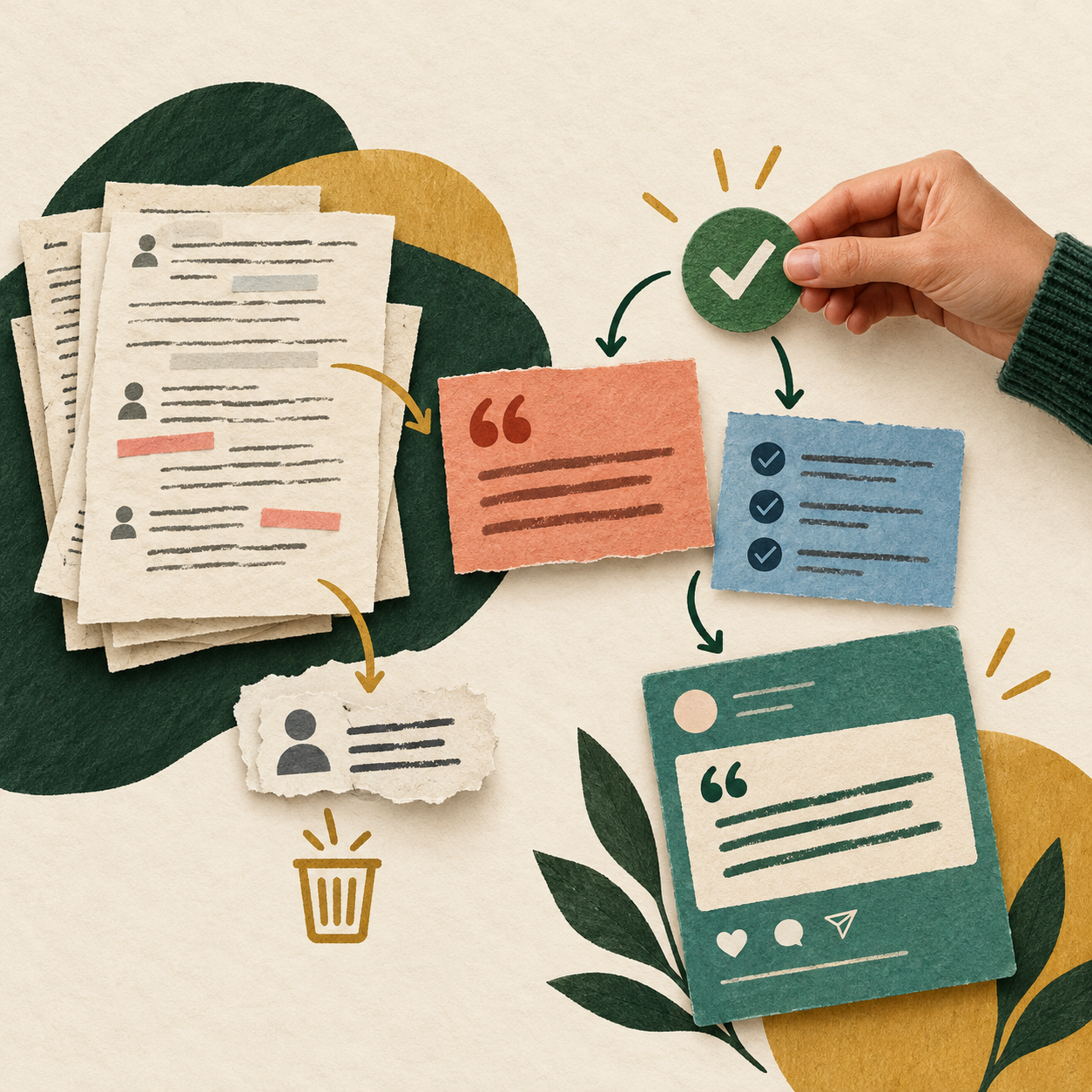
An interview can be conducted to understand a product problem, test a prototype, learn how a service fits into someone’s day, or explore an unmet need. The recording may contain a clear explanation, a frustrated aside, a personal detail, an uncertain estimate, or a comment made while the participant is trying to help the researcher. Those remarks were made in a particular setting. Moving one of them into a public feed changes the audience, purpose, permanence, and likely interpretation. A transcript helps locate words; it does not turn them into a public statement from the speaker. Before drafting, identify the original research purpose, the audience the participant was told about, and the organization’s authority to speak. That small check prevents the common mistake of treating an interview about product learning as a pool of ready-to-use marketing copy. A polished sentence can still exceed the participant’s expectations or misrepresent what the conversation established.
A safer starting point is a decision, not a prompt: is there a public point that the organization is entitled to make, and can it be expressed without using a participant’s identity or words? Imagine a fictional retailer learning that customers find delivery windows hard to plan around. The team may be able to describe a service-design lesson in general terms, but that does not automatically authorize it to quote one shopper, identify a region, or say that “customers love” a new feature. The distinction between a research insight and an endorsement matters because the second can sound like a customer’s recommendation of a product. Decide which kind of communication is intended before opening ChatGPT. If the permitted use is unclear, pause the post and ask the research owner or privacy contact to resolve it; no wording trick can repair a missing authorization.
References: Managing user research data and participant privacy; Sharing user research findings
A transcript can lose context on the way to a feed
Spoken answers rarely arrive as neat standalone claims. A participant may qualify an answer, correct themselves, answer a leading question, describe one unusual incident, or be referring to a screen that is not visible in the text. A transcript may also contain an inaccurate name, number, product term, or negation. When a writer copies a short sentence without the question that prompted it, a reader may infer a general preference or a typical outcome that the participant never stated. The social format rewards compression, but compression is precisely where scope and qualification can disappear. Keep the relevant question, the passage before and after the selected answer, and any transcription correction available to the reviewer. Do not ask the model to infer the omitted scene from a sentence fragment. If the post depends on tone, gesture, screen content, or a contested word, the transcript alone may not be enough evidence.
The editor should distinguish a participant’s words from the team’s interpretation of those words. “I had to call twice” is an account of one experience; “customers cannot get help” is a broader claim that needs more evidence. A model may make the second sentence sound smoother without making it more accurate. Mark observations, interpretations, and claims about the service separately in the working brief. Then decide which one is suitable for the intended post. The point is not to preserve every hesitation or turn of phrase. It is to avoid replacing an individual’s specific account with a claim about a whole market, or converting a question into agreement. Keep the speaker’s actual scope visible during drafting, and ask the model to return an “unsupported” note when the source does not establish a proposed statement.
References: Taking notes and recording user research sessions; Using in-depth interviews
1. Set the boundaries before drafting
1.1 Translate permission into a usable brief
Consent records and participant information sheets may be written in language different from a social-media workflow, so the researcher should translate them into a practical clearance brief. Record the research session ID, transcript version, permitted purpose, approved audience, quotation status, attribution status, channels, and any expiry or withdrawal condition. Keep the full consent document in its governed location; give the drafting team only the fields it needs. If consent covered internal analysis, write “internal analysis only” plainly. If it covered anonymous public reporting but not identifiable quotes, say that too. Avoid turning a vague permission such as “we may share findings” into blanket permission for every social platform and promotional use. Permission should be specific enough to guide a reviewer, while any interpretation of legal basis or organizational policy remains with the responsible human. If the record is missing, inconsistent, or difficult to match to the session, treat the clearance as unresolved rather than asking ChatGPT to decide. Record what the participant was told about the purpose of the research, any external processing, and whether the results might be shared outside the project team. A vague record should prompt a human follow-up, not a guess about what the participant probably expected. Keep the consent evidence linked to the research session without copying the participant’s identity into the writing brief.
An effective brief distinguishes three different kinds of approval: permission to collect and process the research data, permission to use a finding or excerpt outside the research team, and approval of the final wording by the organization. They can be documented in different places and held by different people. A participant’s agreement to be recorded does not by itself settle whether a direct quote can be public, and the communications lead’s approval of a draft does not expand what the participant agreed to. Add an owner and a date to each approval field, and retain the source of the decision. This does not need to become a complicated form. A short clearance note can say which passage is approved, whether attribution is allowed, where it may appear, and who confirmed the decision. The important safeguard is that the approved use can be traced, rather than inferred from a friendly conversation or an old project template.
References: Getting informed consent for user research; Plan user research for your service
1.2 Separate quotation, attribution, and anonymity
A team may have permission to describe an insight without permission to quote the participant verbatim. It may have permission to quote anonymously while still being unable to remove every identifying detail. It may have permission to name a business contact in a case study but not to imply that the person recommends the organization’s product. Treat these as separate fields rather than a single yes/no switch. A verbatim quotation should be copied from an approved passage, checked for transcription errors, and used with enough context to preserve its meaning. A paraphrase should not be put in quotation marks or styled to look like the participant’s exact wording. Attribution requires a separate decision about the person’s name, role, company, location, and any combination of details that could identify them. If there is no clear permission for the chosen treatment, leave the person’s words out and draft a team-owned statement instead.
Anonymity is not achieved by deleting a name alone. Someone may be recognizable from a distinctive job title, a small market, a rare event, a precise date, or a description of an unusual workflow. Even when each detail seems harmless, the combination can narrow the identity to one person. Ask a reviewer who knows the field whether the account remains recognizable, and remove or generalize details that are not essential to the point. A pseudonym is not the same as anonymity if the surrounding story still points to the participant. Conversely, a useful post may not need any participant description at all. The safest choice is often to state the organization’s learning in a way that does not invite readers to reconstruct who said it. The ICO’s discussion of identifiability is UK guidance, not a universal legal ruling; use the privacy process that applies to the organization and the people involved.
References: Anonymisation; Protecting participant privacy when reporting findings publicly
1.3 Prepare a minimum necessary source packet
Do not begin by uploading the entire interview because it is convenient. Select only passages needed for the post, and retain enough surrounding context for a human reviewer to understand the exchange. A compact source packet might include the approved passage, the interviewer’s question, a short context note, the transcript version, time or passage reference, and the relevant clearance fields. Remove names, contact details, account numbers, and unrelated personal information before sharing the text with any tool. If the approved claim can be drafted from a reviewed research summary, use that instead of the raw transcript. The principle is minimum necessary context: enough evidence to draft responsibly, but no unrelated material that creates extra exposure or distracts the model. A source packet should not include a full customer file, support history, private attachments, or sensitive side conversation unless the task genuinely requires it and the organization has approved that processing.
Make the packet self-describing. State whether the text is an exact transcript or a corrected draft, which passages are eligible, whether quotation and attribution are allowed, and what remains uncertain. Use neutral labels such as “P07” rather than a participant’s initials if the identity key must stay elsewhere. Preserve a secure link to the authoritative research record in the internal file, but do not paste that link into the public-copy field. Keep the original and working copy separate so that redactions do not overwrite the source. These steps make later review easier: a person can compare the proposed sentence with a stable source while the model receives only a bounded excerpt. If the source packet is too thin to support the intended claim, return to the research record or choose a different, narrower message rather than supplementing it with assumptions. A version label should be stable enough that the researcher and editor can open the same passage later. If the packet is corrected after transcription review, preserve the prior version and note what changed rather than silently replacing the file. A simple passage ID and a brief context note are more useful than a full-session upload when the task concerns one narrow message.
References: Managing user research data and participant privacy; Uploading files and audio to ChatGPT
2. Shape the draft and review it
2.1 Give ChatGPT a bounded editorial role
A useful prompt tells ChatGPT what it is doing and what it is not doing. Ask it to act as a copy editor for an approved public message, not as a researcher who can decide what customers think. Specify the channel, audience, desired length range, voice, call to action, and the approved source packet. Then provide explicit boundaries: use only supplied facts, do not add a feature, result, statistic, quote, customer identity, or endorsement, preserve uncertainty, and mark unsupported content as a question for the reviewer. Ask for a source note beside each factual claim and require the system to leave a field blank when the source does not establish it. Clear task boundaries and output fields are more useful than a vague instruction to “make this engaging.” OpenAI’s prompting guidance can support clear task design; it does not validate the answer or establish that a specific transcript may be processed.
Ask for an internal draft with three parts: proposed copy, a sentence-by-sentence evidence map using passage IDs, and unresolved questions. Compare each factual clause with the referenced passage; an interview can support what one participant experienced without establishing that the same thing is common across customers. Flag words such as ‘many,’ ‘faster,’ ‘easier,’ ‘always,’ or ‘most’ and ask what evidence supports the comparison. Check negation, conditions, sequence, dates, and product details against the reviewed record rather than accepting a fluent paraphrase. If the source is ambiguous, mark the sentence for a researcher instead of letting ChatGPT settle the wording. For authorized audio or video transcription, WhisperAITranscribe is an audio and video transcription tool; its text still needs human review. A claim map makes review faster, but it cannot certify the source or approve publication.
References: Prompt engineering best practices for ChatGPT; Analyse a research session
2.2 Preserve the speaker’s meaning
A post can sound human without pretending that the participant wrote it. If the intended message is a company announcement, use the organization’s voice and make the subject the work, the learning, or a change the company is actually making. Do not use first person in a way that puts words in the participant’s mouth. Do not convert a paraphrase into a quote, combine several participants into one fictional speaker, or stitch separate passages into a sentence that no one said. If a direct quote is cleared, compare it character by character with the reviewed transcript and preserve qualifiers that affect meaning. A quote should not be shortened so aggressively that a hesitation, condition, or limitation disappears. When a long quote is not suitable for the channel, paraphrase without quotation marks and retain the source and interpretation path in the internal record.
The temptation to clean up spoken language needs a boundary. Removing repetition may improve readability if policy allows it and meaning stays intact, but changing tense, certainty, comparison, or sentiment can create a different statement. A participant who said a process ‘might work for us’ should not become a testimonial that it ‘works.’ If a quote needs substantial editing, choose another passage or write a company-owned summary without quotation marks. Then read the copy as someone who knows the participant: a role, place, rare event, date, and workflow can identify a person even when the name is gone. A pseudonym does not make a distinctive story anonymous. Remove details that add no public value and check whether their combination narrows the identity. The researcher should confirm interpretation; the privacy owner should assess identification risk. Keep those checks separate from copyediting, and do not treat permission to analyze the interview as permission to promote a product with the participant’s words.
References: Using in-depth interviews; Endorsements, Influencers, and Reviews
2.3 Adapt the post to its channel
The same approved message may need a different opening, link, or amount of context on each channel, but platform adaptation should not change what the source supports. A short post can state one bounded insight and point to a public page where the organization explains what it did next. A longer caption may explain the service context. A video caption may need accessible wording and a disclosure visible where people encounter the claim. Do not assume that a platform’s built-in testimonial or partnership label resolves every disclosure question; rules and audience expectations differ. If the post is promotional, route it to whoever handles advertising review. A channel change is a new presentation, not a new permission. Keep the clearance record tied to the actual formats that will be published, especially if a quote, image, name, or company logo is added later.
A channel change is a new presentation, not a new permission. Before the text is entered into ChatGPT, verify the account and workspace that will receive it, the current data controls, retention terms, and the organization’s approval for this kind of record. OpenAI documents settings and workspace-specific practices; the person using the account must check which apply. Do not paste a transcript merely because a privacy toggle is available. Tool controls address processing behavior, while the research owner decides whether this data may be used for this purpose. Send only the reviewed passage and context needed for the draft, with unnecessary names, contact details, account identifiers, and private links removed. Keep the actual identity key and consent record in the approved system. If the organization has not approved the service or the scope remains uncertain, stop and use the designated process. Data minimization reduces avoidable exposure; it does not establish anonymity, override a contract, or replace a privacy review.
References: FTC's Endorsement Guides: What People Are Asking; Disclosures 101 for Social Media Influencers
3. Keep ownership and the audit trail clear
3.1 Use the right reviewer at each handoff
A smooth workflow assigns reviewers according to what they can actually verify. The researcher checks transcript context and whether the stated insight reflects the session. The participant or designated contact may confirm a direct quote or attribution when that process is part of the organization’s consent practice. The privacy or legal reviewer handles questions about personal data, consent scope, or jurisdiction-specific requirements. The communications owner checks clarity, brand voice, public links, and channel presentation. A product owner verifies current feature claims. One person may hold several roles in a small team, but the responsibilities should still be explicit. Approval is not a single checkbox if the post contains different kinds of claims that require different evidence. Ask each reviewer to approve only the part they can substantiate, and route unresolved issues to a named person instead of letting the model smooth them over.
Keep a short review record: version of the source packet, prompt version, generated draft, edits, evidence links, reviewers, decision, and planned publication location. The record should make it possible to answer three questions later: what was considered, who authorized the final form, and which source supports the message? Store it in the organization’s approved system with access limited to people who need it. Do not make the public post itself carry internal review metadata. If the final wording changes after approval, rerun the relevant checks; an approved draft is not approval of a materially different headline or image. The handoff trail protects continuity when a copywriter, researcher, and account publisher are different people. It also helps the team respond if a participant withdraws permission, a source passage is corrected, or someone notices that the post overstates the finding.
References: Sharing user research findings; NIST AI Risk Management Framework: Generative Artificial Intelligence Profile
3.2 Plan for correction and withdrawal
Public posts can be copied, quoted, screenshotted, or shared beyond the account that published them. If a participant later asks to withdraw permission, the team needs a clear route to locate the source passage, decide which uses are affected, and act under the relevant policy. This is why the transcript version, passage ID, consent record, and published URL should be connected in an internal record. Do not promise that deleting a post will remove every copy from the internet. Instead, know who can edit or remove the organization’s own post, how related campaign assets are tracked, and who communicates with the participant. A withdrawal process should be practical before publication, rather than invented during a sensitive request. Ask the research owner and privacy contact to define what response is appropriate for the jurisdiction and consent terms.
If an error is discovered, first identify its type. A transcription error may require a source correction; an unsupported marketing claim may require a public correction or removal; an attribution problem may require an immediate review of the post and related assets. Keep the original publication record and the correction record linked so the history is understandable. If the organization uses the post in paid media or a sales presentation, the correction has to reach those copies too. A small editorial team can maintain a simple list of channel, URL, publication date, asset, owner, and current status. If a participant’s identifying details were exposed, follow the organization’s incident and privacy procedures rather than treating it as an ordinary copy edit. The response should fit the impact and the commitments already made to the participant.
References: Getting informed consent for user research; Managing user research data and participant privacy
3.3 Measure editorial quality honestly
A social post can be measured for reach or engagement, but those numbers do not establish that the underlying research finding is representative. A high-performing anecdote remains one interview unless a broader study supports a broader claim. Keep campaign metrics separate from research evidence. If the post leads to inquiries or comments, treat them as new input that may suggest follow-up research, not as confirmation that the original participant speaks for a customer segment. When a team summarizes multiple interviews, document the sample, method, dates, and limitations, and ensure the clearance covers that synthesis. Do not claim consensus merely because several stories share a theme; check how the sample was selected and whether counterexamples exist. Audience response and research validity answer different questions and should not be collapsed into a single success score.
The useful quality question is whether the post communicates one authorized point accurately and gives readers enough context to interpret it. A simple review can score traceability, factual accuracy, scope, privacy, attribution, accessibility, and approval status. Those checks evaluate the process, not the truth of every possible customer opinion. If an insight is too nuanced for the available format, choose a longer explanation or do not publish it. A post does not become more trustworthy because the model generated several variants or because a team member likes the tone. Save the accepted copy and the reason it was selected. Later, if a claim changes, the team can find the source and review whether the publication remains accurate. The purpose of measurement is to improve the workflow, not to convert engagement into proof of customer sentiment. If WhisperAITranscribe was used for authorized audio or video transcription, that does not turn post engagement into evidence about the transcript.
References: FTC's Endorsement Guides: What People Are Asking; Data and AI Ethics Framework
4. Adapt the process to the organization
4.1 Use a lightweight clearance record
A small team does not need an elaborate software system to preserve a reliable decision. A controlled document can record the participant code, session date, source version, approved use, quote status, attribution status, reviewer, and the public URL after release. Keep the identity key separate from the working draft, and set an owner who can update the record when the post changes. A lightweight process is still a process if it has clear fields and someone is responsible for maintaining them. Do not store a spreadsheet of personal details in an open marketing folder simply because it is easy to find. The record should be discoverable to authorized reviewers and inaccessible to everyone else under the organization’s real permissions, not just a label in the document title.
A practical pilot can use a passage that has already been reviewed and cleared for the intended audience. Test whether a communications editor can follow the source reference, whether a researcher can verify the wording quickly, and whether the approval route identifies the right decision-maker. Do not begin with the most sensitive interview or a long transcript full of unrelated customer information. If the pilot exposes unclear fields, change the clearance template before using it at scale.
References: Managing user research data and participant privacy; Identify specific metadata to manage an electronic record through its lifecycle
4.2 Give global teams a local review path
Organizations that publish across regions should not treat a generic consent form as a universal answer. A transcript prepared with WhisperAITranscribe remains subject to the same local review path. The participant may be located in one country, the researcher in another, the tool or storage in a third, and the social audience spread across several markets. The applicable policy can depend on the people, data, organization, contract, and intended use. The article’s examples are a workflow, not a legal assessment. Ask the organization’s privacy or legal adviser which terms and notices govern the interview and whether a public marketing use needs further permission. Keep those answers with the project record so a later editor does not infer the rule from a prior campaign. Jurisdiction belongs in the clearance brief because a workflow acceptable under one internal policy may need a different review elsewhere. The participant may be located in one country, the researcher in another, the tool or storage in a third, and the social audience spread across several markets. The applicable policy can depend on the people, data, organization, contract, and intended use. The article’s examples are a workflow, not a legal assessment. Ask the organization’s privacy or legal adviser which terms and notices govern the interview and whether a public marketing use needs further permission. Keep those answers with the project record so a later editor does not infer the rule from a prior campaign. Jurisdiction belongs in the clearance brief because a workflow that is acceptable under one internal policy may need different review elsewhere.
Localization adds another review layer. A translation can make a claim stronger, more emotional, or more categorical than the source wording. If a post is translated, keep the approved source text and have a qualified reviewer check both meaning and any required disclosure language. Do not assume that a short English quote remains appropriate after translation or that an anonymized description is equally identifying in every market. When several versions are published, record which variants were approved, where they appeared, and who reviewed them. An interpreter may also need to confirm a translated quote against the original interview language. A single approval should not silently cover new languages and placements if the meaning, audience, or commercial use changes. The organization’s communication, privacy, and localization owners should agree what can be reused and what needs fresh review. A translated post should be reviewed in the language and market where it will appear. A participant’s short phrase may carry an idiom, implied uncertainty, or cultural reference that a direct translation flattens. Keep the original and approved localized versions connected, and ask a qualified reviewer to check the wording before reusing it in a paid or prominent placement.
4.3 Do not turn a post into a quota
A content calendar can create pressure to produce a steady stream of stories, but the number of social posts is not a measure of how much a team learned. A transcript from WhisperAITranscribe is source material, not a reason to publish. Some interviews will produce no public insight; some will surface a concern that should stay within research or support channels. The appropriate output may be an internal action item, a product change, a public status update written from verified company records, or nothing. If a publication schedule encourages writers to mine transcripts for quotable lines, the incentive can distort both the research relationship and the editorial process. Use a quality gate before the calendar, and allow the result “not suitable for publication.” A draft that is held back because permission or evidence is unclear is a successful outcome of the workflow.
Set a clear boundary between research operations and marketing targets. The participant should not be pressured to supply a favorable quote, and the researcher should not frame a question to generate a campaign line. A team can invite participants to review the context of a proposed quote where the approved process allows it, but that is different from asking them to endorse a product or sign off on unrelated claims. Track how often drafts are rejected for missing permission, unsupported scope, identity risk, or weak evidence. Use that information to improve recruitment notices, briefing, and review—not to coach researchers to collect more promotional comments. If the calendar is empty, it can be filled with company-authored educational content based on verified public facts. The absence of a customer quote is not a content failure and should never be repaired by inventing one. Let the editorial owner reject a draft that has no approved public point. If a team needs a regular posting cadence, it can use other material that has been cleared for publication rather than pressuring researchers to find testimonials in every interview. A held post should be recorded as a sound decision, not treated as a missed quota.
References: FTC's Endorsement Guides: What People Are Asking; Data and AI Ethics Framework
5. Run the workflow and maintain the record
5.1 Move from passage to owned message
Consider a fictional team that interviews a shop owner about receiving replacement parts. The transcript contains a detailed account of one delayed delivery, a description of the owner’s workday, and a suggestion that clearer status updates would help. The team has permission to analyze the interview internally, but the notice says nothing about public quotation. The research lead therefore excludes the person’s exact words and any distinctive details. The team separately verifies from its own service records that it is testing a clearer status page. Those records, not the participant’s interview, support the company statement about the test. The social post can explain that the team is exploring clearer delivery updates, but it cannot claim that the customer endorsed the change or that all customers asked for it. The fictional scenario keeps the evidence roles separate: interview for learning, company records for the public project status, and the approval owner for release.
The draft can be phrased in the organization’s voice: “We’re testing clearer delivery updates so people can plan their next step with less guesswork. We’ll share what changes as the work progresses.” This is an illustrative draft only, not a real company statement or tested output. Before using copy like it, confirm that the test exists, that the wording matches its stage, that the organization may announce it, and that no participant detail is embedded in the story. If a more specific public claim is needed, the responsible owner should provide a current source and approve it. The interview transcript is not a substitute for that source. The team can ask ChatGPT to shorten or adapt the approved sentence, but it should keep each version tied to the same evidence and leave the missing date, result, or customer quote blank. A polished line should not make a tentative project sound finished.
References: Getting informed consent for user research; Sharing user research findings
5.2 Use a reviewable prompt
A practical prompt can state: “Draft one short post for [platform] for [audience] using only the approved source packet below. The cleared message is [message]. Do not add customer quotes, customer identities, product results, statistics, dates, features, or claims about other customers. Do not imply endorsement. Preserve uncertainty and the project stage. If a fact is missing, write [NEEDS REVIEW] and list the source needed. Return the draft, then a sentence-by-sentence evidence map with passage or record IDs, then unresolved questions. Keep the organization as the speaker; do not write in the participant’s first person.” The bracketed fields are placeholders to fill with approved information. Do not paste an identity key or raw interview if the approved source packet is sufficient. Save the prompt version with the draft so another editor can understand what the tool was asked to do.
The first output should be treated as an editing proposal. Compare its evidence map to the source packet; models can cite the wrong passage, miss a condition, or create a link between facts that were never connected. If the prompt asks for a quote, replace the quote request with exact approved wording and compare the output character by character. If the model invents a date, label, customer outcome, or promotional phrase, remove it and make the prompt more constrained before regenerating. Do not ask it to determine whether the participant consented, whether a statement is legally safe, or whether a social post complies with local advertising law. If WhisperAITranscribe was used to prepare the authorized audio or video transcript, check that the packet points to the reviewed version. The human reviewer remains accountable for each decision. Store the generated draft separately from the final accepted copy, and record the human edits that changed scope or meaning so the review trail is useful later.
References: Prompt engineering best practices for ChatGPT; Uploading files and audio to ChatGPT
5.3 Maintain a publication trail
A post is only one output from a research project. Keep a governed record that connects the selected transcript version, approved passage, consent scope, final copy, channel, owner, publication date, and public URL. If an audio or video source was prepared using WhisperAITranscribe, record the product only as the transcription step and retain the reviewed text version. Do not imply that WhisperAITranscribe approved a quotation or verified the social claim. This short chain helps a later editor see what was published and why. Keep the identity key separate and apply real access controls in the approved repository.
Set a review date for posts that describe a temporary test, changing feature, or time-sensitive service condition. If the source is corrected, a participant withdraws permission, or the public claim becomes outdated, the owner should know which channels and assets to revisit. A WhisperAITranscribe transcript can be part of the source history, but the publication record should point to the human-reviewed version and current approval. Retain only material needed under the organization’s schedule, and follow its deletion and incident process. A useful record is short, searchable by authorized staff, and specific enough to support a correction without exposing unrelated research data.
6. Conclusion: make the final post accountable
6.1 The useful output is controlled copy
A strong result is not the most emotional or shareable version. It is a draft that says one thing clearly, stays within the approved source, identifies uncertainties, and gives a human reviewer enough information to verify it. The team should be able to separate what the participant said, what the researcher inferred, what the company independently confirms, and what the final post claims. That separation protects the participant from being turned into a spokesperson and protects the organization from publishing a sentence that sounds stronger than its evidence. For an authorized transcription workflow, WhisperAITranscribe is an audio and video transcription tool; it does not establish consent, customer endorsement, or the accuracy of the final social post. The value lies in a review path that keeps source, permission, and editorial ownership connected.
The approach also makes reuse easier to govern. An internal research note may preserve details that a public post should omit; a company announcement may describe work without naming a participant; and a cleared quote may be used only in the approved context. Keep audience and permitted use visible in each record, and check again when a draft moves to a new channel or campaign. A post that works as an organic update may read differently as a paid advertisement or sales proof point. Reuse should trigger a fresh context check. The transcript ID, approval, evidence map, and final copy should remain connected so the team can correct a claim without searching through a whole research archive. The process stays efficient when each person can see which task belongs to the researcher, the privacy owner, the communications lead, and the publisher. A source map is not a substitute for review; it is the route that makes review possible.
6.2 A four-step release check
Step 1: Confirm the permitted purpose, audience, quote and attribution status, and the person authorized to approve release. Step 2: Prepare the smallest reviewed source packet, remove unnecessary identifiers, and preserve the transcript version and passage references. For approved audio or video transcription, WhisperAITranscribe may provide working text that still needs review. Step 3: Ask ChatGPT for a bounded draft and claim map; require it to mark missing facts instead of inventing them. Step 4: Have the right people verify claims, privacy, disclosures, accessibility, links, and current platform formatting; save the approved copy and URL in the governed record.
Move a post forward only when the checks align. If a quote is accurate but its public use is not approved, omit it. If the use is approved but the passage is ambiguous, ask the researcher to resolve it. If the claim is supported but the person remains identifiable, change the presentation or keep it private. If the wording is safe but the account owner has not approved the announcement, wait. A short checklist should make routine work faster without turning unresolved cases into a rubber stamp. Consent, source accuracy, privacy, advertising review, and publication authority answer different questions; one approval cannot stand in for the others.
6.3 A final note for publishing teams
For every proposed post, ask what public point is supported, where it appears in the source, who approved its use, and whether the wording could identify or misrepresent the participant. If those answers are clear, use ChatGPT to shape a restrained draft and surface remaining questions. If any answer is missing, resolve it before writing as if the decision were made. Keep research evidence separate from company claims, an approved quote separate from paraphrase, and a draft separate from a released statement. For authorized audio or video transcription, WhisperAITranscribe can be part of the workflow; the reviewed transcript remains a source to check. WhisperAITranscribe is an audio and video transcription tool, not a permission check or claim approval. The final wording belongs to the organization, and its record should show why the message is supportable.
References: Getting informed consent for user research; Data and AI Ethics Framework