
Introduction
Choose the recording you actually need to describe
A Riverside session can leave several useful artifacts, and they need not answer the same question. An editor may need each participant's individual source to examine an interrupted answer. A producer preparing a reading transcript of the published episode may need the final edit, including its cuts and chosen sequence. A researcher may need the unedited exchange and a clear record of who was present. Begin with that intended use before choosing the most convenient download. A polished short clip can be a complete source for a description of that clip while remaining incomplete evidence for what happened during the full interview. Conversely, a folder of individual recordings can preserve the conversation's components without supplying a ready-made continuous listening version. The useful export is the one whose coverage and timeline support the recipient's actual task, with enough context to explain what was selected.
Name the reference version before transcription starts. Identify the session, the participants required for the task, and whether the source represents a full recording or an edited selection. Keep the downloaded originals distinct from later working files. That small decision makes corrections much easier: a reviewer can identify which source contains a disputed answer instead of searching several nearly identical episode names. It also prevents a common timing mistake. A timestamp in a participant's raw file may start from that participant's own recording, while a timestamp in an assembled episode starts from the episode's beginning. Neither is inherently wrong. Trouble begins when a document gives one coordinate without telling the recipient which recording to open. Use a source label that remains meaningful after the files move away from the dashboard where their relationships were initially obvious.
References: Riverside high-quality tracks, W3C transcript guidance.
What the timing example establishes
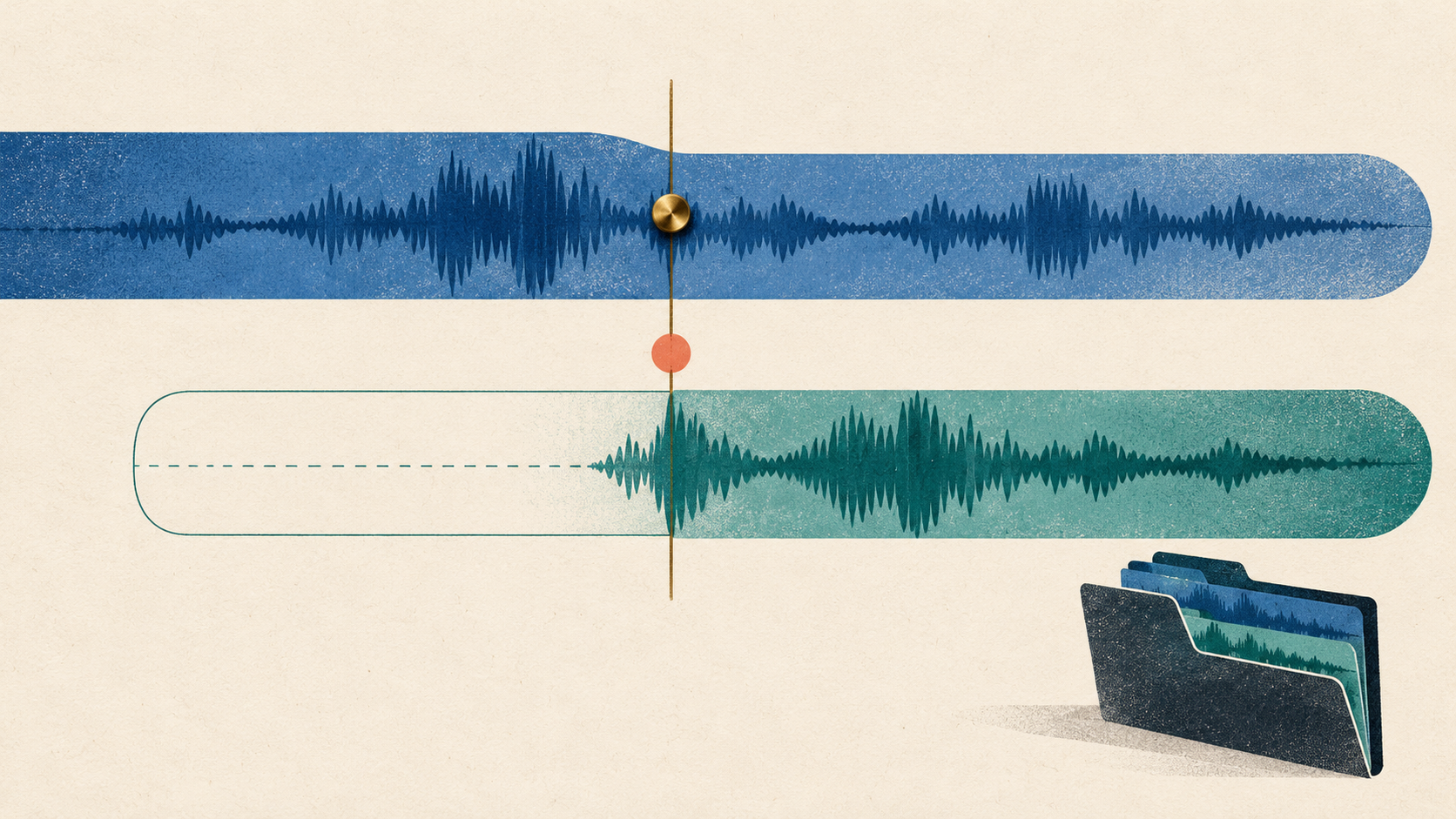
The worked example in this article is an authored timing worksheet, checked with integer arithmetic. It contains no recorded speech and is not a Riverside account or editor test. The host's track covers a ten-minute session. The guest's raw recording begins ninety seconds into that session and lasts six minutes. A screen reference begins later again. These defined relationships let us test time conversion, parallel versus sequential placement, overlapping intervals, an incomplete guest source, and the effect of two removed sections. Eleven checks pass under those authored conditions. They demonstrate how a chosen relationship behaves; they do not discover the relationship in real files. Actual alignment still requires the relevant source information and inspection of the recording. A plausible timestamp calculation cannot establish who spoke or prove that a quiet interval contains no important words.
That distinction keeps the example useful. The guest's passage at raw time 00:15 maps to session time 01:45 because the worksheet explicitly defines a ninety-second start offset. An already aligned source uses its own established origin; adding another ninety seconds would put the same passage at 03:15. Both numbers are easy to calculate, so arithmetic alone cannot tell a reviewer which operation the source needs. The source relationship chooses the calculation. Later, an edited version removes material from two places. Its mapping works differently again, and a passage inside a removed interval has no corresponding position in that edit. Those are practical reasons to retain the selected file and its preparation history. The official instructions explain the available recording types; the local worksheet shows how an incorrect assumption can move an otherwise accurate piece of text.
References: Riverside raw and aligned tracks, W3C transcribing guidance.
1. Select the Source Before Downloading
1.1 Match the export to the question
Establish the session identity, intended document, required participants, source version, selected coverage, time origin, and review purpose. These decisions need not produce a complicated inventory. For a finished podcast episode, the intended document might simply be a reading transcript of one named final export. For an interview analysis, it might require the host and guest's separate sources across the complete discussion. The difference matters when a later edit removes an interruption or rearranges an answer. A transcript can faithfully represent either source, but it should not silently move between them. Decide what the reader needs to verify and obtain the files that support that use. A short source reference beside the transcript often prevents more confusion than trying to reconstruct the version from a familiar title after several files have been circulated.
A download decision should also distinguish the recording from materials used around it. A presentation, shared clip, production note, and participant microphone track have different roles. One may help interpret a term without containing the speaker's actual voice. Another may be part of the edited episode but outside the interview exchange being analyzed. Retain those relationships where relevant instead of treating every file in a project as an interchangeable transcript source. If the question concerns a particular answer, preserve the question and the response needed to understand it. If the question concerns the published edit, use that edit rather than infer its contents from the existence of the original tracks. This is a scope decision, not a judgment that one source type is always better. The appropriate choice follows what the final text is expected to describe.
References: Riverside edited exports, W3C transcript guidance.
1.2 Know which recording family you selected
Riverside distinguishes local participant tracks, cloud recordings, individual sources, combined sources, and edited exports. Its help material explains that high-quality participant tracks originate on the participants' devices before upload, while cloud recordings capture the live call over the internet. An edited export is another selected representation. These distinctions explain why two downloads from one session should not automatically be treated as duplicate copies. The choice can affect coverage, preparation, and the timeline the recipient should use. Keep the artifact's role with the file, especially if the team uses a cloud recording while another source is still becoming available. A backup can be useful for a bounded task without establishing that it is identical to the eventual local track. The source should identify which representation actually supplied the transcript.
Avoid ranking every available file by a single label such as best. A source that is useful for investigating one person's wording may be inconvenient for following a complete overlapping exchange on its own. A combined source may be easier to review while giving less separation between microphones. An edited version may be the correct publication reference even when an unedited recording contains more material. Choose the needed representation, then inspect whether it contains recognizable speech and the relevant context. A format or recording-method label does not establish the accuracy of a transcript produced from it. If two versions disagree in a passage, compare the actual sound and preparation rather than assume the more attractive filename settles the matter. A stable source decision helps the team investigate the specific difference without replacing every artifact in the project. For example, a preview used to decide whether an interview is worth editing and the source used to verify a quotation have different immediate jobs. Keep the preview useful for its bounded purpose. When the quotation matters, locate the appropriate recording rather than let an early convenience choice become the permanent reference by accident. The project does not need to abandon its preliminary notes; it needs to identify which statements have subsequently been checked against the selected source.
References: Riverside cloud recordings, Riverside high-quality tracks.
1.3 Check availability participant by participant
Distinguish recording stopped, upload completed, processing completed, download available, and coverage obtained. Riverside's status guide describes recording, uploading, processing, and ready states, and notes that different participants can be at different stages. A completed host track does not establish that the guest's file is ready or complete. Inspect the participants required for the selected task. When a track is still uploading, follow the relevant completion guidance instead of treating an early available source as proof that the whole session has arrived. The right next step depends on the unresolved state. Waiting for processing, helping a guest complete an upload, and reviewing a downloaded recording are different actions. Keep the observation precise enough that a teammate can tell which action is needed, rather than describe every delay as a failed transcription.
A coverage check remains necessary after availability is resolved. In the authored worksheet, the guest should cover session seconds ninety through four hundred fifty. A deliberately incomplete version stops at second three hundred thirty, leaving two minutes of the intended guest span unavailable. The host's complete ten-minute track does not erase that gap in the guest source. It may contain relevant audible material, but that would need inspection rather than an assumption. Record which source supports the currently usable work and which part remains unresolved. A narrow transcript can proceed when its required material is available; a claim about the entire exchange needs the wider coverage. This approach avoids both unnecessary delay and an overly broad completion label. The project can use what has actually been obtained while retaining the specific missing interval as an acquisition or review question. Do not infer missing coverage from silence alone. A participant can remain quiet while present, and a recording can contain an interval without intelligible contribution. Likewise, an audible response in another microphone does not establish that the requested individual source was obtained. Describe the observation that the evidence actually supports. The handoff may contain a complete host file, a partial guest file, and a usable combined reference, each with a different role in the remaining review.
References: Riverside recording statuses, Riverside incomplete guest uploads.
2. Obtain the Files and Preserve Their Roles
2.1 Download the selected participant tracks
Preserve the project reference, recording session, participant identity, downloaded format, and local source copy. Riverside's current computer instructions lead through the relevant studio and project to Recordings, then the participant's track download and format choice. Use the options actually available to the account and session; the help page qualifies individual-track availability by the account's allotted download hours. This is not evidence that every account has the same allowance or that a missing option can be fixed by renaming a file. Obtain the chosen artifact through the supported route, then inspect the local result. Keep a useful connection between each file and its participant rather than move several same-looking downloads into one directory and rely on recollection. The transcript's later source labels should come from that established mapping.
WhisperAITranscribe is an audio and video transcription tool that can be considered after suitable media has been obtained and its available input conditions checked. This article does not test a Riverside integration or establish native multitrack assembly through the service. The handoff starts with the chosen recording files. If the workflow processes individual sources separately, preserve their identities and time origins with the resulting text. If it uses a prepared combined source, retain how that source relates to the selected tracks. Those relationships make the output useful even when the final reading document uses simpler labels. A person checking a sentence should be able to identify its source without knowing which project panel the producer opened. The acquisition record supplies that context; recognition output alone does not reconstruct it reliably from an episode title. Use filenames that preserve a stable participant reference when the original labels are ambiguous, while retaining the downloaded originals. If the reading transcript uses a simpler speaker name, keep the mapping in the project record. The purpose is to make the relationship portable: a collaborator receiving the folder should understand which source supports each text section even without access to the original dashboard. Renaming can improve that handoff, provided it does not erase the only surviving link to the acquired recording.
References: Riverside recording downloads, W3C transcribing guidance.
2.2 Inspect the actual audio representation
A useful format decision considers audio encoding, channel layout, sample rate, receiving conditions, and required preparation. Riverside's high-quality-track documentation identifies its raw WAV audio as linear PCM with a documented bit depth. That is a specific description of the offered source, not a promise about every file called WAV elsewhere. It also does not establish which file conditions another service accepts. Inspect the downloaded artifact and choose a supported route for the receiving workflow. A compressed alternative can serve a practical purpose, but another conversion should solve an actual requirement rather than function as a ritual before every transcript. Preserve the original download when preparing a derivative. If an error occurs, a clear distinction between the obtained source and the prepared file makes it possible to investigate what changed.
Do not treat encoding choice as a substitute for reviewing the sound. A technically ordinary file can contain a microphone problem, an interrupted word, or a participant who is audible mainly through another microphone. Conversely, a larger uncompressed file does not establish correct attribution or preserve a sentence omitted from the selected edit. Use the representation that supports the task and inspect the relevant content. If a conversion changes channel handling or timing, verify the resulting media before carrying transcript references forward. If it simply satisfies a necessary receiving condition, retain that purpose in the working record. The recipient needs enough information to distinguish a file-preparation issue from uncertain wording. Repeatedly exporting a different format adds little when the original source is complete and the actual unresolved question is what one speaker said at a particular moment.
References: Riverside high-quality tracks, MDN audio-codec guidance.
2.3 Keep the episode export distinct from its ingredients
Track the individual originals, assembled episode, deliberate cuts, and processing choices as separate roles. Riverside's edited-export instructions provide an audio or video download route with selectable options. A resulting episode can legitimately represent a different selection from the individual session recordings. Preserve the exact export used for its transcript, especially when editing continues after a first version has been circulated. A familiar episode name does not establish that two downloads contain the same sequence. Nor does the fact that a project contains all participant sources establish which portions entered the final export. For a published-episode transcript, the delivered media is the immediate reference. For an analysis of the original interview, preserve the source set and context beyond the edit where the question requires it.
Comments and production instructions also need a separate handoff. The edited-export help page explicitly notes that comments are not saved into that export. A note explaining a disputed name therefore needs an appropriate document or review channel if the recipient is expected to use it. Keep the note distinct from words heard in the recording. The same principle applies to an editorial decision about removing an answer, retaining an interruption, or correcting a title in accompanying copy. A media file and a project discussion are different artifacts. Passing one does not automatically pass the other. Identify which reviewed document carries those decisions and which version of the recording it concerns. That prevents a downstream writer from inventing the missing context or assuming an instruction became part of the speaker's actual sentence.
References: Riverside edited exports, Library of Congress audio preservation.
3. Keep Raw Time and Session Time Distinct
3.1 A participant's file can have its own beginning
The key relationship is among raw-file time, session time, and the established start offset. In the worksheet, the guest begins ninety seconds after the session starts. A passage fifteen seconds into that guest source belongs at ninety plus fifteen seconds, or 01:45 in session coordinates. The raw reference 00:15 remains correct when the recipient opens the raw guest file. The session reference 01:45 is useful when the recipient opens a correctly assembled session source. Label the coordinate the document uses. An unlabeled timestamp creates extra work because the reviewer must guess which timeline supplied it. In a short passage that can be annoying; across many participant files, it can make a correct transcript appear systematically wrong even though the words themselves have not changed.
The offset in this example is defined by the worksheet. Real files require their actual relationship to be established from appropriate source information and reviewed reference points. Do not infer it solely from a participant's name, a matching file duration, or a recollection that someone joined late. If there is uncertainty, retain it as a mapping question until the evidence resolves it. A useful handoff can state that the text currently uses the raw participant file's local time. That is more actionable than supplying a confident session coordinate derived from an unsupported offset. A later alignment decision can update the mapping without rewriting the spoken words. Keeping those decisions separate also helps when the same passage is needed in both an unedited archive and an edited episode with another timeline entirely.
References: Riverside raw and aligned tracks, W3C transcript guidance.
3.2 Avoid adding the same padding twice
Alignment padding changes the relationship between file beginning and recorded contribution. Riverside explains that an aligned version can include leading space to position the contribution on the shared timeline, with conditions and device limitations described in its help pages. The practical question is whether the chosen file already contains the relevant placement. In the authored example, an aligned representation places the guest passage at file time 01:45. Adding another ninety seconds moves it to 03:15 and applies the same offset twice. Taking the raw 00:15 reference as session time makes the opposite error. Both failures preserve a plausible-looking timestamp. Resolve which artifact supplied the timing before adjusting it, and keep that choice with the transcript. A calculation should implement the source relationship rather than create an unverified relationship of its own.
A second padding decision arises when the available source is not the type the editor expected. Riverside's aligned-audio guidance explains the audio-only recording condition and describes using an aligned video reference when positioning raw WAV audio in an offline editor. Its broader guidance also qualifies padding availability for app-recorded tracks. Follow the actual source conditions instead of assuming that every downloaded participant audio file is already padded. If an editor creates a new aligned working version, preserve the original and document the established offset. Check the resulting placement at relevant points. This article has not performed that editor operation or measured a Riverside file. The worksheet shows why the choice matters; the actual session needs its own evidence. A source with no alignment padding is not automatically damaged or incomplete because it begins with the participant's recorded contribution. Also distinguish the first recorded instant from the first audible word. A participant can have recorded silence before speaking, so finding the first visible waveform peak does not automatically reveal the start offset. Use the actual relationship and an appropriate reference passage. If the recipient trims that initial silence for a separate purpose, the trimmed derivative needs another origin. Keep that editorial choice visible instead of silently applying the old raw-file coordinates to the newly shortened media.
References: Riverside aligned-audio guidance, Riverside raw and aligned tracks.
3.3 Parallel tracks belong on a shared timeline
Distinguish simultaneous coverage, sequential coverage, and selected listening duration. The worksheet's host covers ten minutes, while the guest covers six minutes within that same session. Placing one complete file after the other creates a sixteen-minute sequence. That does not represent the defined ten-minute conversation. The guest's contribution belongs at the established offset alongside the host, rather than after the host's ending. This is a different problem from joining sequential parts of a single recorder session. The files may have familiar extensions in either case, but their source relationships require different preparation. Decide whether files are parallel contributions, consecutive segments, or alternatives before assembling them. A successful file operation cannot establish that the resulting sequence represents the exchange the recipient intended to review.
If the separate sources are processed through WhisperAITranscribe under the available workflow, preserve their relationships when combining reviewed text. Do not simply append the guest's transcript after the host's because that is the order in which the files were processed. A host question and guest answer may need interleaving on the shared session timeline. Overlap can also matter: the worksheet defines one host event from seconds 103 to 108 and a guest event from 105 to 109, producing three seconds of intersection. This is authored timing, not measured speech or speaker identification. It demonstrates that two file references can legitimately concern the same moment. The eventual document should preserve the order and attribution supported by the actual recording. A clean reading layout can simplify presentation while retaining enough references to review an interruption or simultaneous remark. For a conversation document, preserve the question and response relationship before polishing the layout. Grouping every sentence from one participant together can turn an exchange into separate monologues. Sorting solely by the order of completed transcription jobs creates a similar problem. The reviewed timeline gives the material its conversational position. When overlap is relevant, use a suitable convention that preserves the supported relationship rather than force every contribution into a falsely precise sequence merely because a reading document usually advances one paragraph at a time.
References: Riverside high-quality tracks, W3C transcribing guidance.
4. Preserve Meaning When Preparing a Listening Version
4.1 An individual microphone is evidence, not an identity guarantee
Keep participant metadata, audible voice, source attribution, and reviewed wording in their proper roles. An individual track's participant label helps locate its source, but it does not independently prove that every audible word belongs to that person. A microphone can capture another voice, and an exchange can contain overlap or an off-microphone response. Inspect what is actually audible before assigning a statement to a named speaker. The appropriate review depends on the material and the consequence of an error. A reading transcript of a casual episode may use simple labels, while a passage used for quotation needs a more careful attribution check. The existence of separate tracks is useful evidence about recording structure; it is not a substitute for reviewing who spoke the important words.
A listening copy should help answer that question rather than hide it. If a prepared source uses one participant's microphone, state its coverage and examine whether the needed reply is present. If it combines several tracks, inspect the relationship at an interruption or transition rather than assume that a continuous waveform establishes conversational order. Keep unresolved attribution visible in an appropriate transcript convention instead of selecting the most plausible name from the episode description. Context can guide the review but should not be inserted as recorded speech. The worksheet cannot test voice identity because it contains no voices. Real attribution requires the actual sources and any relevant supporting evidence. That boundary makes the final text more useful: a reviewer can distinguish a confirmed speaker label from a source-file label or an unresolved passage.
References: W3C transcribing guidance, W3C transcript guidance.
4.2 Keep raw, aligned, and edited references recognizable
A file prepared for WhisperAITranscribe should retain its recording identity, participant set, source type, time origin, coverage selection, and review reference where those relationships affect the task. A short label can carry much of this information without burdening the reading transcript. For example, a document can say that its timestamps refer to the selected final episode, while an accompanying source note maps that episode to the original session. Another document may use individual raw-track references because that is what its reviewers will open. Choose one clear convention for the intended document. Mixing raw participant time and edited-episode time without labels can make successive passages seem out of order. The words may be accurate, yet the references direct the reader to unrelated moments in another version.
When an edit changes the sequence, preserve more than a single start offset if the task requires reliable cross-version timing. The worksheet keeps session seconds sixty through three hundred and three hundred thirty through six hundred. It removes the first minute and a later thirty-second section, leaving eight minutes thirty seconds. Session time 01:45 maps to edit time 00:45, while session time 06:00 maps to 04:30. Subtracting only the first minute would put that later passage at 05:00, which is thirty seconds late. The example does not test editing software; it shows why one offset can become insufficient after another cut. A passage removed from the selected edit needs a source reference elsewhere, rather than a fabricated timestamp in a version that no longer contains it. This also changes how corrections should be reported. A reviewer who says that a quotation is missing may be opening a different edit rather than discovering a transcription omission. Establish the source version before changing the words. If the quotation belongs only to the unedited session, identify that source explicitly or reconsider its place in a document describing the published episode. The correction should resolve the mismatch between the document and its intended reference, instead of placing accurate words into a version where they cannot be heard.
4.3 Review processing changes against the selected words
For recordings intended for WhisperAITranscribe, separate format preparation, level treatment, noise treatment, and editorial selection. Riverside's export interface offers processing choices, but the presence of a control does not establish what a particular setting will do to a disputed syllable. Preserve the obtained source and inspect the actual working result. A treatment that makes a long passage easier to hear can still require close review around a quiet qualification or an overlapping answer. The right question is what changed in the material the recipient relies on. If the task is a transcript of a processed published episode, that episode is the immediate source. If the task is to verify an original interview quotation, preserve the relevant original and context alongside any helpful listening derivative.
Do not choose between text variants solely by fluency. An awkward phrase may faithfully reflect the source, while a smooth sentence may omit a correction or change a negation. Check important names, quantities, qualifications, and speaker changes against the appropriate sound. If a prepared version obscures a passage, return to the retained source rather than repeat the same processing as though completion would establish the missing word. A narrow uncertainty can remain marked while the rest of the transcript becomes usable. Conversely, an entire missing participant interval needs a source-coverage decision. Keep these issues separate so the next action matches the evidence. The chosen file can be technically valid and still be incomplete for a broader question. Preparation supplies usable media; content review establishes the words and context that the final document can reasonably report.
References: Riverside edited exports, W3C transcribing guidance.
5. Check the Completed Handoff
5.1 Verify coverage before counting finished files
Check required material, available material, and verified material separately. A folder containing one file per expected participant is a useful inventory result, but it does not establish each file's intended coverage. The authored partial-guest example illustrates the difference: the guest source exists, yet the required span exceeds its available interval by two minutes. Counting the file as present would conceal that specific gap. Listen and inspect the actual sources with coverage appropriate to the task. A critical short exchange may be simplest to review fully. A longer project needs a deliberate review plan that can detect and investigate gaps, rather than treat a recognizable opening as proof that the ending arrived. Preserve what the checks establish so the next reviewer knows which conclusions are supported.
Track completeness also differs from conversation completeness. A participant may not be expected for the whole session, and a shorter track can be entirely appropriate. Another shorter file may be incomplete relative to the intended source. The difference comes from the session relationship, not a universal requirement that every duration match. Likewise, a screen reference is not automatically another speech source merely because it shares the project. Identify the required roles and compare the obtained material against them. Keep deliberate exclusions distinct from unavailable material, and distinguish both from source that was available but not reviewed. This makes progress reporting more useful than a single file-count total. The team can complete a bounded transcript while retaining the precise acquisition or review work needed before describing the entire session as covered.
References: Riverside recording statuses, W3C transcript guidance.
5.2 Resolve the specific unfinished layer
An unfinished source upload needs a different next action from uncertain transcript wording. Riverside provides a guest-upload route for computer recordings and guidance to reopen the mobile app for the corresponding mobile workflow. Use the documented path that fits the actual source and current condition. If the upload is complete but processing remains underway, a different transcription setting does not resolve that state. If a download is available but covers the wrong session, revisit source selection. If the obtained recording is correct and complete but one name is unclear, review the sound and relevant context. A precise diagnosis lets successful prerequisites remain useful. Repeating every earlier step costs time and can introduce another version without addressing the question that actually remains unresolved.
When WhisperAITranscribe is used with an available source subset, keep the output's scope tied to that subset. A host-only transcript may support a question about the host's introduction while remaining insufficient evidence for the guest's complete answer. A cloud reference may support an initial review while a selected local source is still unresolved. Identify which source supplied the current wording and whether later material needs comparison. If another file becomes available, revisit affected interpretations rather than assume that every previously transcribed word must have been wrong. New context can change a summary while the earlier words remain faithful to their source. A clear working record makes that distinction manageable: acquisition status, selected coverage, wording review, and the final claim stay connected without being collapsed into one overly broad finished label.
References: Riverside incomplete guest uploads, Riverside cloud recordings.
5.3 Return corrections to a stable document
Text prepared through WhisperAITranscribe may feed a reading transcript, subtitle track, episode description, or quoted passage. Each output depends on different parts of the working record. A corrected quantity can change an episode summary. A revised speaker label can change who appears to make a claim. A later cut can invalidate subtitle timing even when the retained words stay unchanged. Identify the reviewed transcript version and the source version it describes before passing those outputs along. WhisperAITranscribe output should enter a correction process with an identifiable home rather than become one more unlabeled text copy beside several exports. The recipient needs a practical way to return a disputed passage and locate the sound supporting the accepted revision. That is particularly useful when the original editor is no longer involved in the next publication step.
If a new export is processed through WhisperAITranscribe, compare the affected text and timing before replacing annotated work. A familiar project title does not establish that the underlying edit stayed the same. Preserve intentional differences between a full-session document and a publication transcript instead of trying to force both into one universal version. Where a correction changes a conclusion, update the dependent summary or quotation as appropriate. Where it changes only a source label, keep the valid wording and repair the reference. A stable document can remain simple when the project is small, but its relationships should be clear enough for another person to use. The final handoff should reduce the need to repeat source acquisition merely to investigate one sentence or determine why two otherwise credible timestamps refer to different places. Keep a small distinction between a proposed correction and the accepted reading text. A name suggested from show notes may help someone listen again, but the suggestion should not silently become a confirmed audible spelling. Once review resolves the passage, return the accepted change to the document that feeds publication. This prevents an old transcript copy from restoring the earlier wording in the next subtitle or summary export. The amount of history can stay proportionate to the project while preserving the decision that matters.
6. Conclusion
6.1 Export the source that supports the intended transcript
A dependable Riverside handoff preserves the selected session, required participants, available coverage, track relationships, the chosen timeline, and reviewed meaning. WhisperAITranscribe can be considered once suitable media has been obtained and the current input conditions checked. Start by deciding whether the document describes individual session sources, an assembled conversation, or a particular edited episode. Then obtain those artifacts through the available supported download route. Keep the originals and label deliberate preparation. A source's familiar project name does not establish its coverage, and one participant's ready state does not establish every required file's availability. The practical outcome is a recording set that the recipient can identify and use, with enough context to trace important wording back to the actual sound rather than guess among several versions.
The timing worksheet shows why those relationships matter after download. A raw guest passage at fifteen seconds belongs at session time 01:45 under the defined ninety-second offset. Applying that offset twice produces 03:15. Placing the parallel host and guest sources sequentially produces sixteen minutes rather than the defined ten-minute session. Removing two intervals creates a new mapping that cannot be maintained by subtracting only the opening cut. These are authored arithmetic checks, not Riverside media, alignment detection, or speech-recognition results. Actual files need their own source evidence and review. Use the example to identify the relationship that must be checked, then verify that relationship in the real work. A technically successful operation should support the specific conclusion it establishes without silently becoming proof of source completeness, speaker identity, or accurate wording.
6.2 Follow four steps from session to reviewed text
Step 1: define the document's scope, required participants, source version, and intended time origin. Step 2: obtain the selected Riverside files and check their suitability for the intended WhisperAITranscribe workflow. Step 3: preserve raw, aligned, and edited relationships while reviewing coverage, attribution, and important wording. Step 4: deliver the corrected text with source references and a clear place for later revisions. Maintain timeline traceability so a reviewer can find a passage in the artifact they are actually opening. The process can remain lightweight for one finished episode, while a project with several participant sources needs more explicit mapping. What matters is that the recipient can distinguish the recording's components from a deliberate edit and understand which material supports the final document's claims.
Begin with a representative session before repeating the process across a larger collection. Include conditions that could change the handoff: a participant joining late, app-recorded material, separate microphones, an incomplete source, or an episode with more than one cut. Check the source relationships actually present rather than add conversions or adjustments by habit. Reuse steps whose inputs remain unchanged and revisit the specific difference introduced by another source or export. If the media is complete but a phrase is uncertain, review that phrase. If the required interval is unavailable, preserve the gap and bound the conclusion. This makes the work efficient without treating speed as evidence of completeness. The final transcript should be useful to someone who did not attend the session and who needs a clear route back from a sentence to its supporting recording.
6.3 Deliver text whose timestamps lead somewhere useful
Useful multitrack transcription connects source identity, participant coverage, time coordinates, and faithful wording. Use WhisperAITranscribe where the available workflow fits, after obtaining the media that actually supports the intended document. Preserve which sources are raw, which have an established alignment, and which represent a deliberate edit. Keep individual files on their proper shared timeline instead of assuming that download order supplies conversational order. Review the sound where attribution, overlap, corrections, or missing context can change meaning. A short, explicit source reference is often enough to prevent a correct passage from becoming impossible to verify. When a later export changes the selection or sequence, revisit the dependent timing and interpretation. Whether the text began with WhisperAITranscribe or another reviewed process, the recipient should be able to open the right version, locate the relevant passage, and understand the scope of the material the document describes.
References: Riverside raw and aligned tracks, W3C transcript guidance.