
Introduction
Begin with the claim you need the label to support
A practical identification pass starts by listening to clear passages, assigning provisional labels, and checking the changes of voice around important exchanges. Decide whether you need a consistent anonymous label or a confirmed real-world identity. These are different deliverables. A research team can analyze a customer's experience using a participant code, provided the code consistently points to the right speaker. A report naming an individual needs evidence that connects that voice to the person and permission appropriate to the project. Automatic voice grouping alone does not supply either connection. Start with the narrowest supported claim: this interval appears to contain the same speaker as that reference passage. Then add role or identity information only when the interview context, reliable records, or an authorized confirmation supports it. This keeps a useful editing task from becoming an unsupported identification exercise.
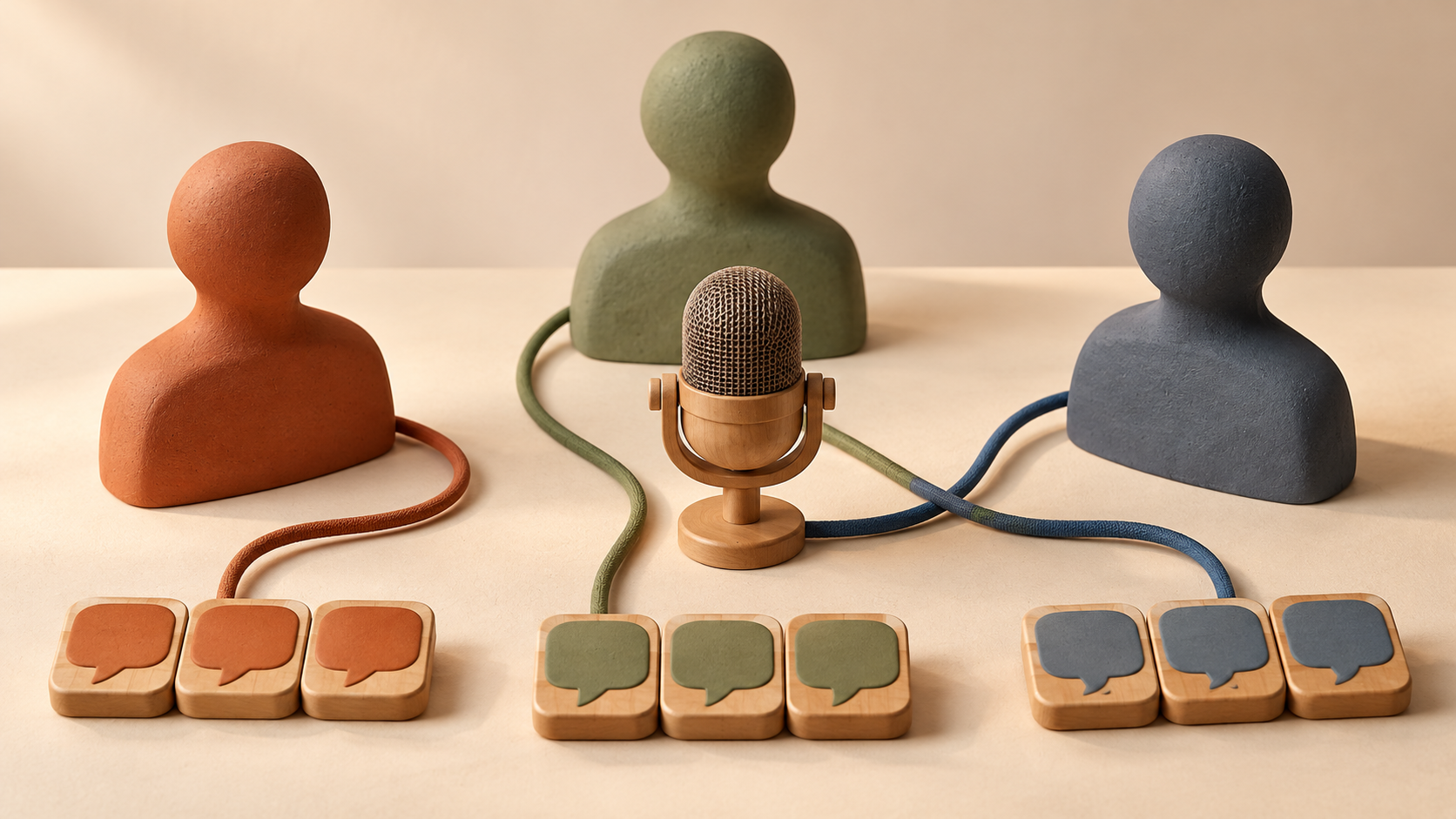
Consider a fictional interview about a stock-counting application. A researcher talks with a shop manager, and a colleague from the shop joins partway through to explain a different shift's routine. The researcher asks most of the questions, but also reads a proposed interpretation aloud. Both shop staff sometimes agree, sometimes interrupt, and sometimes describe each other's work. A transcript that assigns every answer-like sentence to the manager can distort the findings. Conversational role is evidence to check, not a fixed rule for identifying the voice. The example will return throughout this guide, including a brief agreement, an overlapping correction, and a microphone move. It is an invented editorial scenario, not a customer case or product test. Its purpose is to show why reliable attribution depends on specific passages rather than the apparent plausibility of the written conversation.
References: GOV.UK: Analyze research observations; W3C: Transcription accuracy.
Understand what automatic speaker labels mean
A diarization system divides audio into segments associated with speaker indices, while speech recognition supplies the words and a later review establishes the intended identity mapping. Systems can combine these tasks in an output, but they remain conceptually distinct. A clear transcript can have speaker mistakes, and a useful diarization can accompany imperfect wording. Public diarization tools illustrate this separation by returning time spans and recurring identifiers. Those identifiers are convenient handles within an analysis. They are not universal voice passports. Speaker 1 in today's recording need not be the same individual as Speaker 1 in tomorrow's recording, and the number does not inherently encode who spoke first or who attended the meeting. Read the current tool's documentation before interpreting its label convention, especially if the output will feed another system.
Some workflows also expose provisional results before the final segment is complete. Microsoft's diarization quickstart shows intermediate assignments that can be unknown and later resolved in the example output. That is one implementation example, not a promise about every application. It illustrates why a researcher should distinguish live or draft labels from the reviewed document. The final research label is an editorial responsibility. If you rename Speaker 1 as Manager, record what establishes that mapping and inspect the segments receiving the name. A confident display can hide a cluster containing two people or one person spread across several clusters. Review the actual assignments instead of treating the number of labels as a verified attendance count. When the initial result is uncertain, a provisional code is often more useful than an attractive but unsupported name.
References: pyannote.audio: Diarization project; Microsoft: Diarization examples and provisional speaker IDs.
1. Establish a speaker map from the recording
1.1 Find clear reference passages for each voice
Choose anchors with sustained speech, limited overlap, good audibility, a known timeline, a distinctive passage, an explicit confidence note, and a supported label. A greeting can help if the speaker identifies themselves clearly, but a longer answer may provide a better listening reference than a single name. Keep the anchor time and the source recording together so that another reviewer can hear the same passage. Describe why the mapping is supported in ordinary terms. The participant introduced themselves, a facilitator clearly addressed the next speaker, or an authorized project record identifies a separately recorded channel. Avoid treating a guessed name from the transcript as independent evidence. The recognition system could have misheard it, and a person can mention somebody else's name without being that person. Listen to the full exchange before assigning the identity. An anchor should also survive ordinary review conditions. Save a reference that includes the complete phrase rather than a fragment cropped so tightly that a colleague cannot recognize its context. If the phrase is unusually quiet or masked, choose another clear interval where available. Record a second anchor later in the session when the microphone position changes or the recording spans a long conversation. Agreement across independent passages is more useful than repeatedly listening to the same uncertain second. The aim is a workable reference for comparison, not a claim that a short snippet can authenticate a person beyond this interview.
In the fictional study, the manager introduces their role and gives a clear account of the morning stock check. The researcher records that passage as an anchor for the manager's provisional participant code. When the colleague joins, a separate clear explanation becomes another anchor. The researcher also keeps a reference for their own voice, because an interviewer can contribute substantial speech and may read customer-like statements aloud. Where video is available, use visible participation as an additional clue without assuming every visible face is producing the current sound. A conferencing layout may keep one tile on screen while another person speaks, and a cut can show a listener during an answer. Compare the audiovisual exchange and other supported context before accepting the mapping. If the recording is audio-only, avoid adding visual certainty that the evidence does not contain. The map can still be dependable at the participant-code level even when a real-world name is unavailable or unnecessary for the research task. Anchors should remain audible and reproducible. If a later editor receives only a trimmed excerpt that omits introductions, the speaker map should still indicate where its support can be found in the full recording. Do not overwrite the sole clear anchor with a heavily edited clip. A short map containing participant code, source, interval, and basis is usually enough to make the next review efficient without requiring a full biography or speculative voice description.
References: Audacity: Labeling reference regions; Library of Congress: Identifying and organizing audio.
1.2 Keep roles and names separate from voice evidence
Distinguish the voice label, the interview role, the participant code, the displayed name, and the basis for a correction. A customer can ask a question, and an interviewer can make a declarative statement. A colleague can describe the manager's work in the first person while quoting an earlier conversation. These features of the language help interpret an exchange but do not reliably identify who produced the sound. Use role information to investigate an odd assignment, then return to the audio. If a participant appears to ask the researcher's standard question, that may signal a label error; it may also reflect a clarification or role reversal. The surrounding turns should determine which explanation is supported. Avoid repairing the transcript solely because its written dialogue looks more natural after swapping the speakers.
An explicit mapping also helps when a project uses pseudonyms. The internal participant code can remain stable while the display label changes for a particular audience. Keep the mapping in the appropriate restricted project records instead of scattering names through comments and exported filenames. A pseudonym does not automatically make an interview anonymous: the spoken content can still include a shop location, a distinctive job history, or a specific incident. Review those details according to the project's sharing decisions. Speaker identification and disclosure review are related but separate tasks. The first aims to connect words to the correct source voice; the second determines how much identifying information belongs in a particular copy. Keeping them separate lets a team preserve reliable attribution without unnecessarily attaching personal information to every quotation used during analysis.
References: UK Data Service: Text anonymisation; GOV.UK: Separate observations from interpretation.
1.3 Inspect channels before assuming one mixed conversation
Check the channel layout, audio streams, microphone routing, cross-channel leakage, and timing alignment. Separate microphones may provide useful evidence about who was recorded where, but the file must actually preserve that separation. A stereo file can contain two different feeds, the same mixed conversation on both sides, or a spatial recording of the room. The extension and channel count do not settle which arrangement applies. Listen to each channel where appropriate and compare known passages. If the manager is strongest on one channel and the researcher on another, that relationship can guide attribution. It does not mean every sound on the channel belongs to one person; microphones can capture other speakers, and an application may mix feeds before saving. Confirm the routing against the recording rather than relying on the session setup alone.
Keep a copy of useful channel-separated audio before making a mono derivative for another tool. Some diarization pipelines automatically combine channels; the pyannote Community-1 model card documents downmixing its multi-channel inputs to mono. That is a specific pipeline behavior, not a universal assumption. A preparation step can discard useful separation. If a downstream service requires a mixed file, retain the original so that reviewers can revisit an ambiguous interruption with the extra channel evidence. Do not manufacture separate voices by splitting two identical channels and naming them after the participants. Equally, do not attribute a voice to the owner of a conferencing account simply because their microphone carried it. People can share a room or device. Channel information is part of the evidence map and needs the same care as any other clue.
References: Audacity: Splitting stereo channels; pyannote Community-1: Input and channel behavior.
2. Review automatic labels and repair their structure
2.1 Treat the first speaker map as a working draft
Inspect label consistency, speaker changes, cluster membership, missing turns, and the relationship to text before renaming the output. Listen to a few clear passages associated with each label, then inspect a passage that appears inconsistent. The same numeric label can look plausible across many paragraphs while containing one important mistake. A speaker may also be divided into separate clusters after a change in sound. Begin with the output's useful structure and correct the parts supported by evidence. There is little value in replacing every machine label manually if a stable grouping already exists, but there is also little value in renaming a whole cluster confidently before checking what it contains. A compact review can establish which labels are reliable starting points and which need a closer pass. Check the same label at separated positions rather than selecting several adjacent paragraphs from one easy answer. An early clear passage says little about what happens after a colleague joins or a recording interruption occurs. Start with a few varied anchors, then expand around any pattern you find. If a label changes ownership after one boundary, investigate that boundary and later assignments instead of renaming the entire cluster. This approach saves listening time while keeping the review sensitive to changes that a single opening sample would miss. Keep the coverage note brief and specific to the recording.
WhisperAITranscribe is an audio and video transcription tool whose current homepage describes speaker labels. If its output is your starting point, compare those labels with the reference passages from the interview. The visible feature description does not establish real-name recognition, cross-file identity tracking, or the accuracy of a specific assignment. Keep participant naming in your own supported speaker map and inspect the text available in the actual result. A label suitable for browsing may still need correction before a quotation is used as evidence. If the current workflow does not preserve a field you need, maintain the relationship in the working transcript or an appropriate annotation tool. The practical requirement is a usable connection between words, recording position, and the speaker evidence, regardless of which tool supplied the first draft.
References: NVIDIA: Speaker labels and recognition; Microsoft: Speaker-ID output.
2.2 Repair a merged label without swapping the whole file
A merged cluster occurs when two voices receive one label. Separate the affected segments using reference anchors, local listening, and a recorded correction rule. Do not assume every occurrence of the label belongs to the same mistaken person. In the fictional interview, the manager and colleague may both appear under Speaker 2 after the colleague joins. Renaming Speaker 2 as Manager preserves a hidden error in every colleague turn. Instead, identify where each voice appears, split the relevant assignments, and leave uncertain passages unresolved until checked. An annotation tool with separate speaker tiers can help represent the corrected regions. The goal is to repair the actual grouping, rather than make the transcript look consistent by applying a broad replacement that assigns the same name to everyone in the cluster.
At the join point, hear the last clear manager turn, the colleague's introduction, and the first extended explanation afterward. Then follow the conversation beyond the first convenient example. The two people may alternate several times under the merged label. If the chosen workflow exposes a speaker-count constraint, use it only when the recording supports that count and assess the new result rather than treating the setting as a guarantee. An unexpected extra voice from a recorded demonstration or another person nearby can complicate the assumption. Keep corrections local enough to explain. A note that particular intervals were reassigned to the colleague is more informative than “fixed Speaker 2.” It lets a later reviewer understand which interpretation changed and avoids accidentally reverting the repair when the transcript is exported or another recognition pass is compared. Before applying a broad rename, distinguish changing the display name from changing segment membership. A name replacement can be correct for a pure cluster and destructive for a mixed one. Preview the affected intervals if the editor allows it; otherwise work in a copy and compare the result. Keep a recoverable version until the corrected map has been checked. This is especially useful when a research repository treats one speaker field as shared metadata and propagates a change through many excerpts. The desired scope is the evidence-backed correction, not every item that happens to carry the same original string.
References: pyannote Community-1: Speaker-count constraints; Praat: Multiple annotation tiers.
2.3 Consolidate split voices without merging different people
A split occurs when one person appears under several labels. Compare the suspect segments with known anchors and the recording conditions before consolidating them. A microphone move, a quieter passage, or a different position in the room can be a reason to investigate a split; none proves that two clusters belong together. Listen for the voice across a continuous stretch and use supported session context. Avoid joining labels simply because the transcript contains similar vocabulary or describes the same job. Two colleagues may share terminology, and the interviewer may repeat it. A good correction explains why the grouping should change while preserving the source intervals, so that the decision can be revisited. The aim is to reduce a demonstrable fragmentation of one speaker, not to force the recording into an expected number of participants.
In the hypothetical shop interview, the manager leans toward the shared laptop during a demonstration and the output begins using a new identifier. The reviewer compares the voice before and after the movement, checks the uninterrupted exchange, and confirms the mapping against a clear later answer. If the evidence supports one speaker, the displayed participant code can be consolidated across those intervals. Keep the original model labels in an internal comparison if they are useful for tracing revisions. The correction does not require rewriting the participant's words. It also does not mean every new label after a sound change should be merged automatically. The colleague may speak during the demonstration as well. Follow the actual changes of voice and preserve short unresolved passages until they can be assessed with enough surrounding material.
References: pyannote.audio: Speaker segmentation and embeddings; Audacity: Listening across selection boundaries.
3. Handle the exchanges that resist tidy attribution
3.1 Review brief agreement and interruption in context
Short replies provide little speech evidence, may sit near a turn boundary, and can carry disproportionate interpretive weight. A brief agreement after the researcher proposes an explanation may be counted as customer validation in the findings. Check who actually spoke it and what they were agreeing with. Replay the lead-in, the reply, and the continuation. If the sound remains ambiguous, retain a clear uncertainty note rather than assigning it to the person whose opinion would make the report easier to write. The transcript can still preserve that an agreement was heard without making a stronger identity claim. Keep uncertainty attached to the span, not hidden in a general footer saying that the whole file might contain mistakes. A colleague should know which evidence needs another listen before using it.
In the fictional session, the researcher asks whether the stock-count issue happens on every shift. A quiet agreement is followed immediately by the colleague qualifying that it occurs mainly at closing time. If the brief response is mistakenly attributed to the manager, the report may imply that both staff endorsed a universal problem. Hear the full exchange and distinguish each contribution before drawing that conclusion. The issue is more specific than generic transcript accuracy: a very short utterance can alter the apparent number of people supporting a finding. A reviewer may decide that the longer qualification is the supported quote and that the brief response remains unattributed. That is a reasonable editorial outcome when the recording supports one contribution clearly and leaves another uncertain. Completeness does not require pretending every syllable has a known owner.
References: W3C: Faithful transcription; GOV.UK: Observations and findings.
3.2 Represent overlapping speech without inventing a sequence
Distinguish simultaneous speech from rapid alternation. Two voices can occupy the same interval, while an ordinary reading transcript tends to present one paragraph after another. That presentation may need an overlap note or separate speaker intervals to preserve the exchange. Avoid rearranging simultaneous words into a perfectly orderly dialogue unless the recording supports the order. If both contributions are intelligible, a tier-based annotation can retain each span. If one is masked, record the limitation. A single-speaker rendering of an interval can simplify text association while losing information about overlap. Review what the selected output represents before treating its clean sequence as a complete account of the conversation. More elaborate notation is useful only when it helps the reader understand the interaction or find the sound.
The colleague in the example might correct a detail while the manager is still explaining the process. A transcript that assigns the whole interval to the manager can turn disagreement into a self-correction. A transcript that moves the colleague's words into the next paragraph can suggest a response that occurred later than it did. Listen to the overlap and choose a representation appropriate for the research purpose. If the finding concerns disagreement between staff, retain that interaction explicitly. If the overlap is an irrelevant interruption and the substantive answer is clear afterward, the reading copy can be simpler while the working record preserves the uncertainty. The important decision is to avoid using layout to settle an acoustic question that has not been resolved. A tidy page should not manufacture conversational order or conceal the source of a correction.
References: Praat: Interval annotation; pyannote Community-1: Regular and exclusive diarization outputs.
3.3 Keep quoted speech distinct from the current speaker
Check the audible speaker, the quoted person, and the research interpretation separately. An interviewer may read a proposed summary in the first person. A manager may imitate a customer's complaint or quote a colleague's earlier message. Those words belong to the voice producing them in this recording, while the content refers to somebody else. Diarization is not designed to reconstruct that narrative relationship from text alone. Keep quotation context in the transcript where it changes interpretation. Removing a phrase that introduces reported speech can make a quotation appear to be the participant's own current view. Likewise, renaming the turn after the person mentioned in its text confuses topic with speaker. Listen to the setup and preserve enough wording for a reader to understand whose experience is being described.
When reviewing WhisperAITranscribe output, the fictional researcher should inspect the passage where they read a draft interpretation aloud and ask for feedback. The draft statement may sound like an attractive customer quote when copied out of context, but it remains the researcher's wording until the participant responds. Label the researcher correctly and keep the response as a separate contribution. If the manager repeats part of the proposed wording, assess that response in context rather than treating repetition as independent spontaneous evidence. The same care applies to a customer support example spoken during the interview. An account of somebody else's complaint can inform analysis, but it is not interchangeable with a direct statement from that absent person. Reliable attribution lets the research team distinguish these evidence types instead of flattening everything into a collection of favorable-looking sentences.
References: W3C: Maintaining spoken meaning; GOV.UK: Research analysis practice.
4. Verify attribution before using the findings
4.1 Check the quotations that drive a decision
For every consequential quotation, verify the words, the source position, the speaker mapping, and the surrounding exchange. These checks answer different questions. A transcript can have a correct sentence and timestamp while placing it under the wrong participant code. The report then misstates whose experience supports the finding. Listen from before the quote begins and continue beyond its end, especially when the statement contains a comparison, disagreement, or later qualification. Compare the voice with the recorded anchor if the assignment is uncertain. Keep enough source information beside the selected extract for a second reviewer to repeat the check. The reference should identify the recording as well as its time; the same minute-and-second value appears in every interview and cannot identify a source on its own.
Use an explicit acceptance condition that fits the decision. A working navigation transcript may tolerate some unresolved minor turns. A quotation naming a participant or supporting a major product change deserves a firmer attribution basis. That does not require declaring every other turn perfect. Describe what was checked and keep uncertainty where it remains. In the fictional study, the manager's account of a morning stock check and the colleague's account of closing work may support different findings. Combining them under one participant code could erase that distinction. A reviewer should be able to see which voice supports each account and how the mapping was established. A second reviewer is most useful when they test the difficult relationship rather than simply approve the first reviewer’s choice. Provide the source interval and the clear anchors, and ask which voice the passage supports. If the reviewers disagree, describe the disagreement at that span and inspect any additional channel or session evidence. Consensus produced by reading the same plausible written dialogue is weaker than a comparison grounded in the sound. Where the evidence remains insufficient, the team can choose a clearer quote or limit the claim instead of forcing a name for the sake of a finished report. This is more useful than a general confidence impression based on how fluent the transcript reads. Fluency describes the text; attribution concerns the evidence connecting that text to a speaker.
References: Audacity: Reviewing a selected region; UK Data Service: Consistent contextual documentation.
4.2 Audit attribution errors separately from spelling errors
In a WhisperAITranscribe-based review, separate missed speech, false speech, wrong-speaker assignments, merged voices, split voices, and incorrect identity mapping. These categories lead to different repairs. Correcting spelling does not fix a speaker swap, while merging two labels does not recover words masked by an interruption. A transcript can improve in one dimension and remain weak in another. Keep review notes specific enough to guide the next action. “Colleague's closing-time explanation appears under manager” is actionable. “Diarization bad” is not. This distinction also prevents an unnecessary full reprocessing pass when a handful of local assignments need correction. Conversely, a systematic merge deserves a broader pass than one renamed paragraph. Let the observed pattern determine how much of the transcript needs attention.
A simple illustrative comparison shows why overall impressions can mislead. Suppose an editor checks twenty selected turns and finds two with wrong speaker assignments. That observation describes the checked set; it is not a measured error rate for every second of the full interview. The selected turns may concentrate on hard overlaps, or may omit them entirely. Record the sampling basis and separately check every quote entering the report. If evaluating a tool across interviews, keep the source conditions and annotation rules comparable before drawing conclusions. A duration-based diarization score and a count of wrongly attributed quotes answer different questions. For a research team, the latter may be more directly related to the immediate risk, while the former can be useful in a controlled technical evaluation. Choose the measure that fits the work without presenting a small editorial sample as a universal benchmark.
4.3 Carry speaker distinctions into the reading copy
When editing WhisperAITranscribe text, preserve participant codes, turn boundaries, source references, and unresolved attribution through formatting changes. Combining several short paragraphs may improve reading, but do not merge turns from different people into one paragraph under a single label. A long answer interrupted by the researcher can be laid out cleanly while retaining the interruption. If the reading copy intentionally simplifies minor overlap, keep the richer working record available to the team. The distinction should serve the use case. A findings report can be concise; a transcript used to verify who said what needs enough structure to support that verification. Do not let a document template erase the very labels that the attribution review established, especially when quotations are later copied without their neighboring paragraphs.
After exporting, reopen the file and inspect a multi-speaker exchange. Check that labels remain attached to the correct text and that page breaks do not make a label appear to govern the next person's answer. If the destination uses a table, rich-text formatting, or a repository-specific segment field, test that representation in the actual reading view. A bold speaker name in the source can become ordinary text after conversion, and an omitted line break can join two people. Keep essential distinctions understandable without relying solely on color. The source audio remains the reference, but the document should not require a new listening pass just to discover a formatting mistake. A short export check at an overlap, a speaker transition, and a quote can catch a class of errors that a final spelling pass will never reveal. For a translated reading copy, preserve the speaker mapping separately from the translated wording. A translator can reorganize a sentence naturally without changing who produced the original speech. If several short turns are combined for readability, retain enough attribution to avoid presenting a shared exchange as one person’s monologue. The source interval should still lead to the original language recording. A reviewer who does not understand that language may need an authorized bilingual review for disputed wording or attribution. Translation fluency alone does not verify the relationship between the translated passage and the source voice.
References: W3C: Transcript structure and speaker identification; UK Data Service: Example transcription conventions.
5. Keep speaker identities stable as the project grows
5.1 Reconcile labels across excerpts and new processing runs
Treat file-local labels, project participant codes, and new processing outputs as separate namespaces. A new excerpt can begin with the colleague rather than the manager, and its numeric labels may differ from those in the full session. A fresh processing run can also organize clusters differently. Do not join records across files just because the strings match. Use the source relationship, clear reference passages, and the project's supported speaker map. If an excerpt omits the anchor introductions, retain a reference to the full recording that establishes its mapping. This avoids a subtle catalog problem in which one person's comments appear under several participant records, or several people are combined because each file calls somebody Speaker 1. The research identifier should express a checked relationship rather than an accidental coincidence in model output.
For the fictional shop study, the event where the colleague joins can be retained in the full transcript even if the shared excerpt starts afterward. The excerpt's mapping can say which participant codes correspond to its local labels and point to the supporting source. If a new export is generated, compare a few representative turns before replacing the reviewed version. Do not automatically restore old labels by segment number; boundaries can change between runs. Preserve the reviewed quotations and their source intervals so that a later output can be reconciled rather than blindly accepted. This need not become an elaborate database. A small mapping note is often enough for a few interviews. The important discipline is to distinguish the stable project relationship from the convenient numbering a particular file happened to receive.
References: pyannote.audio: File-level diarization outputs; Library of Congress: Organizing source recordings.
5.2 Share only the identifying information the task needs
Use clear audience boundaries and appropriate identity detail when sharing a transcript. A researcher reviewing sound may need access to the source and the internal speaker map. A product team discussing a finding may need only a participant code, relevant context, and the approved quote. A pseudonymized reading copy can preserve stable attribution while limiting unnecessary names, but it still needs a content review for indirect identifiers. Keep the identity mapping with the appropriate project records and avoid embedding it into every exported asset. This is a practical documentation choice, not a claim that one naming convention guarantees anonymity or satisfies every legal obligation. Follow the project's established permissions and handling decisions when choosing what to circulate, including whether recipients should receive the audio itself.
A WhisperAITranscribe transcript can contain identifying material in the speech as well as in its labels. Renaming a speaker does not remove a shop address mentioned in an answer or an account name read from a screen. Review the copy that will actually be shared rather than assuming the label edit completed the disclosure work. If a passage is redacted, preserve enough structure to show that an editorial omission occurred where appropriate, and maintain a source relationship for authorized reviewers. A public report and an internal working transcript may legitimately contain different detail. Keep those versions identifiable so that someone does not attach the restricted map to the simplified copy by mistake. Reliable speaker labeling and sensible sharing can coexist when the project distinguishes attribution evidence from the information each audience needs.
References: UK Data Service: Anonymising text data; UK Data Service: Preparing documented data.
5.3 Improve the next recording with observed failure cases
Use recording practice, clear introductions, microphone placement, and review feedback to reduce avoidable attribution work. If several people share a device, an introduction and occasional clear handovers can provide useful anchors. Where the recording setup supports separate microphones, verify the saved channels rather than assuming the session configuration survived export. Keep a short test recording before an important session when practical. If WhisperAITranscribe supplies the later transcript, the preparation should focus on clear source material, not on trying to manipulate a particular label number. Review recurring WhisperAITranscribe attribution corrections as evidence about the team's recordings and workflow, while keeping observations limited to the files actually checked. A consistent problem with a distant participant may justify a microphone change; it does not by itself establish a universal weakness in a model or service.
Compare a small set of representative sessions before changing the whole production process. Include a one-to-one interview, a colleague joining late, and overlapping speech if those conditions occur in the study. Evaluate the time needed to establish the speaker map, the important quotes requiring correction, and what survives export. These are proposed evaluation tasks, not measured product results. If WhisperAITranscribe output is part of the comparison, use the same recordings and review criteria as the alternative workflow. Keep recognition mistakes separate from labeling and handoff mistakes. The purpose is to identify where a practical change saves reliable work. A workflow that produces fewer labels is not automatically better if it merges two customers, while a more detailed output can be useful even if the reading copy ultimately presents only a few stable participant codes.
6. Conclusion
6.1 Make every important label an evidence-backed relationship
Reliable speaker identification combines clear source passages, consistent participant codes, reviewed boundaries, supported naming, visible uncertainty, and preserved references. WhisperAITranscribe can provide an initial transcript with speaker labels, while the research review establishes which assignments support the intended use. Start from the sound, use known context carefully, and repair merges or splits at the level where they occur. Keep personal identity separate from automatic clustering and avoid transferring file-local numbers across interviews as though they were universal identifiers. For a small customer study, a concise map and a focused quote review may be sufficient. The quality of that relationship matters more than the sophistication of the label names or the visual polish of the document containing them.
The fictional shop interview illustrates why plausible reading is an incomplete test. The researcher can speak in the customer's voice while reading a proposed interpretation. The manager and colleague can use similar terms while describing different shifts. A brief agreement can be hard to assign, and an interruption can change who supplied a correction. These cases should be resolved through evidence where possible and left visibly uncertain where necessary. A report becomes stronger when it distinguishes a clear customer statement from an ambiguous response instead of treating both as equally verified. Keep the selected quotes connected to the recording and the speaker map. Another reviewer should be able to follow the reference, hear the relevant voice, and understand why the attribution was accepted without relying on the original analyst's memory of the session.
6.2 Use four actions to keep the review manageable
Step 1: identify the source recording and collect clear anchor passages for the people who can be supported. Step 2: review the starting transcript, including WhisperAITranscribe output when that is the chosen workflow, and map provisional labels to the project's participant codes. Step 3: correct merged or split voices, inspect short replies and overlaps, and verify the quotations that will support findings. Step 4: reopen the delivered copy and confirm that labels, source references, and unresolved passages survived the handoff. Preserve an auditable speaker map appropriate to the project rather than scattering personal names through every working file. The actions are simple enough for a solo researcher and explicit enough to divide among colleagues when several interviews need to be reviewed.
Keep the handoffs specific. A wording reviewer should not imply that speaker attribution is complete if they checked only spelling. An attribution reviewer should identify the reference file and the passages reviewed. A person preparing a report should carry the quote's participant code and source reference into the findings document. If a later correction changes the speaker, revisit the finding as well as the transcript label. The same words can support a different interpretation when they belong to a researcher, a customer, or a colleague reporting another shift. That is why attribution deserves its own completion state. The goal is not to turn every minor exchange into a technical annotation project. It is to ensure that the statements people rely on can be traced to the right voice and understood in the conversation where they occurred.
6.3 Preserve what the recording can actually establish
A useful transcript makes the speaker distinction, the evidence, the context, and the remaining uncertainty easy to follow. It does not need a confident name beside every sound. When working from WhisperAITranscribe output, retain the useful automatic structure and review the passages where attribution changes the findings. Use participant codes when names are unnecessary, preserve overlapping contributions when they matter, and resist assigning a short reply solely because it makes the written exchange look orderly. Keep the source recording and speaker map available through the project's approved workflow. If a quote's owner cannot be established, resolve it or use evidence that can be supported before presenting it as a customer's view. Whether the starting text comes from WhisperAITranscribe or another source, finish with assignments a second reviewer can hear, understand, and assess.
References: W3C: Useful transcripts with speaker information; GOV.UK: Working from research observations.