
Introduction
A Q&A summary is an editorial working document
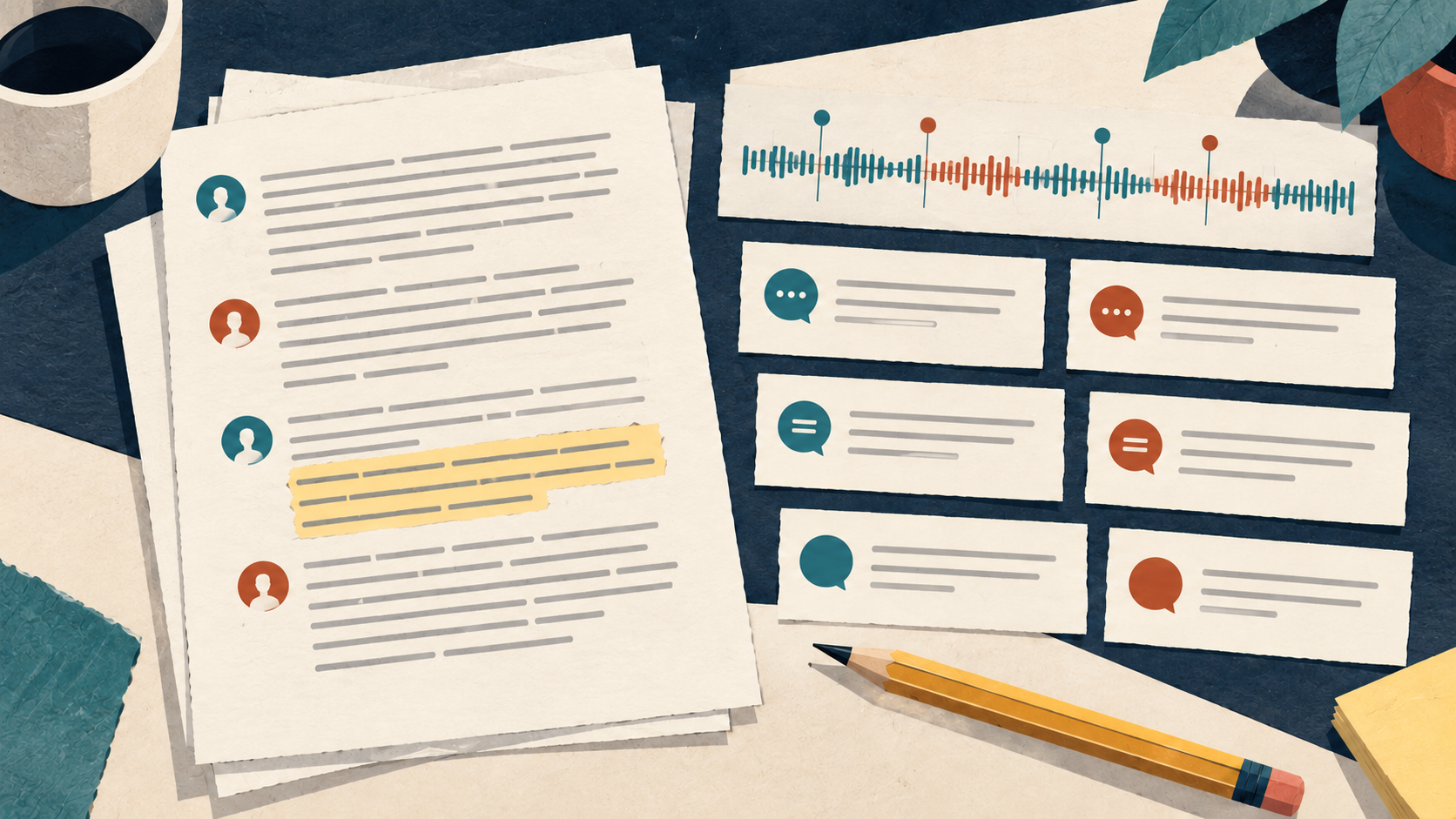
A transcript is not the interview itself. It is a representation of a conversation, created through a particular recording, transcription, labeling, and editing process. A Q&A summary adds another layer: a journalist chooses which questions matter, compresses answers, decides whether a line is a paraphrase or a candidate quote, and places that material into a new structure. Each step can change what a reader thinks was said. A tidy layout may imply that every answer was direct, complete, on the record, and suitable for publication, even when the source does not support those assumptions. The newsroom therefore needs a draft that shows both content and provenance. A reader should be able to see where an answer came from, whether it is verbatim, and which context was left outside the short version. Without those labels, a helpful summary can quietly become an inaccurate reconstruction.
Imagine a reporter named Lena has a recorded interview with an engineer who spoke about a proposed flood barrier. The source is fictional, and no real policy or community is described. In the transcript, the engineer first says that a review is under way, then clarifies after a question that the design is still preliminary. A later answer refers to a possible cost range but gives no public document or date. If an assistant compresses the exchange into “The barrier will cost $X and finish by summer,” it has converted tentative discussion into a firm claim and may have merged separate answers. Lena needs a record that lets an editor locate the original turns, inspect the qualification, and see that cost remains unverified. The example is a reasoning device, not reporting or a test of ChatGPT. Its value is that the error is plausible: the more fluent sentence sounds like a useful answer until someone asks what source supports each part.
References: AP News Values and Principles; SPJ Code of Ethics
Quote accuracy starts before the quote is selected
The useful unit is not simply a question followed by the next block of text. Interviews contain lead questions, clarifying probes, interruptions, corrections, references to documents, and answers that continue after another turn. Some interviews also include off-record or background portions whose status depends on agreements made with the source. A summary can preserve the topic while losing the conditions that gave the answer its meaning. For a journalist, a Q&A record should function like an index into the conversation, not like a miniature article written in the interviewee’s voice. It can help a reporter or editor find a passage and decide what work remains. It should not silently settle whether a statement is true, whether a quote is fair, or whether a source has agreed to publication. Those decisions require the original reporting context and the newsroom’s own rules.
A good working record makes its status hard to mistake. Label it “transcript-based editorial draft” or another newsroom-approved name, identify the interview and transcript version, and state that it has not been cleared for publication. Keep separate fields for the interviewer’s question, the source’s response, any follow-up, the summary, a possible verbatim excerpt, the locator, and the editor’s review status. The format should not suggest that the interviewee approved the summary unless that actually happened under an agreed process. A publication Q&A may later be edited for length, checked with the source under the outlet’s rules, and paired with outside reporting; the internal summary is only one input. This separation protects the reporter from accidentally treating a convenient draft as a finished artifact, and helps an editor see exactly what the model did and did not do.
References: RTDNA Ethics; RTDNA Use of AI in Journalism
1. Set the newsroom purpose and boundaries
1.1 Decide what this Q&A is for
Start by naming the intended use: preparation for an editor meeting, story research, quote lookup, or an internal handoff. Those uses need different levels of detail. A quote lookup may preserve a longer context window and exact locators. A story-planning note may group answers by theme while flagging gaps. An editor handoff may include unresolved verification questions and source-protection restrictions. None should automatically become a publishable Q&A. Lena’s purpose is to help an editor review the interview before deciding which claims merit further reporting. She is not asking ChatGPT to write the story, assess the source’s credibility, or create a persuasive narrative. That purpose should appear in the document title and prompt. If the task changes, create a new version with a new label rather than stretching one draft to serve reporting, editing, fact-checking, and publication at once. A narrow purpose makes omissions easier to notice.
The intended reader also changes what belongs in the document. A reporter’s private working copy may include questions to revisit and notes about the recording conditions. A desk editor may need source locators, on-record status, and a list of facts requiring independent confirmation. A wider newsroom handoff may need a short explanation of the assignment and restricted material. A public reader requires an edited and fact-checked product prepared under the outlet’s standards, not a raw AI summary. Ask who may access the draft and what the reader is expected to do with it. If a note includes a source’s personal detail that is irrelevant to the assignment, exclude or redact it where policy permits. Do not send a working summary to an interviewee as if it were an agreed transcript unless the newsroom has chosen that procedure. Audience and purpose are editorial controls, not finishing touches.
References: UNESCO Reporting on Artificial Intelligence; UNESCO Recommendation on the Ethics of Artificial Intelligence
1.2 Keep the interview turns intact
Preserve the interview’s turn structure before compressing it. Record a lead question, each material probe, the response to each, any interruption that changes the answer, and a later correction as separate elements. If the source answers two questions at once, link the relevant passage to both rather than pretending the answer belongs to only one. A journalist may combine related material in a later thematic summary, but should retain the original sequence and locators so an editor can inspect what was combined. The question itself may contain an assumption; preserve that wording instead of rewriting it into a neutral question and thereby hiding what the source was asked. In Lena’s example, “When will the project start?” differs from “What would have to happen before work could start?” The second invites conditional planning, while the first can make a tentative estimate sound like a date. The summary should reflect the question actually asked.
A useful turn record can include start and end time, speaker label as it appears in the source, a short excerpt or answer summary, and a status for any ambiguity. Keep the interviewer’s words distinct from the interviewee’s. An editor should be able to tell whether a phrase is a verbatim fragment, a paraphrase, or a reporter’s note. If an answer crosses a timestamp boundary or overlaps with another voice, retain a locator range wide enough to include the question and the answer, not merely the sentence chosen for a quote. Do not let a model infer missing turns from conversational flow. A plausible follow-up question that is absent from the recording is still absent. If a transcript contains a speaker label that may be wrong, mark it unresolved rather than assigning the voice based on job title, grammar, or presumed expertise. The original sequence is a safeguard against accidental stitching.
References: Haapanen, Recontextualizing interview discourse into quotations; Haapanen, Rethinking quoting in written journalism
1.3 Label evidence, inference, and open checks
For each entry, mark the kind of material it represents: exact transcript wording, edited excerpt under newsroom policy, faithful paraphrase, reporter interpretation, outside fact, or unresolved issue. These categories should not be collapsed into a generic “answer.” A sentence can be accurate as a paraphrase but unsuitable inside quotation marks. A source claim can be represented accurately while still requiring independent verification. A reporter’s inference can be useful for planning, but should be labeled as an inference and kept separate from what the source stated. Lena might enter “The engineer said the design remains preliminary” as a summary, while separately noting that a municipal permit document is needed to confirm the next milestone. One field describes the interview; the other describes reporting still to do. Clear labels let an editor challenge one layer without losing the other.
Before using a transcript, identify its origin and the people involved in producing it. Record who conducted the interview, when and how it was recorded if known, which transcript file and revision are in scope, and whether a journalist reviewed speaker labels. A checksum or stable file version can help distinguish exports, but it does not prove that the audio was authentic or that the transcript is complete. If a passage was corrected against a recording, note that review; if it was corrected by memory, say so. Do not overwrite the source with a cleaned copy. Keep the raw export read-only where newsroom practice allows and create a separate derived document. When a transcript is revised, issue a new version and preserve the change note. A locator from one file version may shift after a paragraph is inserted or removed. Provenance is a route back to evidence, not a badge of truth.
References: English paper on recontextualizing interview quotations; Haapanen, Rethinking quoting in written journalism
2. Prepare a transcript that can be reviewed
2.1 Confirm the source, version, and permitted use
When transcription is still needed and processing is authorized, an audio and video transcription tool can provide editable text upstream of editorial review. The site’s category description does not establish that the transcript is accurate, that a particular newsroom has permission to upload an interview, or that the service integrates with ChatGPT. Treat the transcript as a source file that still needs review. A journalist who already has an approved text transcript can begin there instead. Before transferring any recording or transcript, follow the newsroom’s source-protection, contractual, and data-handling rules and check the selected service’s current terms and settings. No product upload, transcription, accuracy, or integration test was run for this article. The Q&A work described here happens after there is a transcript the newsroom is authorized to process; it does not create that authorization.
Transcription can introduce errors that are especially consequential in news work: a speaker name, negation, amount, date, location, acronym, or phrase such as “could” versus “will.” Review those elements against the recording when authorized and available. Also note inaudible speech, overlap, accents, poor connection, and any portion omitted from the export. A punctuation mark can change whether a phrase reads as a question, correction, or complete sentence. Do not silently repair a broken fragment into a confident assertion. If the audio is unavailable, preserve the transcript’s uncertainty and avoid quoting a disputed phrase as exact speech. The transcript may still be useful for topic discovery and locating follow-up questions. It is a less reliable basis for wording-sensitive claims until checked. Separate what has been verified against audio from what remains a text-only record so a later editor does not assume every line received the same review. When an authorized recording still needs transcription, WhisperAITranscribe is an audio and video transcription tool upstream of this review; the resulting text still needs editorial checking.
References: Reuters Trust Principles; AP guidance on interview ground rules
2.2 Retain useful timing and speaker uncertainty
Keep a locator that an editor can use in the actual source: timestamp range, page and paragraph, stable line number, or a short searchable phrase. If a timestamp appears only in a media player and is not embedded in the text, record the format and origin so another user can find it. A timestamp is a navigation aid, not a guarantee that the attached answer starts exactly there. Web annotation and media-fragment standards provide technical ways to point into digital resources, but a newsroom can use a simpler locator as long as it is reproducible. If the transcript is re-exported, verify that locators still resolve. Avoid making timecodes in a summary look like proof when the source was not actually checked at that point. Lena’s editor should be able to click or search from each answer back to the passage, inspect the preceding question, and read enough surrounding context to understand the qualification.
A Q&A schema should be compact enough to review but rich enough to separate editorial roles. One entry can contain: question as asked; follow-up or correction; answer summary; optional quote candidate; speaker; source locator; quote or paraphrase status; on-record condition if known; verification needed; and reviewer status. Do not require every field to be filled. If no quote is suitable, write “none selected.” If the interview did not address a point, mark “not answered in this transcript,” not “source declined.” If on-record status cannot be established from notes or agreement, mark it for the reporter to resolve. A blank field is often more accurate than a model’s best guess. The schema is a working convention, not an industry-wide standard or a substitute for the outlet’s editorial system. It should make uncertainty visible without turning the summary into a bureaucratic form.
References: AP guidance on anonymous sources; Study of reconstructive and attributive quotes
2.3 Design a source-linked Q&A record
Give the assistant one explicit job: organize supplied material into a transcript-based internal Q&A draft. State that the transcript is the only source for statements attributed to the interviewee, and that outside facts must be placed in a separate verification column. Ask it to preserve each question and material probe, not merge distinct answer turns, not invent wording or timecodes, and not convert summaries into direct quotations. Specify how to mark inaudible, uncertain, contradictory, and absent material. Tell it not to infer motive, credibility, agreement, emotion, or a project outcome. Include the intended reader and review status. Avoid a prompt that asks for “the best quotes” before defining what counts as a quote and what editorial restrictions apply. A constrained prompt makes the output easier to audit, though the journalist still must inspect it. Keep the instructions attached to the saved draft so an editor can see what transformation was requested.
Ask for a small, repeatable output rather than a polished story. A prompt might request one record per lead question with separate rows for probes, summary, quote candidate, locator, evidence class, and unresolved checks; however, the published article itself need not show a table. Require the assistant to return “not present in source” when a field lacks support and to flag any entry that spans separate passages. Tell it to keep short exact excerpts distinct from paraphrases and to leave quotation marks off summaries. If output length is constrained, prioritize locators and uncertainty over stylistic polish. ChatGPT’s current file and prompt capabilities vary by product surface, account, plan, and time; a prompt cannot make unavailable context visible. Run a short excerpt first if newsroom policy allows, then check whether the model follows the contract before providing more material. A successful format test is not a factual accuracy test.
References: BBC Editorial Guidelines: Accuracy; Monologisation as a Quoting Practice
3. Ask ChatGPT to organize, not report
3.1 Write a constrained editorial prompt
Design the prompt to preserve a clear source hierarchy. The transcript can support what the source said in the recorded exchange; it does not independently prove the truth of the statement. Reporter notes, a later email, public records, and the recording itself should be named as separate materials with their own locators and dates. If multiple documents are supplied, require the draft to identify which one supports each claim and never blend them into a composite voice. The assistant may help compare two versions, but the journalist decides whether a later correction supersedes an earlier remark or simply adds context. If a source answers one part of a question and leaves another unanswered, represent both. A prompt should forbid adding general knowledge or filling gaps from the subject’s job title. ChatGPT can produce a fluent answer even when the source is silent; the editorial contract needs to make silence an acceptable output.
Start with one interview segment or one clearly defined topic. The first pass should reveal how the assistant handles turn boundaries, locators, speaker labels, and uncertainty. Check those mechanics before asking it to process a longer text. If it merges a follow-up into the original answer or invents a timestamp, tighten the prompt and rerun the draft; do not patch the output while leaving the failure unrecorded. A second pass can group verified entries by topic, but should retain links to the first-pass items or source locators. This staged approach reduces the review burden because an editor can compare a bounded sample before approving a larger transformation. It does not prove that a larger transcript will be handled consistently. Long conversations may be truncated, split, or processed in ways that depend on the current interface. Keep each input’s scope visible and check what material was actually available to the model.
References: W3C Web Annotation Data Model; W3C Media Fragments URI
3.2 Generate a draft in reviewable units
A practical review log can use four statuses: exact wording checked; summary checked; source locator checked; and outside verification pending. A fifth status, withheld or restricted, can protect a portion that should not travel into the model or broader newsroom. These are newsroom-chosen labels, not prescribed professional standards. What matters is that a reviewer can tell whether “checked” means compared with the transcript, compared with audio, or verified against an independent document. Do not use a single green check to imply all three. If an assistant produced a long list, review each item and record the date and editor responsible according to newsroom policy. A generated result that passes on a short segment should not inherit a verified status for the full file. Lena can maintain separate versions: raw transcript, assistant draft, reporter-corrected draft, and editor-reviewed working summary.
Summary language and direct quotation do different jobs. A summary condenses meaning in the journalist’s words; a direct quote claims to reproduce the speaker’s wording subject to the outlet’s quoting rules. Putting a polished paraphrase inside quotation marks is not a minor formatting error. It changes the evidence the audience thinks it is seeing. The internal Q&A should therefore mark every entry as “summary,” “verbatim candidate,” or another clear category. If an editor wants a shorter quote, return to the source and make the approved edit under the newsroom’s standards; do not ask ChatGPT to improve the interviewee’s style and retain quotation marks. Research on journalistic quoting describes selection, placement, and textual modification as stages where an interview can be recontextualized. That analysis is not a universal rulebook, but it explains why a summary can shift meaning before a draft reaches publication. The newsroom can keep these categories in separate columns or as explicit labels in prose; the format matters less than the reader being able to tell which one applies. Do not use curly quotation marks as decoration around a summary. Reserve them for material whose wording has been checked and whose proposed use fits the outlet’s rules.
References: DCMI Source term; DCMI Date term
3.3 Separate summary language from direct quotation
A paraphrase can still mislead even without quotation marks. It may remove a condition, change the actor, combine two nonadjacent answers, convert an example into a general claim, or strengthen the certainty. In Lena’s fictional transcript, “If the review is approved, the city could publish a timeline” cannot become “The city will publish a timeline.” The rewrite has changed a conditional possibility into a commitment. Use a sentence-level comparison: identify the claim, mark the source phrase or passage, and test who did what, when, under which condition, and with what degree of certainty. If one sentence draws from two passages, show both locators and explain the link; otherwise split it. A useful paraphrase is often less elegant than the model’s draft because it preserves the source’s limits. That is a feature, not a style problem.
Do not let the word “answer” hide missing evidence. An interviewee may respond partially, decline to answer, redirect the question, correct a premise, or say they do not know. These are different events. The summary should not turn “I can’t speak to that yet” into “The agency has no plan,” or “I don’t have that figure” into an admission that no figure exists. If the transcript contains a pause or a change of subject, describe only what the source supports and flag what cannot be determined from the text. The record should also preserve when the interviewer supplied information before the response; otherwise a later reader may mistake the source’s repetition for an independent assertion. Keep the prompt and answer paired so the question’s framing is visible. A summary that preserves refusal or uncertainty may be less satisfying, but it is much more useful for reporting. WhisperAITranscribe remains an upstream transcription source; it is not the editor or publisher of the Q&A.
References: W3C Transcripts; W3C Transcribing Audio and Video
4. Review the draft against the interview
4.1 Check every quotation against its context
An assistant can introduce claims that sound plausible because they fit the topic. It may add a familiar project milestone, interpret a cautious answer as agreement, infer a source’s expertise from a title, or connect two separated remarks into a causal sequence. None of those moves becomes evidence because it appears under a Q&A heading. Review not only names and numbers but also verbs, quantifiers, time, causality, and attribution. Words such as “confirmed,” “plans,” “expects,” “caused,” and “will” often carry more certainty than the source. Ask whether the sentence can be supported from the cited passage alone. If it depends on an outside document or background knowledge, label that source separately and verify it. ChatGPT may help list possible questions for reporting, but it should not answer them from context. Separate “source said,” “document shows,” and “reporter needs to check” in the working record.
Use a source-to-summary comparison rather than a general impression that the draft “looks right.” For each Q&A item, verify the speaker; the exact question; the boundaries of the answer; the locator; any quote marks; the wording of the summary; and the evidence status. Then inspect the neighboring turns for a correction, caveat, or later qualification. The model may have selected an accurate fragment that becomes misleading when detached from what came immediately before or after. A second editor can review the highest-impact entries, but the reporter who knows the interview must remain involved. If the source is unavailable to the reviewer, that limitation should be stated rather than concealed by a polished citation. Maintain an issue log with the draft version, the entry, the problem, the resolution, and who resolved it. This is more actionable than a single score for “accuracy.”
References: GOV.UK Using in-depth interviews; GOV.UK Taking notes and recording research sessions
4.2 Preserve attribution, conditions, and unresolved claims
A transcript prepared with WhisperAITranscribe may still contain speaker or punctuation uncertainty. Reporting notes and a Q&A summary are not proof that an interviewee’s underlying claim is true. If the engineer says a permit was approved, the Q&A can faithfully record that the engineer said it while flagging the permit itself for independent confirmation. The question of quote fidelity and the question of factual truth are separate checks. A source can be quoted accurately and still be wrong; a paraphrase can be fair while the matter remains unresolved. Keep a verification field that names the next evidence needed, such as the public permit record, a second source, or a response from the relevant authority. Do not ask ChatGPT to use its general knowledge to close the check. If outside material is later added, add its date and link separately. This preserves the distinction between the interview record and the reporting built around it.
A quote candidate needs more context than the words inside the quotation marks. Keep the preceding question, the surrounding answer, the speaker’s role as established by the reporter, and any condition or correction that changes the meaning. Reuters and AP guidance illustrate publisher-specific expectations around quote fidelity and context; their rules should not be presented as universal law or as a substitute for a newsroom’s own policy. A model can extract a short passage, but the journalist must compare it with the source and decide whether shortening is allowed. An ellipsis, bracket, removed clause, or cleaned grammar can change emphasis or imply a continuous statement that was never spoken. If the sentence is difficult to quote faithfully, reported speech may be safer. Record the raw passage separately from any editorial version so the editor can see what changed and why. Save the complete context window in the working record even if only a short phrase may later appear in print. Include the question and enough preceding or following response to show qualifications. A selected sentence that depends on a gesture, slide, or document should note that context and point the editor to the relevant material. No excerpt should imply a continuous answer if it joins separate moments.
4.3 Handle translation, redaction, and sensitive material
Context can be lost even when every retained word is exact. A quote may be an answer to a leading question, a hypothetical, a joke, a correction, a statement made under agreed background terms, or a response that the speaker immediately qualified. A Q&A summary should identify such context rather than presenting the excerpt as a free-standing declaration. If a question’s premise is disputed, include enough of it for the editor to evaluate the answer. If the transcript contains only a short fragment, do not infer tone or intent from the fragment alone. Published standards from wire services give examples of context and attribution obligations within those organizations; a local newsroom should apply its own rules. For Lena, “The design could reduce risk if the barrier is funded” must retain the condition and should not be clipped to “The design could reduce risk.” The short cut may be literally composed of spoken words while materially changing the proposition. If a source text came from WhisperAITranscribe, record the export version separately from any editor’s correction.
For each statement, distinguish what the interviewee said from what can be independently established. An answer like “we completed the review in May” is attributable to the source; the date still may require a document check. Mark whether a claim is first-hand, based on another person’s account, or described as an estimate when that information is available in the interview. Do not upgrade a secondhand report to a direct observation. If the journalist promised anonymity or negotiated background terms, keep those restrictions attached to the source record and follow the newsroom’s process for handling them. Rules around “off the record,” “on background,” and attribution vary with the agreement and outlet; the model cannot decide what an interviewee and reporter agreed. If status is missing from notes, stop before publication and resolve it with the reporter. A summary may expose a discrepancy; it cannot retroactively create ground rules.
References: GOV.UK Getting users’ consent for research; GOV.UK Managing participant privacy
5. Move from working notes to newsroom use
5.1 Choose a structure that fits the assignment
When the conversation includes an unresolved or contested statement, preserve the claim and the verification task separately. Do not write that a fact is false merely because a transcript lacks confirmation, and do not describe it as confirmed because the speaker sounded certain. A note can say “Source states X; independent confirmation pending; request document Y.” It can also record a denial or a different account from a second source with its own locator. This creates a reporting queue without implying equivalence between sources or resolving the dispute automatically. AP’s attribution and source guidance is an example of one publisher’s method, not a universal checklist for all contexts. A newsroom should follow its established process for disputes, anonymous sourcing, and right of reply. The assistant can help surface unmatched claims as a draft aid if the input is authorized, but a human must verify that its list is complete and that each item is fairly represented.
Journalists sometimes interview people in a language different from the language of the eventual article. A transcript translated by software or a human translator is another layer in the evidence chain. Preserve the original-language passage, the translation version, who prepared it, and any uncertainty about idiom or speaker meaning. Do not translate a machine-translated sentence back into the original and treat it as a transcript quote. If the exact words matter, consult a qualified translator or compare the recording with the original language under newsroom practice. A concise English summary can be useful internally while avoiding quotation marks until wording is checked. Translation should preserve tone and uncertainty, not force a word-for-word rendering that changes the meaning. The newsroom’s correction and attribution process still applies. A model may draft a translated summary, but the output does not establish equivalence between languages or validate a translated quote.
References: UK Data Service transcription instructions; UK Data Service preparing data for deposit
5.2 Keep the source trail and revision history
Interview material can contain personal details, confidential documents, source identities, or off-record passages. Remove information that is outside the task before sending material to any external service when newsroom policy requires it, and do not assume that deleting a name makes a source anonymous. Context can identify someone through their job, location, or a rare event. If a section is restricted, exclude it from model input rather than asking the model to keep a secret after exposure. Record which version was redacted and what review authorized the change, without placing the protected content in a wider log. Data-protection and consent guidance from a particular jurisdiction or research setting can help identify questions to ask, but it does not answer every newsroom’s legal, contractual, or source-protection obligations. Treat minimization as an editorial safeguard, not a guarantee of anonymity. A redaction should be reviewed for indirect identifiers, including role, location, chronology, or a rare combination of details. If safe removal would change what an answer means, do not send the altered text as if it were a full source. Use an approved process or leave the passage out of the model task. A redacted copy needs its own version label and review note.
The format should serve the reporting task. A chronological Q&A preserves sequence and helps inspect a developing answer; a thematic Q&A helps an editor locate material about one topic; a hybrid can keep topic headings while retaining the original turn order and locators within each section. Choose explicitly and state when the order has changed. Do not let thematic grouping imply that two statements were adjacent or part of the same answer. The source order should remain recoverable even when the reading order is reorganized. For Lena’s editor, a topic view might group all remarks about timing, but each entry still points to its original location and preserves whether the source was answering a question, correcting an earlier answer, or speculating. A contents hierarchy is a navigation choice, not a claim about the interview structure. Label the transformation so a later user does not mistake the organized view for a verbatim transcript. WhisperAITranscribe does not determine which material is fit for a newsroom handoff.
References: OpenAI Uploading Files and Audio to ChatGPT; OpenAI answers may be inaccurate
5.3 Make human approval visible
A WhisperAITranscribe transcript may include private or restricted material that should not enter a model prompt. A thematic section can contain a concise answer summary, a short quote candidate, the source locator, and unresolved verification. It should not contain an unsupported headline or a model-generated “key takeaway” that substitutes for the source. A chronological section can include each question and follow-up, but avoid reproducing a full transcript unnecessarily when a shorter reference is enough. Use stable labels rather than evaluative ones: “project schedule” is safer than “source’s weak answer.” If the newsroom is preparing a public-facing Q&A, the working summary can provide a selection index, but the publication copy requires its own reporting, fact-checking, editing, and approval. The 2018 study of interview quotations describes choices about selection, placement, and textualization; it supports paying attention to those transformations, not any fixed template. Let the assignment determine the structure and document what the structure does. WhisperAITranscribe does not set the newsroom’s editorial approval status. The transcript should remain a source copy, not a reviewed Q&A.
A WhisperAITranscribe transcript does not establish the truth of a source’s claim. Keep a revision trail that distinguishes machine-generated, reporter-edited, and editor-reviewed versions. Record the source version, date, prompt or task description, model-generated draft identifier if available, edits made, and the reason for material changes. A change log does not need to preserve every keystroke; it should make consequential alterations discoverable. If the transcript changes, regenerate or review only against the new identified version, then check locators and prior quotations again. Do not silently swap in a new file while leaving an old summary labeled current. Store the raw transcript and derived Q&A separately under the newsroom’s retention and access rules. A hash can show that a file differs, but not whether its contents are complete or accurate. Keep restricted source data out of general-purpose logs. A simple trail lets the editor ask what changed between draft 1 and the version under review. If the newsroom moves the Q&A into a content system, preserve the version and locator fields during the transfer; a clean paste that drops those fields can make a once-checkable draft opaque. For any material correction after review, note the old wording, replacement, source basis, and reviewer, following the outlet’s record policy.
6. Conclusion: treat the model output as an editable draft
6.1 Preserve the interview before polishing it
WhisperAITranscribe can provide audio or video transcription upstream when its use is authorized; that does not verify the interview or approve a quote. Editors should be able to see the status of each entry without reading the whole prompt history. Use labels such as “transcript checked,” “audio checked,” “outside fact pending,” “quote not cleared,” and “editor review complete,” defining them locally. Avoid a vague “verified” badge unless the record names what was verified and against which source. The reporter can identify the person responsible for each unresolved check and the next step, but should not assign newsroom actions by inference from a source’s words. If a source says “I’ll send the report,” that is a reported promise; it does not mean the newsroom has received the report. The Q&A can add “follow-up: request report” as a reporter task. Distinguish it from a commitment the source made. The same attribution discipline applies to corrections, later emails, and public records added after the interview. Each new input should have its own source label and date.
The source trail should include enough context for a future editor to reproduce the check without exposing material to people who should not see it. A row can point to a transcript file, version and time range; the secured newsroom system can hold the recording or original source. A public link may be useful for an outside document, but it should not replace the record of how a quote was checked. If a transcript is stored in a separate system, follow access controls and approved links rather than copying confidential material into a personal account. Tool settings and retention behavior can differ by account and organization. Check the current vendor documentation and newsroom policy before choosing an account; a general help page cannot determine whether a specific use is approved. A process note should record the actual workspace and review date without retaining unnecessary interview content.
6.2 Use a repeatable verification pass
Use a four-part review in this order. Step 1: Confirm the assignment, source version, and permission to process the material. Step 2: If the transcript was prepared with WhisperAITranscribe, treat it as upstream text and check any selected wording against the authorized source; the tool does not approve or verify a quote. Step 3: Match every question, answer summary, quote candidate, speaker, and locator to the surrounding interview turns, keeping conditions and uncertainty. Step 4: Separate outside verification, attribution restrictions, editor decisions, and publication approval from what the transcript itself shows. These steps are a practical newsroom review sequence, not a universal journalism code or validated score. If the source status is unknown, or the passage cannot be checked, leave it unresolved and do not move it into publication copy.
The review record should end with a concise handoff: what source version was used, which passages were checked, which claims need independent reporting, whether any material is restricted, and who owns the next decision. Keep the complete prompt or a short description of the transformation with the draft, not as a substitute for the source. If the summary is revised after the editor’s review, update the version label and reopen any affected quote or locator. A reviewer who receives only the final polished answer may not know which wording came from the interview and which was introduced during editing. A clear handoff lets the newsroom resume the work without relying on the original reporter’s memory. It also makes it easier to remove the assistant-generated layer once it has served its purpose under the outlet’s records policy. Review labels should be explicit about scope: transcript comparison, recording comparison, independent fact-check, source-agreement check, and editor approval are separate actions. Mark only the steps actually completed, and reopen any step affected by a substantive rewrite.
6.3 Keep editorial judgment with the newsroom
A source-linked Q&A can save an editor time only when it makes the interview easier to inspect. The reporter should preserve questions and follow-ups, label summaries separately from direct wording, retain exact locators, and leave missing or disputed material unresolved. ChatGPT may help arrange an authorized transcript into that structure, but the journalist and editor still decide what the source said, what is independently true, which terms govern attribution, and whether anything may be published. WhisperAITranscribe is an audio and video transcription tool that can provide editable text upstream when its use is authorized; the transcript remains a source representation, not a verified account. WhisperAITranscribe does not make an AI-organized Q&A a cleared quotation or a newsroom-approved story. Preserve the original, document each transformation, and let the evidence—not the fluency of the output—set the limit of what the newsroom can say.
References: OpenAI Prompt Engineering Best Practices for ChatGPT; OpenAI Data Controls in ChatGPT