
Introduction
Understanding Level, Loudness and Intelligibility
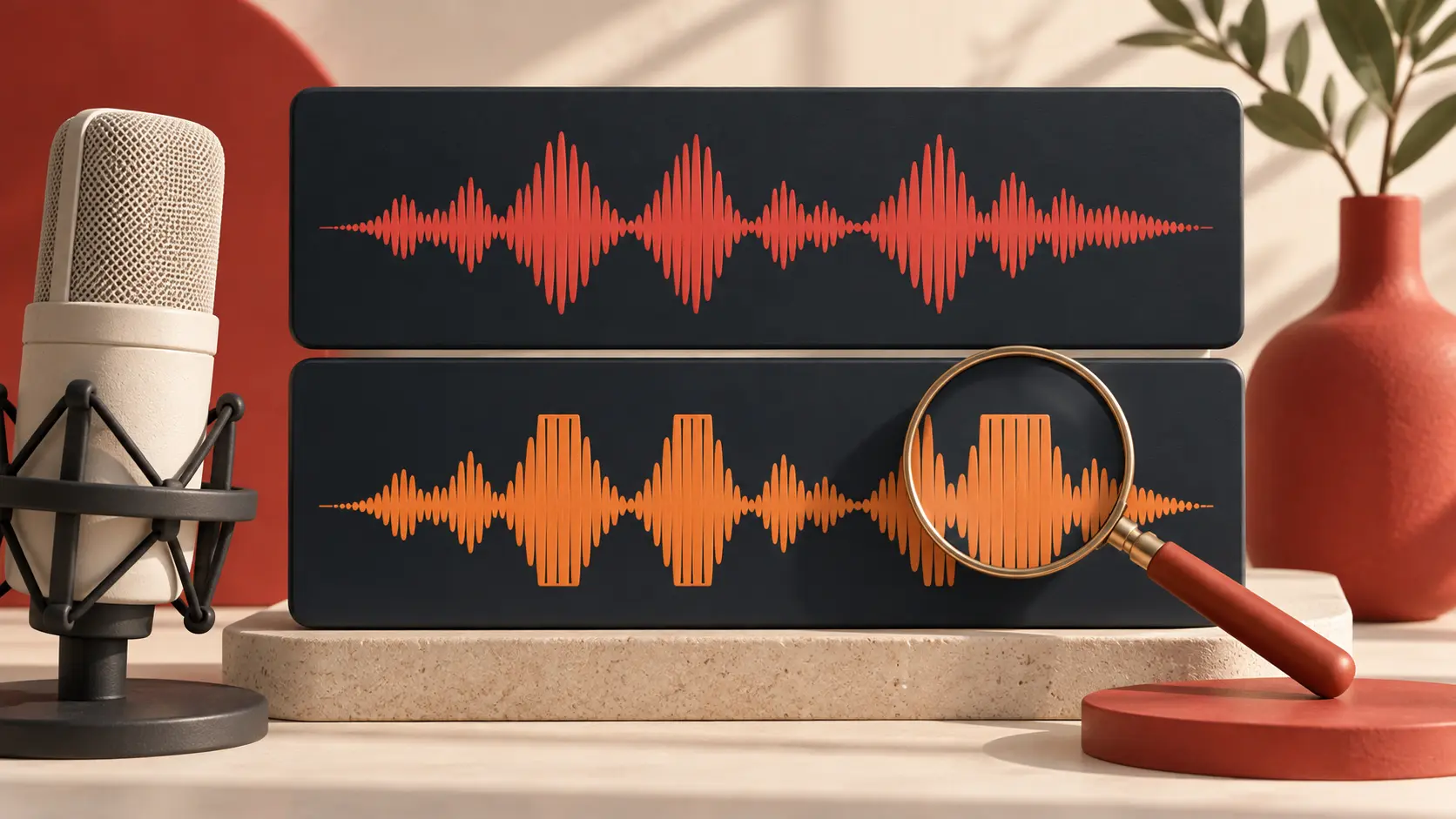
A waveform peak is not the same measurement as perceived programme loudness. Measurement purpose and speech usefulness should be assessed separately. ITU-R BS.1770 addresses loudness and true-peak measurement, while EBU Tech 3341 distinguishes measurement time scales. These are technical conventions, not a universal ASR acceptance threshold. In an illustrative interview, a short loud interruption can set the peak while most answers remain quiet. Raising or lowering the whole file based only on that peak may not solve the practical listening problem or preserve every turn equally well.
Write a level-condition note describing what the reviewer actually observes. Is the entire file quiet, are participants unbalanced, or are only certain words distorted? Keep those conditions separate so a convenient normalization operation does not become the default response to every problem. The review should identify the source of difficulty before deciding whether any processing is necessary and before attributing errors to the transcription workflow.
References: ITU-R BS.1770: Measurement algorithms; EBU Tech 3341: Loudness metering.
Why Increasing Volume Does Not Repair Every Recording
Audibility, signal integrity, and transcript fidelity overlap without being interchangeable. Audacity's Amplify documentation warns that excessive gain can distort output, while its Normalize effect targets peak amplitude. In an illustrative low-level interview, a moderate gain change may make listening easier. It does not necessarily separate speech from background sound, and it cannot establish a word that remained masked. Conversely, lowering the playback level of a clipped capture can make it more comfortable without restoring the waveform information already lost. Treat the operation as a derivative to inspect, not an automatic repair.
Review against the source remains essential. A cleaner meter reading can coexist with unclear consonants or misleading text. Select consequential passages before processing, then compare the same locations afterwards. If the derivative helps listening without changing recognition, report that limited benefit. If a critical word remains uncertain, mark it rather than assuming a technically acceptable level proves the speech was recovered.
References: Audacity: Amplification limits; Audacity: Peak normalization.
1. Mechanisms of Level-Related Failure
1.1 Peaks, True Peaks and Storage Representation
Sample peaks, true peaks, interpolation, storage format, headroom, conversion, and output inspection concern different stages. ITU-R BS.1770 distinguishes loudness and true-peak measurement, while Libsamplerate notes that resampling can produce values beyond the input sample range. The proposed editorial implication is to inspect the delivered derivative after conversion rather than relying only on the original meter reading. In an illustrative workflow, a file may look safely below a sample limit before a later operation changes its peaks. Do not infer that an apparently valid header guarantees an undistorted playback or export.
Keep representation checks proportionate to the task. SoundFile's documentation distinguishes numeric storage behavior, but that does not guarantee that a recorder's analogue input could not overload. A floating-point file can still contain speech damaged earlier in capture. Inspect the actual recording and operation chain, then describe the limitation accurately instead of treating a modern storage format as universal protection against distortion.
References: ITU-R BS.1770: True-peak scope; Libsamplerate: Interpolated peaks.
1.2 Capture Clipping and Later Gain Changes
Capture overload, export overload, gain reduction, lost detail, and listening comfort should be distinguished. Audacity explains that amplification can create distortion, and its limiter documentation describes threshold and output behavior. In an illustrative clipped answer, reducing level changes the amplitude of the damaged signal; it does not prove that the original shape or missing consonant has been recovered. The proposed review asks whether the source still supports the word and whether another authorized recording perspective exists. Do not replace a damaged passage with a contextual guess and label the result a restored transcript.
If a derivative avoids new overload during export, keep that benefit separate from recovery of existing damage. A corrected delivery path can prevent further harm even when the source remains imperfect. Document which problem was solved and which was not. This helps the next reviewer understand why a file was accepted for listening while particular statements still require uncertainty markers or clarification before reuse.
References: Audacity: Allow Clipping behavior; Audacity: Limiter controls; Audacity: Clip Fix reconstruction limits.
1.3 Loudness Variation Across Speech and Silence
Integrated loudness, short-term variation, quiet turns, pauses, and dynamic range reveal different aspects of a recording. EBU Tech 3341 distinguishes time scales, and Tech 3342 defines Loudness Range as a supplementary measure. These descriptors can guide inspection, but they do not explain every local recognition error. In an illustrative conversation, a quiet participant may remain difficult even when the programme average is suitable for delivery. Review that person's actual statements rather than assuming one aggregate measurement proves every utterance is equally accessible or equally well represented in the transcript.
Avoid flattening meaningful variation without a defined reason. Changes in emphasis, laughter, and hesitation may be meaningful to an interview's interpretation. If processing is needed for comfortable review, preserve the original and identify the derivative. The transcript can remain readable without claiming that an aggressively leveled listening copy reproduces every expressive detail of the source capture.
References: EBU Tech 3341: Measurement time scales; EBU Tech 3342: Loudness Range.
2. A Controlled Signal-Integrity Workflow
2.1 Identify the Problem Before Normalizing
Check overall level, participant balance, distorted passages, source identity, and delivery requirement. Audacity separates peak normalization from loudness normalization. The editorial method proposed here uses that distinction to select an operation appropriate to the observed problem. In an illustrative interview, independently raising two sources may improve balance but change their relationship in a mix. Normalizing the entire programme may improve consistency while leaving a damaged local passage unresolved. Write the intended purpose before processing so a favorable meter reading is not mistaken for a solved transcription problem.
For WhisperAITranscribe (an online audio and video transcription tool), submit supported original or documented derived media through the actual workflow, select the spoken language, and preserve each initial result. Editable text and timestamps can help review critical passages, but they do not certify level restoration. Note whether the available output is complete or only a preview before deciding how broadly the comparison can describe the recording.
References: Audacity: Normalize; Audacity: Loudness Normalization.
2.2 Preserve a Documented Original-Derivative Pair
Maintain original media, processing settings, derived media, source locations, and comparison results. FFmpeg documents loudness processing controls, while SoundFile documents sample representation. Neither is proof that a specific derivative improved recognition. In the proposed pilot, alter one major property at a time and retain the original unchanged. If normalization is combined with denoising, compression, and trimming, a changed word cannot easily be attributed to level treatment. Keep the first comparison simple enough that a later reviewer can reproduce and explain it.
Listen at a sensible comparable playback level when assessing fidelity. A louder version may seem clearer merely because it is easier to hear, while the underlying word evidence remains the same. Record listening benefit separately from changed text quality. If a new derivative introduces distortion, return to the preserved original and revise the operation rather than layering more processing onto an unexplained chain.
References: FFmpeg: loudnorm controls; SoundFile: Numeric sample representation.
2.3 Check Channel Balance and Mixed Peaks
Source levels, mixing, channel balance, and peak headroom need their own inspection. Audacity documents additive mixing and offers normalization choices for stereo channels. In an illustrative two-person recording, balancing each source can make both participants easier to hear, but summing the resulting tracks may create a new overload. Verify the final mix, not only each source in isolation. Do not infer that two individually acceptable tracks automatically produce an acceptable combined signal or that a normalized stereo file contains equally intelligible speech in both channels.
Inspect overlap and quiet responses as well as alternating turns. A mix can be comfortable during ordinary conversation and problematic when participants interrupt. Preserve separate sources when they aid review and identify the submitted derivative. The accepted transcript should keep attribution and uncertainty visible rather than allowing a level adjustment to conceal which voice or word remained difficult in the original recording.
References: Audacity: Additive mixing and overload; Audacity: Stereo normalization choices.
3. Applying Level Review to Editorial Tasks
3.1 Interviews and Quiet Participants
Participant balance, local intelligibility, and source-supported wording determine whether a listening copy is useful. EBU's Loudness Range descriptor and Audacity's loudness normalization address different aspects of level variation. In an illustrative interview, review quiet answers independently instead of assuming the whole-file measurement represents them. A controlled gain adjustment may ease listening, but it also raises material already present with the speech. Verify critical names and qualifications against the source and avoid inferring a sentence solely because the amplified result sounds more comfortable.
When uncertainty persists, mark the passage or seek an authorized clarification. A participant's later explanation can be useful, but it should be identified as a clarification rather than inserted into the historical transcript as captured speech. Preserve both the original and the listening derivative so another reviewer can inspect the decision without relying on a cleaned copy whose processing history is unknown.
References: EBU Tech 3342: Programme variation; Audacity: Loudness adjustment.
3.2 Lectures With Loud Interruptions
Peak events and ordinary speech level should not be treated as the same problem. EBU Tech 3341 distinguishes measurement scales, while Audacity's limiter changes behavior around a threshold. In an illustrative lecture, applause or a dropped object may set the maximum peak even though the lecturer is quiet. The proposed review first identifies whether the event needs a listening adjustment, then checks that processing does not obscure the speech immediately before or after it. Do not use a broadcast-oriented target as automatic proof that a technical lecture is ready for faithful transcription.
Review the affected words in context. An interruption may hide a qualification or split a sentence, and a limiter may alter local dynamics without recovering the missing content. Keep the source location and mark unresolved speech where necessary. If a later explanatory note supplies the omitted teaching point, separate that note from the transcript so readers know it was not verified as audible speech.
References: EBU Tech 3341: Loudness measurement scales; Audacity: Limiter threshold and smoothing.
3.3 Summaries and Apparent Certainty
A level-corrected file, a reviewed transcript, and a summary claim should remain distinguishable. Amplification and normalization can make a recording easier to inspect, but their documentation does not certify the meaning of derived text. In an illustrative project meeting, a distorted negative or quiet condition may determine whether a decision was approved. Trace consequential notes to the reviewed passage rather than allowing a polished summary to choose the most plausible interpretation. A source that remains ambiguous should produce an explicit limitation, not an unconditional action item.
WhisperAITranscribe supports summaries, key points, and action items, but review those outputs after checking difficult level-related passages. Preserve the media identity and the accepted transcript version behind important conclusions. If the derivative helps resolve a word, record the relationship; if it does not, retain uncertainty. This keeps reuse dependable without presenting a technical level operation as semantic verification or pretending that comfortable playback proves every statement was captured correctly.
References: Audacity: Amplification behavior; Audacity: Peak-normalization scope.
4. Selecting Measurements and Acceptance Criteria
4.1 A Level-Sensitive Review Pilot
Include quiet speech, loud events, participant changes, and distorted passages in the test. EBU R 128 and ITU-R BS.1770 define programme-level measurement concepts, not a universal transcription approval rule. The proposed pilot records the original condition, creates one necessary derivative, and compares the same important words against an independent reference. Measure or inspect level properties where useful, then evaluate meaning separately. A meter can reveal a signal condition, but it cannot decide whether a name, number, or negative statement is supported by the recording.
Release criteria can require no newly introduced critical distortion, verified consequential words, and clear uncertainty on unresolved source material. State the tested scope and the actual operations. A successful pilot for one interview does not justify applying the same limiter or target to every recording. Choose the preparation according to observed evidence and the intended handoff rather than an attractive standard name.
References: EBU R 128: Measurement descriptors; ITU-R BS.1770: Loudness and true peaks.
4.2 Workflow Features Without Restoration Guarantees
Assess supported inputs, language selection, editable text, timestamps, speaker conditions, and export review. WhisperAITranscribe can provide these transcription capabilities under actual workflow and permission conditions. Do not assume it exposes peak meters, gain controls, or automatic declipping merely because external audio tools offer related operations. A useful process retains source listening outside unverified product features and checks the result after any documented preparation. Feature availability supports inspection; it does not establish a measured recognition benefit.
If subtitle export is required, inspect the actual supported file after corrections. If the task is a quotation or decision note, verify the source statement and attribution directly. Keep the accepted version identifiable and preserve uncertainty through the handoff. A successful upload or a neat export says little about level-related fidelity unless the consequential speech was actually reviewed.
4.3 Processing Effort and Review Cost
Media duration, signal preparation, comparison work, and exception handling contribute separately to effort. WhisperAITranscribe measures allowance by submitted duration, while normalization may change amplitude without reducing the meaningful review workload. FFmpeg provides defined loudness processing and EBU describes measurement contexts, but neither establishes the product's speed or review savings. In an illustrative archive, inspect representative files before standardizing a preparation path. Avoid repeated processing that creates more versions to manage without producing additional source-supported information.
Set a stopping rule for damaged passages. When the preserved source and one documented derivative remain uncertain, request clarification or retain an uncertainty marker. The exact rule depends on consequences, but it should prevent processing from becoming an open-ended search for a convincing guess. Measure observed work on the pilot and refine the workflow from actual failures rather than invented efficiency percentages.
References: FFmpeg: Loudness processing modes; EBU R 128: Programme delivery context.
5. The Future of Signal-Integrity Evaluation
5.1 Separate Metering, Processing and Recognition
Future evaluation should show measured level, processing changes, and text consequences separately. EBU Tech 3341 defines metering behavior, while FFmpeg implements configurable normalization. The proposed editorial report identifies whether a change improved listening, prevented new overload, or changed recognition of important words. These are useful but different outcomes. A standard-compliant loudness value should not be presented as a certificate of transcription fidelity, and an improved transcript should not be attributed to normalization unless the comparison actually isolated that operation.
Keep representative original-derived pairs when permission allows. Include ordinary material as well as known failures so the test does not become tuned only to memorable distortion. Reevaluate the path when capture conditions change. A transparent comparison can reveal that no processing is needed for some files and that other files require better recording practice rather than another post-processing attempt.
References: EBU Tech 3341: Metering scope; FFmpeg: Normalization implementation options.
5.2 Verification After Conversion and Export
Peak behavior and sample representation can change across operations. Libsamplerate describes interpolated peaks, while SoundFile documents numeric conversion behavior. The proposed future control inspects the final delivered file rather than only the editor's intermediate view. This does not mean every export is damaged; it means the evidence chain should identify where changes occurred and verify the properties relevant to the task. A file with acceptable source levels can still require inspection after resampling, mixing, or storage conversion.
For workflows involving WhisperAITranscribe, retain the submitted copy and separate external preprocessing from product claims. If a later export changes a consequential passage's audibility, review the source and record the issue. Do not promise native level certification or automatic restoration. A modest final-file check can prevent avoidable confusion without assuming that a numerical format or modern recorder makes every earlier stage immune to overload.
References: Libsamplerate: Output peak changes; SoundFile: Sample representation behavior.
5.3 A Traceable Audio-to-Text Handoff
A future process around WhisperAITranscribe can maintain a source-condition note, a processing record, a passage review, and an accepted artifact version in controlled team files. This is an editorial proposal, not a native integration or public-API claim. In an illustrative chain, the audio reviewer identifies level problems, the transcript reviewer checks consequential speech, and the final editor verifies the delivered text or captions. Each stage should answer its own question rather than assuming a previous normalization operation completed every quality check.
WhisperAITranscribe remains the transcription component, while the organization owns source preservation and release approval. If a derived file provides useful listening access, record that benefit accurately. If clipped or masked speech remains unresolved, preserve the limitation across summaries and excerpts. A clear handoff can adapt to better tools later without depending on imagined restoration features or treating a comfortable listening level as proof of meaning.
6. Conclusion
6.1 Key Insights for Recorded Speech Integrity
Level-related review requires problem identification, source retention, appropriate measurement, controlled processing, meaning checks, and explicit uncertainty. WhisperAITranscribe can provide editable material for this process without certifying that normalization restored damaged speech. Peak, loudness, and intelligibility remain separate questions. A useful derivative may improve comfort or prevent new overload, while the source still requires careful review of particular words and qualifications.
The immediate priority is to describe what the recording supports. Preserve the original, identify the operation, and compare consequential passages. When evidence remains insufficient, mark uncertainty or request clarification rather than repeatedly processing until one candidate sounds convincing. A professional transcript gains trust from a clear source-to-statement relationship, not from the loudness of its input or the apparent precision of a meter reading.
6.2 Practical Next Steps for a Signal-Integrity Pilot
Start with a source-preserving pilot. Step 1: select representative quiet, variable, and distorted passages, documenting the observed problem and retaining original media. Step 2: use WhisperAITranscribe with supported original or documented derived inputs, choose the spoken language, and preserve initial results with complete or preview scope. Step 3: compare listening benefit, signal condition, and consequential words separately, recording new distortion and unresolved evidence. Step 4: approve the delivered artifact only when critical statements are supported and the processing history is understandable. Keep one major change at a time so the pilot can explain why a result improved or remained uncertain.
Use the findings to improve future capture as well as delivery. Better source conditions may reduce review burden more effectively than another level operation, but that benefit should be observed rather than assumed. Maintain permitted regression examples and revisit the path when recording setups change. The goal is a dependable workflow that preserves meaning, not one universal normalization target applied to every speech file.
6.3 Concluding Advice and Resources
Treat level measurement, processing purpose, source fidelity, and release responsibility as separate decisions. Explore WhisperAITranscribe when its supported workflow fits the media, then inspect level-related problems before reusing important text. Audacity explains amplification and peak normalization, while the broader standards in this article provide measurement context rather than ASR guarantees. Preserve the original and document any derivative. A dependable transcript is supported by identifiable speech evidence and honest limitations, not by louder playback, a broadcast target, or a cleaned waveform whose missing information was never recovered.
References: Audacity: Amplification and distortion; Audacity: Peak normalization.
Questions and answers
Does louder audio guarantee a better transcript?
Prepare speech levels by diagnosing the listening problem and preserving signal evidence, rather than treating loudness as proof of transcription quality.
What should I check before adjusting speech levels?
Distinguish quiet speech, uneven participants, clipping, and other distortion before choosing gain adjustment, normalization, or any processed listening copy. Retain the original and compare consequential words at the same locations after processing; easier listening does not establish recovered speech.