
Introduction to Reliable Batch Deliveries
Understanding a Batch as a Collection of Distinct Deliverables
Treat batch membership and artifact identity as separate concepts. UK Data Service guidance uses a structured data list for interview collections; CSV documentation addresses how fields containing punctuation must be serialized. A folder's file count does not explain which source produced each item, whether its contents are current or why an expected output is missing. A manifest makes those relationships explicit without depending on filenames alone.
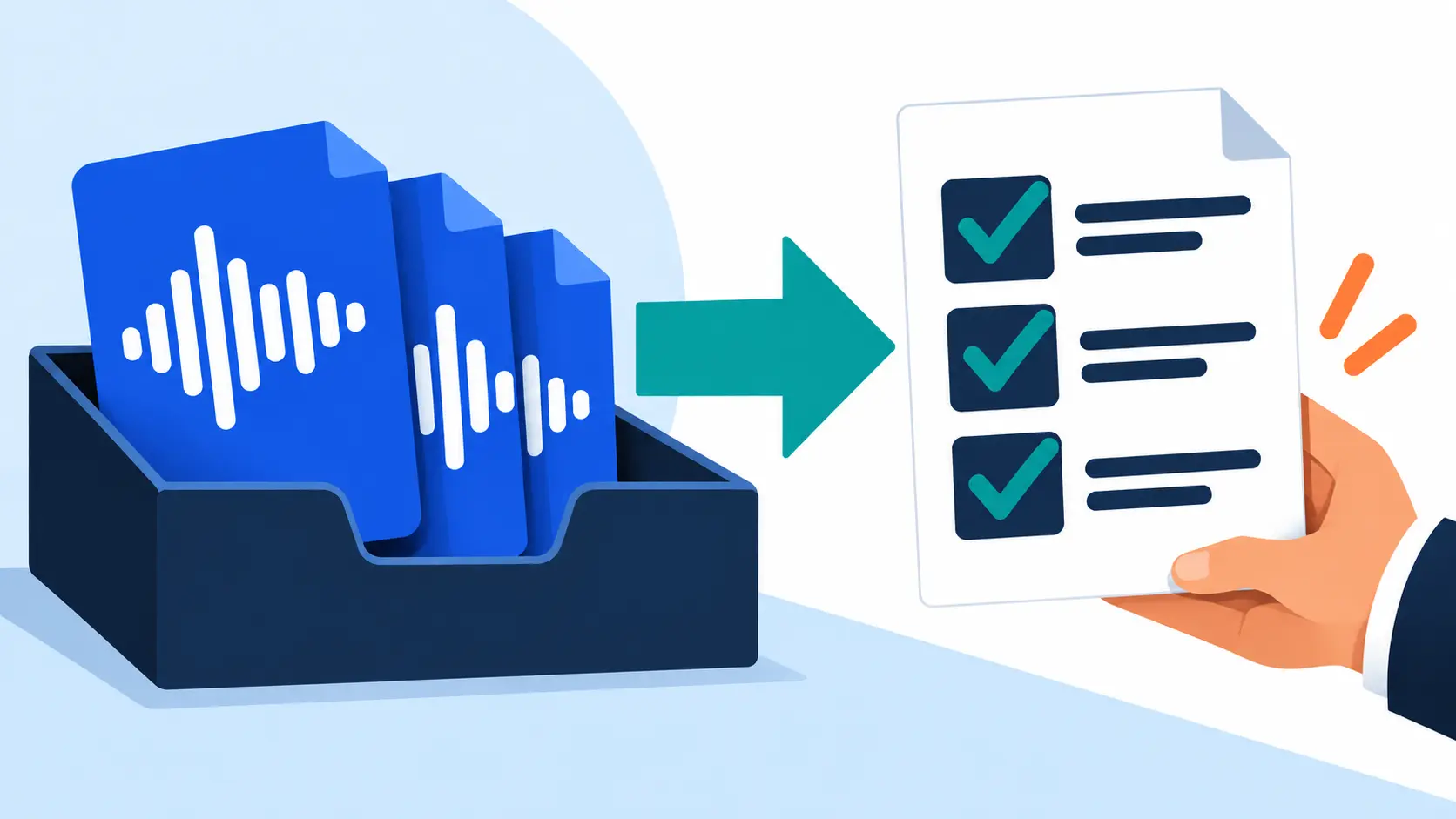
Consider an illustrative eight-recording batch requiring one reviewed transcript per source and subtitles for three recordings. Two source files share the same original name, one summary is held for clarification and one subtitle was accidentally paired with an earlier edit. The coordinator needs to expose these differences before transfer. This scenario is a proposed operating exercise, not a customer result, product test or proof that any particular destination supports every export.
References: UK Data Service: structured collection documentation; RFC 4180: CSV field serialization.
Why Exported Text and Usable Subtitles Need Different Checks
Distinguish transcript content, timed cues and media pairing. The Library of Congress describes SRT as a text file without embedded audio or video; WebVTT specifies time-aligned cue structure. A transcript may read correctly while its subtitle version starts against the wrong edit. Conversely, a file may parse successfully while containing incorrect names or an unsupported attribution. These are different acceptance questions and should not share one vague completion tick.
Define a deliverable-specific acceptance rule for the eight-recording batch. Text requires source-linked review and readable encoding. Subtitles additionally require the intended format, media version and synchronization check. A summary requires claim review before inclusion, even if its transcript is already accepted. Keep each artifact's state visible so withholding a doubtful summary does not imply that the entire source is missing or that every other output has failed.
References: W3C: WebVTT cue structure; Library of Congress: SRT sidecar structure.
1. Defining the Batch Handoff Contract
1.1 Build a Manifest That Describes Expected and Actual Files
Record batch identifier, source identifier, artifact identifier, relative filename, artifact role, version and acceptance state. UK Data Service's collection guidance illustrates contextual file documentation; BagIt defines completeness and integrity checks for packaged files. The adaptation here is a lightweight editorial manifest, not a claim of formal BagIt conformance. It connects each required deliverable with its actual file and leaves missing or held items identifiable before release.
Use an expected-versus-received register rather than counting whatever happens to be present. For the eight-recording batch, the expected transcript count remains eight even while one file is being corrected. Record the three subtitle requirements separately. An extra obsolete export should not compensate numerically for a missing current file. The manifest should let a recipient identify the exact discrepancy without opening every document and guessing its role.
References: UK Data Service: collection and file metadata; RFC 8493: complete and valid file packages.
1.2 Separate Source, Attempt and Release Versions
Keep source identity, processing attempt, artifact version, release membership and replacement reason distinct. Dublin Core defines version relationships; DPC discusses documentation and validation at transfer. One recording can produce several attempts and derivatives without becoming several sources. A release should identify the particular accepted artifact it contains rather than simply pointing to a folder whose contents continue changing.
For the two identically named source files, assign stable project identifiers before processing. Retain the original names as metadata, not as the only lookup key. If a transcript correction changes a speaker attribution, create a new artifact version and review dependent summaries or subtitles. The release manifest then specifies the accepted version. Do not silently substitute new content under an unchanged acceptance record and expect the recipient to infer what changed.
References: Dublin Core: version relationships; Digital Preservation Coalition: documented transfers.
1.3 Make the Manifest Portable Without Losing Identifiers
Check field quoting, character encoding, leading zeros, language labels and destination interpretation. RFC 4180 describes CSV quoting and escaping; Unicode explains that byte-order-mark handling depends on format or protocol. Those facts do not guarantee how a particular spreadsheet will import a manifest. Test the actual receiving application, especially when identifiers resemble numbers or fields contain commas, quotation marks or multilingual text.
Use a round-trip manifest test with the batch's real field types. Open a copy through the intended import route and compare identifiers, filenames and accented or non-Latin characters with the original. A source identifier beginning with zeros must remain the same identifier, not become a shorter numeric value. Document encoding expectations rather than changing them indiscriminately. A readable preview is insufficient if the saved or re-exported manifest alters the mapping.
References: RFC 4180: commas, quotes and line breaks; Unicode: UTF encoding and BOM conditions.
2. Capabilities and Limits of Manual Delivery
2.1 Distinguish Export, Upload and Destination Availability
Separate local export, selected file, upload completion, destination location and recipient access. Google Drive and OneDrive document manual upload routes, with different interface and file-handling conditions. These are destination-side workflows, not evidence of a transcription product integration. A local export may exist while its upload is incomplete; an uploaded file may remain inaccessible to the intended recipient under the chosen sharing configuration.
WhisperAITranscribe (an online audio and video transcription tool) can prepare outputs for a manual handoff, subject to actual workflow and permissions. Record the saved artifact and its intended destination before transfer. After upload, check the receiving location and confirm that the recipient can access the intended copy. Do not treat an uploader's own preview as proof of recipient access or describe a manual cloud-storage upload as a native connection between the services.
References: Google Drive: manual file uploads; Microsoft OneDrive: upload and save routes.
2.2 Validate the Export Format and the Intended Media Together
Test actual file contents, format syntax, text rendering, cue timing and media version. WebVTT defines its file signature and timed cues; the Library of Congress describes SRT's sequence of subtitle blocks. Renaming an extension does not perform a format conversion. Use the destination's supported format and inspect the exported contents, then test playback against the exact media edition named in the manifest.
In the illustrative batch, the misplaced subtitle can be syntactically valid yet wrong for a shortened edit. Check recognizable opening, middle and ending speech, plus the known cut boundary. This targeted synchronization exercise does not prove every cue is correct, so expand review where drift or mismatched content appears. Record the tested media version and scope. Do not replace a meaningful playback check with the fact that the text opens in an editor.
References: W3C: WebVTT signature and synchronization; Library of Congress: SRT timing blocks.
2.3 Use Completion States That Do Not Overclaim Success
Distinguish prepared, transferred, opened and accepted. AWS Batch documents separate job states and process-level success; DPC describes validation during acquisition. The AWS example is an orchestration analogy, not a current product feature or the proposed team's infrastructure. A process finishing successfully does not establish editorial acceptance. For a manual batch, the recipient's checked result is a separate event from file creation or transfer.
In the eight-recording batch, mark the doubtful summary held even when its file exists. Record the mismatched subtitle as requiring replacement rather than counting it as accepted. Unknown receipt should remain unknown, not become a zero failure count. A handoff report should state its cutoff and show what is ready, what is delivered and what remains unresolved. This makes partial completion useful without disguising it as an all-finished outcome.
References: AWS Batch: submission and terminal states; Digital Preservation Coalition: acquisition validation.
3. Applying the Contract to Practical Team Handoffs
3.1 Package Only the Approved Release and Explain Its Contents
Connect release manifest, approved artifacts and receiving route. Apple's guidance describes creating and opening ZIP archives; OneDrive describes file and folder uploads. Neither mechanism proves that the selected collection is complete or appropriate for release. Packaging should follow the manifest rather than sweep a working directory into an archive, where temporary copies and held drafts can be mistaken for approved outputs.
For the batch, create a release copy containing accepted artifacts and a short explanation of held items. Exclude private working notes and obsolete exports unless their inclusion is specifically required and permitted. Open the package after preparation and compare its contents with the manifest. A compressed archive is a delivery container, not a quality label. The recipient should understand why a file is absent without searching through unrelated drafts or requesting every working version.
References: Apple: compressing and opening archives; Microsoft OneDrive: receiving file and folder uploads.
3.2 Test Text Display in the Recipient's Actual Workflow
Separate encoding validation and destination rendering. Unicode explains encoding and BOM conditions; WebVTT specifies UTF-8 for its files. A valid text encoding does not guarantee that every receiving interface presents the content as intended. Check representative names, multilingual passages and punctuation in the actual destination. For subtitle delivery, confirm both displayed text and cue behavior instead of relying exclusively on a general-purpose file preview.
Include a difficult character sequence from an authorized source in the test scope without exposing unnecessary personal content. If a destination transforms the file, verify the transformed copy rather than assuming the original check covers it. Record whether the test involved viewing, downloading or importing. These routes can produce different artifacts. Avoid broad claims about every browser or spreadsheet; the evidence establishes only the tested route and version.
References: Unicode: encoding and byte-order-mark interpretation; W3C: UTF-8 WebVTT files.
3.3 Handle Replacement Files Without Creating Ambiguous Twins
Document superseded version, replacement artifact and recipient acknowledgment. Dublin Core supplies version relationships; Google Drive explains that uploading the same filename can create a revision and that separate copies can be retained. Destination behavior makes filename-only reasoning unreliable. The handoff contract should identify which artifact is current and which previous release it replaces, independent of whether storage presents it as a revision or another file.
WhisperAITranscribe can support preparation of a corrected output while the team manages replacement delivery. In the batch, send the corrected subtitle with its updated media pairing and identify the obsolete copy explicitly. Request acknowledgment against the replacement artifact, not a generic statement that the folder is accessible. Preserve a scoped change note so the recipient knows whether transcript meaning, timing or merely packaging changed.
References: Dublin Core: substantive version relationships; Google Drive: same-name uploads and revisions.
4. Choosing and Evaluating a Batch Handoff Method
4.1 Exercise Missing, Duplicate and Changed-File Cases Before Scaling
Test missing artifact, obsolete duplicate, altered file and incomplete documentation deliberately using authorized copies. BagIt separates package completeness from validity; UK Data Service describes readiness checks and collection documentation. Those sources inform the mechanism, not a requirement that every team adopt a formal archival package. A small negative-case exercise reveals whether the proposed manifest can detect mistakes instead of merely describing a clean folder.
Use a handoff acceptance exercise for the illustrative batch. Remove one expected copy, add an obsolete duplicate and change a test file after its integrity value is recorded. The checker should identify each specific mismatch rather than produce one reassuring total. Separately test the wrong-media subtitle, which byte integrity alone will not catch. Keep semantic review distinct from package checks and document which failures require human judgment.
References: RFC 8493: package completeness and checksum validity; UK Data Service: readiness and documentation checks.
4.2 Verify Product Conditions Before Committing a Delivery Scope
Check source permission, spoken language, coverage, speaker-label conditions, output type and allowance. WhisperAITranscribe supports audio or video files and public accessible media URLs under actual conditions. Select the spoken language and inspect the output. Optional speaker labels depend on file and language support; they do not verify a person's identity. A batch contract should promise only the reviewed artifacts the current workflow can actually produce.
A free preview may be partial, and allowance is measured by media duration. Summaries, key points and action items are listed capabilities, not accepted conclusions or guaranteed complete exports. SRT and VTT availability depends on the actual workflow and permissions. Confirm the intended deliverables before setting an expected manifest. Otherwise a planning assumption can become a missing-file incident even though the product never promised the assumed output or scope.
4.3 Compare Packaging Convenience with Verification and Access Costs
Balance recipient convenience, release clarity, verification effort and access exposure. WhisperAITranscribe can supply material, while the team chooses an authorized delivery route. Apple documents archive handling; DPC discusses transfer validation and surrounding documentation. A single archive may simplify collection delivery but add unpacking and replacement work. Separate files may support targeted corrections while making release membership harder to recognize without a manifest.
Choose the route around the recipient's actual task rather than declaring one method universally best. A subtitle editor may need a checked text track and matching media reference; a transcript reviewer may need a readable document without unrelated source media. Include only authorized material and record access conditions. Measure preparation, destination testing and correction effort during the pilot. More convenient packaging should not hide unresolved review or expose private working copies unnecessarily.
References: Apple: archive preparation and opening; Digital Preservation Coalition: validated and documented transfer.
5. Future Directions for Auditable Batch Operations
5.1 Automate File Checks Without Confusing Them with Acceptance
Future tooling can assist manifest comparisons, version relationships and state reporting. AWS Batch illustrates explicit process states; Dublin Core provides metadata terms for related versions. These mechanisms do not replace transcription review. A script may confirm that expected files exist and a process ended successfully while missing a wrong attribution, incomplete source coverage or a subtitle tied to the wrong edit.
If separate packaging automation is introduced, define its scope and retain human acceptance as an independent state. Test whether it reports missing and unexpected files, preserves identifiers and refuses to overwrite an accepted release silently. A successful script run establishes only its checked conditions. The team should be able to explain what remains untested rather than interpreting any automated success message as evidence that the complete batch is ready for use.
References: AWS Batch: process-level completion states; Dublin Core: describing related versions.
5.2 Preserve Receiving Evidence When Interfaces and Routes Change
Maintain destination test records and replacement mappings alongside the manifest. Google Drive and OneDrive document distinct manual upload routes and conditions. Interface changes should trigger a limited retest of the actual handoff path, not a presumption that every prior acceptance remains valid. Keep the evidence compact: artifact identity, receiving location, tested route, review scope and acknowledgment are more useful than an unstructured collection of screenshots.
WhisperAITranscribe contributes prepared outputs while the team maintains receiving evidence outside the product. No native cloud-storage integration or recipient approval system is claimed. If a delivery route changes, reopen representative artifacts through the new route and check their intended use. A new destination copy should not inherit acceptance simply because its source export was reviewed; record whether transfer preserved the approved version and whether access remains appropriately scoped.
References: Google Drive: upload routes and file handling; Microsoft OneDrive: manual upload conditions.
5.3 Establish a Clear Boundary Between Manual Processing and Automation
A practical operating contract separates product preparation, human review, file packaging and receiving acceptance. WhisperAITranscribe currently has no public API. The proposed eight-recording batch therefore uses approved manual processing and documented handoffs. A coordinator's spreadsheet or a local archive-checking script can support that workflow, but neither establishes a native unattended transcription queue, callback mechanism or automatic cloud-storage connection.
Describe what actually happens at each boundary. WhisperAITranscribe prepares outputs; people confirm their scope, review the required content and release accepted files. Separate tools may later help compare a manifest or check transferred bytes, subject to their own authorization and testing. Evaluate any future integration independently. Automation is useful when it preserves artifact identity and acceptance evidence, not when its label conceals manual steps or unverified delivery states.
6. Conclusion
6.1 Key Insights and Future Direction
Reliable batch delivery connects source identity, artifact versions, expected membership, format validation, receiving evidence and human acceptance. WhisperAITranscribe can prepare editable material, while the handoff contract establishes which outputs are ready for the recipient's task. CSV, subtitle, storage and package documentation address different technical layers. None alone proves that an entire collection is semantically correct, appropriately shared and accepted for use.
Keep expected files visible, exclude obsolete copies from release and test the receiving route rather than only the local export. Pair subtitles with the exact media edition and separate package integrity from content review. Report partial or held work explicitly. The result is a batch the recipient can understand and verify, with clear correction paths and honest limits, instead of a folder whose apparent completeness depends on undocumented assumptions.
6.2 Practical Steps for a Verified Batch Handoff
Step 1: assign source and artifact identifiers and define expected deliverables. Step 2: prepare permitted material with WhisperAITranscribe and review each required output. Step 3: build a release manifest, validate export formats and transfer only approved artifacts. Step 4: open the receiving copies, test intended use and record scoped acceptance. Preserve explicit completion states so exported, transferred and accepted remain distinguishable throughout the batch and any replacement delivery.
Accept the handoff when expected files map to the intended source versions, required outputs pass their own review criteria and the recipient can use the approved copies. Hold missing artifacts, wrong-media subtitles and unverified receipt. Record a limited release when appropriate rather than manufacturing a complete outcome. Corrections should name the replaced artifact and explain which checks must be repeated, allowing the team to recover without recreating the entire batch blindly.
6.3 Deliver Collections with Clear Identity and Acceptance
WhisperAITranscribe can support editable preparation, reviewed text, subtitle handoffs and documented manual delivery. Combine those capabilities with a manifest and receiving checks suited to the recipient's task. BagIt distinguishes package completeness from integrity, while DPC explains validated transfer. The original operating method adds artifact-level human acceptance and media pairing. This produces a reconstructable batch release without claiming native automation, formal archival conformance or successful delivery merely because a file was generated.
References: RFC 8493: complete versus valid packages; Digital Preservation Coalition: acquisition and transfer validation.
Questions and answers
What makes a dependable batch transcription handoff?
A dependable batch transcription handoff connects each recording to checked, current deliverables and evidence that the receiving team accepted them.
What should I check before accepting a batch delivery?
Build a source-linked manifest that records artifact versions, expected outputs and missing items instead of relying on filenames or folder counts. Check transcript content separately from subtitle timing and media pairing, then test the intended destination before recording acceptance.