
Introduction
A Q&A summary is a navigable account, not the study’s findings
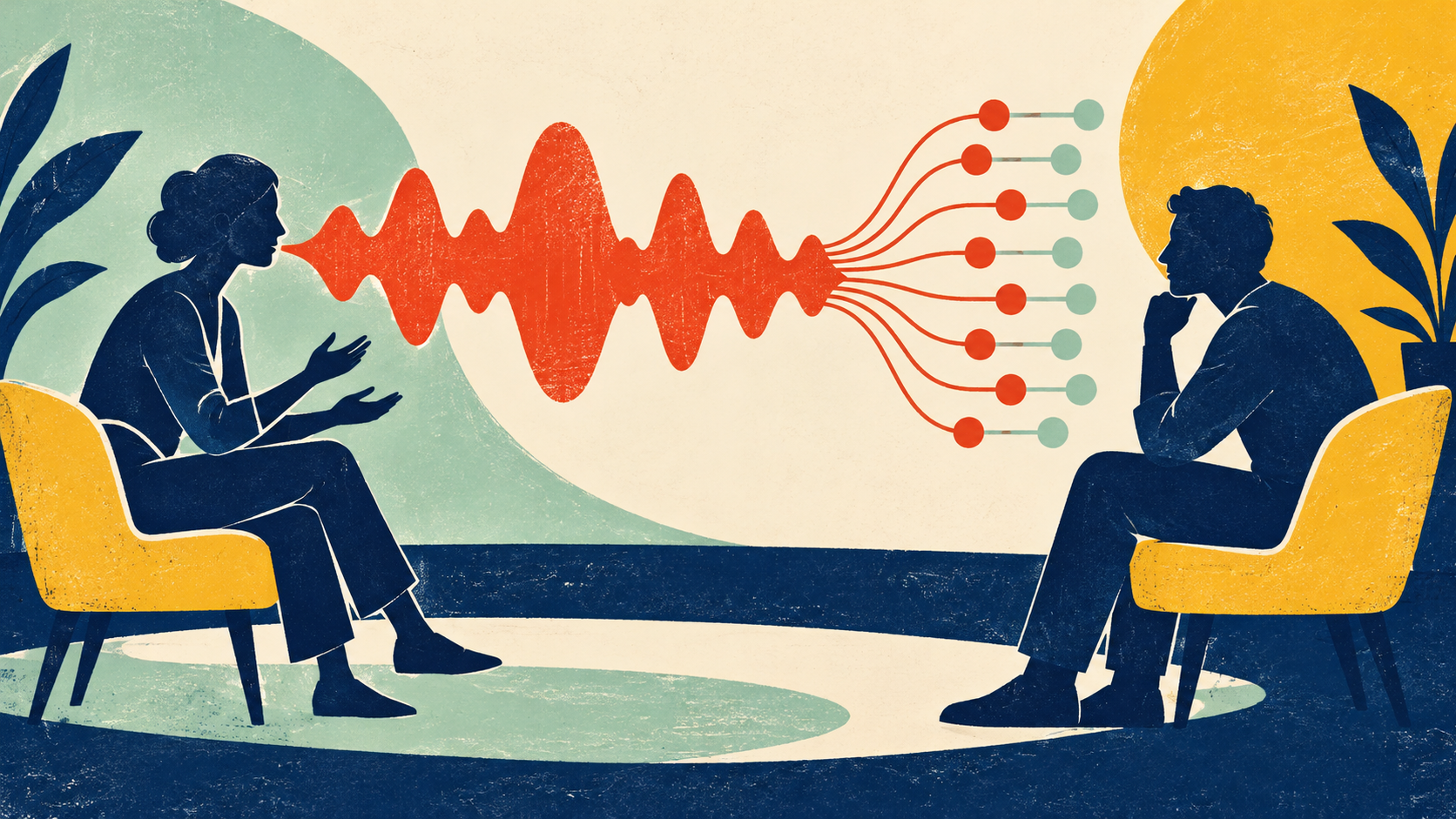
A transcript records a conversation; a Q&A summary rearranges selected parts of that conversation around questions. That sounds modest, but the change in form can change what readers notice. A researcher may see a neat sequence of question followed by answer and infer that the participant responded directly, completely, and without qualification. The transcript may show something different: a hesitant answer, a follow-up probe, a correction, a contradiction, or a question the interviewer introduced after the participant had raised an unexpected issue. Formatting can make an interpretation look like a quotation, even when the answer has been shortened or paraphrased. The safer goal is not to make every interview sound clean. It is to make the source easier to navigate while preserving the boundaries between the interviewer’s prompt, the participant’s words, and the researcher’s editorial decisions. That is why the output should identify its status and intended use instead of presenting a clean page with no indication of how it was produced.
For a concrete illustration, imagine a wholly fictional study of how adults use evening services at a public library. One participant says that the service is convenient after work but that the last bus home leaves too early. A second says that the online renewal page is difficult to use on a phone. A Q&A draft could put both under “What makes the service hard to use?” That may be useful for a briefing, but it is already a choice about grouping. It is not a neutral copy operation. The original question, response, and locator should remain available beside any shortened display version, so a reviewer can see whether the heading combines different concerns or erases the distinction between access, timing, and digital usability.
References: O’Brien et al., “Standards for Reporting Qualitative Research”; Tong et al., “COREQ: A 32-item Checklist for Interviews and Focus Groups”
The research question sets what belongs in each answer
A journalist’s Q&A usually helps a public audience follow a person’s account. A podcast listener FAQ anticipates what an audience may want to know about an episode. A research interview Q&A has a different center of gravity: it helps a research team inspect a participant’s response in relation to the study design. The same transcript can support more than one product, but each product has different permission, audience, and analytic requirements. A working research summary may keep participant codes and detailed locators because its readers need to check the source. A public-facing explanation may need different wording, fewer details, and a separate disclosure review. A draft for participant feedback may need to show where the researcher has paraphrased or reorganized an answer. Calling all three outputs “a summary” hides important distinctions.
Start by writing one sentence that states what the summary is for and who may read it. “Help the research team review responses to the approved interview guide” is different from “publish a short Q&A on the project website.” Decide whether the document will be used to prepare analysis, check transcript coverage, share an interim update, or communicate findings after analysis. Do not ask ChatGPT to choose the study’s audience or purpose from the transcript; those decisions belong to the approved protocol and research team. Reporting frameworks such as SRQR and COREQ address transparency in the study report, not a shortcut for converting one interview into a validated result. The summary should preserve enough context to serve its stated job without presenting itself as a complete account of the participant or the study. If a team cannot state the intended use in a sentence, it is too early to ask a model to decide which parts of an interview matter.
References: HHS, “The Belmont Report”; UK Statistics Authority, “Ethical Considerations Associated with Qualitative Research Methods”
1. Set the Research Boundary Before You Ask ChatGPT
1.1 Name the purpose, audience, and approved question set
Before opening a model, identify the document’s audience, the research purpose, and the approved question set. Those three decisions determine whether a Q&A is appropriate at all. A researcher preparing an internal transcript review may need a one-to-one map from each interview-guide question to the participant’s answer. A project lead preparing a plain-language update may need a small number of broader questions, but only after the findings have been analyzed and approved for communication. A public Q&A that presents a single person’s account as the voice of a community creates a different risk. Keep the field team’s analytic notes, participant-facing material, internal review copy, and public copy conceptually separate, even when they draw on the same recording. The researcher’s analytic trail should state who chose the questions, how answers were shortened, and whether the summary is descriptive or interpretive.
The fictional library study makes the choice visible. If the goal is to check whether each scheduled topic was asked, the output can mirror the interview guide and mark a topic as “not asked” or “no direct answer.” If the goal is to inform service planning, grouping a comment about the last bus with a comment about the mobile page may be useful only if the research question explicitly concerns barriers. ChatGPT should not silently invent a new question such as “What should the library change first?” when the guide never asked participants to prioritize improvements. An unanswered prompt is evidence about the interview record, not a blank the model must fill. Write down which questions may be consolidated, which must remain separate, and who has authority to approve that decision before generating any draft. Where the guide changes between waves, keep the relevant version with the interview rather than retrofitting earlier answers to a later instrument.
References: HHS Office for Human Research Protections, “Informed Consent FAQs”; UK Statistics Authority, “Ethical Considerations Associated with Qualitative Research Methods”
1.2 Confirm that the transcript may be processed in this way
Consent to take part in an interview does not automatically answer every later question about where its transcript may be processed. The participant information sheet, consent record, approved protocol, institutional policy, funder conditions, and applicable law may describe who can access identifiable data, which service providers may process it, and whether data may be reused or disclosed. Check the approved data flow before pasting or uploading anything. If a researcher cannot establish that external model processing is permitted, the safe next action is to ask the project’s responsible ethics or data-protection contact, not to test a few lines in a personal account. The answer can depend on the study, jurisdiction, participant group, and service configuration; a general blog article cannot decide it for a specific protocol.
Data minimisation applies even when the workflow is approved. Send only the portions needed for the defined task, remove fields that do not help answer it, and avoid combining a transcript with contact lists, consent forms, or identity keys. Check the current ChatGPT account and workspace terms rather than assuming that a paid personal plan, an opt-out control, or a temporary chat changes every retention or processing condition. OpenAI describes different handling for individual and business services and separate retention behavior for chats and files; the researcher must verify the current configuration that actually applies. Training controls and retention controls are different questions. If the institution requires an approved environment or a local-only workflow, use that route rather than trying to approximate the rule with prompt wording. A researcher should also check whether the proposed method changes who can access the data, where it is processed, or how long a derivative copy remains available.
References: EUR-Lex, General Data Protection Regulation, Article 5; OpenAI, “How Your Data Is Used to Improve Model Performance”
1.3 Treat indirect identifiers as part of the disclosure review
Replacing a participant’s name with “P04” does not necessarily make an interview anonymous. Qualitative accounts carry identity through context: a rare job, a small town, a sequence of events, a family relationship, or a distinctive combination of details can point to one person even when direct identifiers are gone. A model may also be asked to organize precisely the contextual details that make a story recognizable. Review the whole passage, not just a list of names. Decide whether an exact date, employer, location, diagnosis, or unusual event is needed for the research task. When it is not, generalize it consistently and keep the transformation record outside the model prompt. Do not erase details that are analytically essential without recording the change, because privacy editing can also alter meaning. This review should include details about people mentioned in passing, not only the participant whose interview is being summarized.
A practical review asks what a colleague, community member, or motivated reader could infer by combining the summary with public information or personal knowledge. If the fictional participant’s job title, one-day event, and bus route would identify them in a small town, masking only the name has not addressed the risk. Pseudonymised data can remain personal data when a separate key or additional context makes re-identification possible. Anonymisation of narrative material needs human judgment; quantitative suppression rules do not transfer neatly to unstructured interview text. Preserve the identity key in a separate controlled location, limit access, and document why details were retained or generalized. The model’s ability to produce a fluent paragraph says nothing about whether the remaining account is safe to share.
References: UK Data Service, “Anonymisation for Text Data”; ICO, “How Do We Ensure Anonymisation Is Effective?”
2. Prepare a Transcript That Can Be Reviewed
2.1 Fix the source recording and transcript version
A defensible Q&A starts with a known version of the source. Record the interview identifier, date or sequence code used internally, transcript filename, version, language, transcription method, and any correction status in a separate project-controlled log. If a transcript has been checked against audio, say so in the record; if it is an automatic or preliminary transcript, keep that status visible. A Q&A generated from version 1 should not be silently paired with version 3 after names, speaker turns, or wording have changed. The recording remains the reference point for disputed speech, subject to the project’s permissions and retention plan. When a researcher cannot revisit the audio, uncertain phrases should stay marked as uncertain rather than being resolved from what sounds plausible. For a study that corrects transcripts in rounds, assign each draft a clear status so a reviewer does not mistake an unchecked machine transcript for a settled source.
When an interview begins as audio or video, a transcription step comes before the research summary. WhisperAITranscribe is an audio and video transcription tool; in this workflow, treat its text as an upstream transcript to review, not as a research interpretation. Preserve the file or export version and the manual corrections that matter to the analysis, where project rules permit. Do not assume that a transcript generated by one service has been checked for names, specialist terms, overlapping speech, or participant intent. Conversely, do not imply that a transcription tool can determine whether a participant’s answer is representative, ethically shareable, or analytically important. The Q&A’s evidence chain begins with the source record, then passes through transcript review, selection, paraphrase, and researcher approval.
References: MacLean, Meyer, and Estable, “Improving Accuracy of Transcripts in Qualitative Research”; Lapadat and Lindsay, “Constraints and Opportunities with Interview Transcription”
2.2 Preserve speaker turns, interviewer prompts, and nearby context
A transcript is not just a string of answer sentences. It may include the original question, probes, interruptions, a participant’s correction, a pause that changes the meaning, or a researcher’s clarification. Keep interviewer and participant turns distinct, and do not let ChatGPT combine a researcher’s assumption with the participant’s answer. A short excerpt can be useful, but include enough preceding and following text to determine what pronouns refer to, whether the participant is agreeing or disagreeing, and whether the answer was conditional. A locator should lead back to the actual passage, such as a stable transcript paragraph, line range, timestamp, or internal segment ID. If the source has no reliable timestamp, do not ask the model to manufacture one.
The transcription convention also matters. Some projects preserve filled pauses, grammar, overlap, or nonverbal markers because those details affect the question being studied. Others prepare a more readable transcript for a different purpose. That is a methodological choice, not an automatic cleanup task. In cross-language work, a literal translation may preserve wording but obscure idiom, while a fluent translation may hide uncertainty or culturally specific phrasing. The research team should document who translated, what was checked, and which version is authoritative for the Q&A. Correcting recognition errors is different from smoothing participant speech. A model may suggest that “renewal” was said where the audio says “removal”; a researcher can verify that against the source. Rewriting a hesitant answer into a polished policy statement is a different intervention and must be visible. A short locator plus a stable transcript version is usually more useful than a page number alone, since pagination may change when the project edits or exports the file.
References: UK Data Service, “Managing Data: Tools and Templates”; MacLean, Meyer, and Estable, “Improving Accuracy of Transcripts in Qualitative Research”
2.3 Separate transcript corrections from analytical edits
Maintain two distinct records: corrections to what the audio or original transcript says, and edits made to produce a readable Q&A. A transcript correction might fix a clearly misheard proper noun after an authorized audio check. An editorial edit might remove a repeated phrase, combine two sentences, or move an answer under a shorter heading. The first is a source correction; the second changes presentation. Do not overwrite the source transcript with a cleaned Q&A. Keep the transcript version, the generated draft, and the reviewed output separate, and record who made a material change and why. This separation lets a co-researcher distinguish an original statement from a model’s paraphrase without having to reconstruct the history from chat messages.
The distinction becomes important when a participant’s wording carries analytic weight. A person may say “I suppose I could use the online form, if my daughter is there,” which is not equivalent to “I can use the online form with help.” Removing hesitation or dependency may make the answer easier to read but alter the condition the study is examining. Research on transcription treats transcription choices as part of the research process because representing speech always involves decisions about what to preserve. Readability is not the same as fidelity. If the summary uses edited prose, label it as a paraphrase, retain the source passage, and avoid quotation marks unless the wording is checked and reproduced accurately. The analyst, not the model, decides which edits preserve the meaning required by the research question. If the research question concerns language, interaction, or hesitation, even a seemingly harmless edit can remove the very feature under study.
References: Lapadat and Lindsay, “Constraints and Opportunities with Interview Transcription”; UK Data Service, “Anonymisation for Text Data”
3. Design a Q&A Structure That Preserves the Interview
3.1 Keep the study guide visible while drafting
Use the approved interview guide as the spine of the first draft. Give each question a stable identifier, preserve the wording actually asked, and attach the participant’s response beneath it. If the interviewer used a probe, record it as a probe rather than blending it into the main question. This matters because the prompt shapes the answer: “How did you use the evening service?” invites a different account from “Did the evening service help?” A model that sees only a selected answer may not know whether it is responding to the guide, a follow-up, or an unplanned conversation. A question ID is a practical audit key, not a claim that the participant’s account can be reduced to a form field. Keep the guide version alongside the transcript version so the summary can be checked against the instrument used in that interview.
For the fictional library example, the guide might ask about opening hours, online access, and staff support. A participant’s remark about a bus schedule could answer the first question directly, while also raising an issue the guide did not anticipate. The Q&A can preserve both relationships: place the statement under the hours question and flag the unexpected transport detail for researcher review. ChatGPT should not rename that response “transport is the main barrier” unless the study team has made and documented that interpretation. Keep generated headings provisional until a researcher confirms that they describe the source accurately and fit the intended audience. Reporting checklists such as COREQ prompt transparent description of interview questions and analysis; they do not validate a model-created question taxonomy or authorize the model to change the study guide. A research assistant can then compare the model’s proposed heading with the guide and flag any wording that changes the question’s premise or scope.
References: Tong et al., “COREQ: A 32-item Checklist for Interviews and Focus Groups”; UK Statistics Authority, “Ethical Considerations Associated with Qualitative Research Methods”
3.2 Preserve the difference between answer, probe, and analysis
A useful draft can place the guide question, the participant’s answer, a short source locator, and a separate researcher note in a consistent order. It should not collapse those fields into one polished paragraph. A note such as “participant describes a scheduling barrier” may be an analyst’s label; it is not necessarily something the participant said. If the project needs that label, place it in a clearly marked analytic field and keep the evidence excerpt separate. Do not let a model’s heading become a finding by typography alone. A plain-language question can help readers navigate, but it should not rewrite a participant’s answer as though the person had addressed the new question directly. Where several guide questions cover one topic, retain the original identifiers and record the cross-reference instead of silently merging them. This is particularly important for multi-part prompts, where a model may combine a direct answer to one part with a researcher’s follow-up about another.
The same separation helps with omissions. If an answer is missing because the question was skipped, mark “not asked” in the working record. If a question was asked but the participant declined, distinguish that from a transcript gap. If a participant answered only part of a multi-part question, preserve the partial answer rather than supplying the rest from a neighboring response. The UK Data Service’s data-management guidance emphasizes documentation, consent and transcription conventions as part of preparing reusable qualitative material. A Q&A summary should be traceable enough that another authorized researcher can tell which parts are participant evidence, which are editorial paraphrase, and which are analyst commentary. It does not need to expose sensitive details to every reader; access and detail should match the summary’s purpose.
References: O’Brien et al., “Standards for Reporting Qualitative Research”; UK Data Service, “Prepare Your Data Collection for Deposit”
3.3 Give ChatGPT a narrow, reviewable drafting task
A bounded prompt should identify the source version, the guide questions to use, the output fields, and the rules for uncertainty. It can ask ChatGPT to draft one answer per supplied question, keep unanswered questions marked, preserve speaker distinctions, avoid outside facts, retain short evidence spans, and label paraphrases. It should also say what to do when the transcript is ambiguous: return a “review needed” note with the locator rather than guessing. Ask for a draft that can be checked, not a final research summary that conceals its construction. If a task spans a long transcript, process a small, clearly labeled portion first and check that the model follows the requested structure before continuing. The researcher should not upload additional sensitive material merely to improve fluency or fill a missing response. If the first output changes speaker labels, omits uncertainty, or invents a locator, stop and revise the instructions before processing more excerpts.
A simple instruction might say, in ordinary prose, “Use only the transcript excerpt and the listed guide questions; preserve each participant’s meaning, cite the transcript locator, mark ambiguity, and do not infer themes or answer missing questions.” The prompt should distinguish direct quotations from paraphrases and specify whether the summary is internal or participant-facing. WhisperAITranscribe is a separate audio/video transcription tool, while ChatGPT is being asked to organize supplied text. Keep that provenance in the source log, and do not treat either tool’s output as a validated research finding. Published studies of researcher interactions with ChatGPT report both possible support for early qualitative work and continuing concerns about accuracy, consistency, and contextual understanding. A clear prompt helps constrain a task; it does not remove the need for researcher review.
References: Zhang et al., “Human-AI Collaboration in Thematic Analysis Using ChatGPT”; NIST, “Artificial Intelligence Risk Management Framework: Generative AI Profile”
4. Review for Meaning, Not Polish Alone
4.1 Check each answer against its source passage
Review the Q&A one question at a time. Open the cited transcript passage and check whether the participant actually answered that question, whether the answer includes a condition or correction, and whether the summary has added a causal claim. A useful audit asks: Can a reader find the supporting lines? Does the draft preserve who said each clause? Is a quotation exact? Does a paraphrase retain uncertainty, scope, and time? Did a response to a follow-up get attached to the right guide question? A locator is only useful if it resolves to the source version actually reviewed. If line numbers shift between versions, store a stable segment identifier or retain a short text anchor with the transcript version. When evidence cannot be found, remove the claim or label it for review; never let a plausible answer pass because it sounds consistent with the rest of the interview.
A practical quality check can compare each Q&A item to the transcript using a fixed set of fields: question ID, answer span, speaker, locator, edit type, and reviewer status. These fields need not appear in the public-facing summary, but they should exist in the working record when the project requires traceability. NIST’s Generative AI Profile describes confabulation as a risk in which systems produce false or misleading content, while a study of researchers using ChatGPT reported concerns about reliability and context. The implication is operational rather than dramatic: treat every generated statement as a draft claim to verify. A correct answer in one item does not establish that the whole interview was handled correctly, and a fluent paragraph is not evidence that the source contains it. A second reviewer can focus on high-impact items such as quotations, sensitive details, names, numbers, and statements that may be used in a report.
References: NIST, “Artificial Intelligence Risk Management Framework: Generative AI Profile”; Zhang et al., “Human-AI Collaboration in Thematic Analysis Using ChatGPT”
4.2 Look for changes in certainty, scope, and sequence
Many errors in a Q&A are not invented facts; they are small changes that make the answer stronger than the source. “Sometimes the page freezes” becomes “the page is unreliable.” “I could ask my sister” becomes “family support solves the problem.” “I have not tried the evening desk” disappears because the model has no answer to summarize. Read for shifts in certainty, frequency, causality, time, comparison, and who is included. Check whether a statement about one participant has become a statement about all participants, whether a possibility has turned into a plan, or whether a question’s premise has been accepted as fact. These shifts can occur during paraphrase even when every noun in the output appears in the transcript. If an upstream transcript came from WhisperAITranscribe, preserve the source version and correction status while checking these shifts.
Sequence also matters. A participant may first describe a barrier, then revise the account after the interviewer asks for an example. A summary that extracts only the first sentence may miss the correction; one that extracts only the last may hide the original uncertainty. Review the passage around the answer, including a probe or clarification that changes what a pronoun or “that” refers to. Keep disagreement visible rather than smoothing it into a single position. If one participant gives two different answers at different points, record the tension and let the researcher decide whether it reflects a change, a context shift, or a transcription problem. A summary can reduce reading time without pretending that human speech is perfectly linear or internally consistent. A reviewer can mark a mismatch directly beside the locator, then return to the transcript rather than trying to repair the sentence from memory.
4.3 Keep participant accounts separate from emerging themes
A Q&A summary is not thematic analysis. It can help a researcher locate material, compare answers to a guide, and notice a question that deserves closer reading. It cannot by itself establish how common a view is, whether it is representative, or what the study’s final interpretation should be. Participant-level answers and cross-interview themes belong in different analytic layers. If the team later develops a theme such as “digital access depends on private support,” it should return to the full dataset, examine variation and counterexamples, and document the analytic process. A generated Q&A for one transcript can contribute evidence to that work, but it is not a denominator, a codebook, or a finding simply because it uses consistent language. That distinction remains even when the source transcript was produced with WhisperAITranscribe; transcription provenance does not establish a cross-interview pattern.
This distinction also protects minority and negative cases. A model asked to “summarize the common response” may downplay a participant whose experience differs from the apparent pattern. For a single-interview Q&A, avoid language such as “most users” or “participants generally” unless a separate dataset-level analysis supports it. Do not use the Q&A to infer population prevalence. SRQR emphasizes transparent reporting of qualitative methods and the links between interpretations and empirical material; a model-generated summary should not obscure those links. A researcher can use a separate memo to note possible analytic questions, such as whether transport constraints recur elsewhere, while keeping that memo explicitly provisional. The next step is to review other authorized interviews under the study’s method, not to ask the model to generalize from one account. The distinction also makes it easier to report how the research team moved from raw accounts to interpretation, without attributing the team’s conceptual language to participants.
References: O’Brien et al., “Standards for Reporting Qualitative Research”; Zhang et al., “Human-AI Collaboration in Thematic Analysis Using ChatGPT”
5. Keep the Q&A Inside an Accountable Research Process
5.1 Version the draft, access, and retention decisions
Keep a controlled record of the transcript version, prompt version, model or service configuration when known, generated draft, reviewer changes, and approval state. The purpose is not to save every chat forever; it is to preserve enough information to explain how the Q&A was made and to support a correction if the source or protocol changes. Use the project’s approved storage and access rules. Separate identity keys, consent records, and raw audio from the working Q&A where possible, and avoid placing personal identifiers in filenames or document titles. A deletion plan needs to cover uploaded files as well as chats. OpenAI’s current help documentation describes chat and file retention separately, including files that may remain in a Library after a conversation is deleted; researchers should check the current account behavior and institutional agreement rather than infer deletion from the chat window disappearing.
Record the Q&A as a derivative working document, not as the only surviving account of the interview. If an answer is corrected, retain the change history required by the institution and make the final reviewed version distinguishable from the generated draft. Pseudonymisation can reduce risk, but it does not automatically remove the need for access controls or prove that nobody can identify a participant. Limit access according to role and purpose. The project may need one authorized analyst to hold the re-identification key while another reviewer checks a pseudonymised excerpt; that division should be explicit. Do not transfer the mapping file to a general-purpose prompt just to make it easier for a model to label participants. The project log can record the approved destination and deletion step without copying sensitive transcript text into a second, less controlled record.
References: OpenAI Help Center, “Chat and File Retention in ChatGPT”; ICO, “Pseudonymisation”
5.2 Decide whether participant review fits the purpose
Some projects invite participants to review a transcript, a quotation, or a plain-language account. That can be valuable, but it is not a universal requirement and it is not the same as asking someone to approve a researcher’s final interpretation. The study protocol and consent materials should describe what participants are being asked to review and how their feedback will be used. A person may correct a transcript, clarify a term, or object to a disclosure risk; those actions do not automatically resolve how the research team should analyze the account. Name the review task precisely. “Check whether this excerpt accurately represents your words” is different from “confirm that this theme is the study’s conclusion.” Keep the participant’s feedback and the researcher’s analytic decision documented as separate records. Where a participant identifies a factual correction, the team should record whether the transcript changed and whether the Q&A must be regenerated or manually updated.
If the summary is shared for participant review, provide enough context for the participant to understand the proposed excerpt without sending unrelated interview material. Use accessible language, explain whether edits are optional, and follow the approved process for changes or withdrawal. The UK Statistics Authority’s qualitative ethics guidance emphasizes that risks and participant needs can arise throughout the research lifecycle, including dissemination; consent and review should therefore be considered in the study context rather than bolted onto a generated document. Do not treat silence as approval. If a participant does not respond, record the project’s actual decision rule rather than letting the model or editor infer agreement. For sensitive studies, consult the ethics lead before exposing a summary that could reveal another person’s identity or private information. If the working transcript came from WhisperAITranscribe, participant review still concerns the recorded account and the study’s process, not approval of the transcription tool.
References: HHS, “The Belmont Report”; UK Statistics Authority, “Ethical Considerations Associated with Qualitative Research Methods”
5.3 Expect tools to change while the research standard stays human-owned
Model features, file handling, privacy settings, context limits, and institutional contracts change. A workflow written for one account or model version may not fit another. Recheck the service’s current documentation before processing new data, especially after a plan change or a switch between personal and managed workspaces. A small, low-risk test with synthetic text can show whether the requested structure is followed, but it cannot establish accuracy on a sensitive participant transcript. Test the workflow with invented material first and define what a reviewer will inspect before the real data path is approved. If the model cannot preserve locators or distinguish paraphrase from quotation in that trial, revise the process rather than relying on a more emphatic prompt. Use the same review questions after a model update, but do not assume that an earlier test proves the new configuration behaves the same way. If an upstream transcript originates in WhisperAITranscribe, record that step. Keep WhisperAITranscribe transcript generation separate from ChatGPT Q&A generation.
Keep audio/video transcription as a distinct upstream stage; the Q&A and research interpretation happen later and require their own review. Record the transcript’s origin where relevant, while the ChatGPT prompt and generated draft remain subject to the research team’s actual data rules. Do not infer that WhisperAITranscribe supports an institutional research workflow, anonymizes participants, or connects directly to ChatGPT unless those capabilities have been separately verified. A sensible future setup may compare a cloud model, an institutionally managed service, and a local process, but the choice depends on data classification, approval, usability, and required retention. The governing standard is accountable handling of evidence, not the newest feature or the most impressive demo.
6. Conclusion
6.1 Let the transcript stay more authoritative than the polished draft
ChatGPT can help place interview material under a defined set of questions, but it cannot decide whether the material may be processed, whether an answer is analytically representative, or whether a polished paraphrase preserves the participant’s meaning. Start with the approved purpose and guide. Confirm that the transcript may be handled in the chosen environment. Preserve version, speaker, question, and source locator. Then draft a Q&A that leaves unanswered questions, uncertainty, and divergent accounts visible. Finally, review each statement against the transcript and keep participant evidence distinct from researcher interpretation. A clear summary is useful because it makes checking easier, not because it removes the need to check. For a recording-based project, WhisperAITranscribe is an audio and video transcription tool in the upstream source workflow; its transcript still needs review before it becomes research material.
ChatGPT’s role begins only after a transcript is ready: the Q&A that follows is a separate text-organization task, with its own permissions, data settings, and quality checks. Do not present either step as a substitute for the study’s approved methods. A fictional example can make a prompt easier to understand, but only the research team can determine whether real participant data may enter that workflow and what counts as an acceptable summary. Keep the source passage close to every answer so that another authorized reviewer can inspect what was preserved, shortened, or left unresolved. A reviewer should be able to move from an answer to the cited passage without relying on a model’s explanation of how it reached the wording.
6.2 Follow four reviewable steps
Step 1: Define the audience, research purpose, and exact guide version; mark which questions must stay separate. Step 2: Confirm consent, ethics approval, service configuration, data minimisation, and the project’s access and retention rules before sharing any transcript text; record whether the source was prepared by WhisperAITranscribe and which version is approved. Step 3: Ask ChatGPT for a bounded draft using only approved source material, retaining question IDs, participant turns, uncertainty labels, and locators; do not ask it to create findings or fill gaps. Step 4: Have a researcher verify every quotation and paraphrase against the correct transcript version, review indirect-identification risk, record material edits, and approve any participant-facing or public version through the project’s normal process. These steps do not promise that a summary is valid; they make it possible to identify where judgment entered and who is responsible for it.
The order matters. A privacy decision made after a transcript has already been pasted into a service cannot undo that disclosure. A citation added after the model has paraphrased an answer may point to a passage that does not support the final wording. A neat Q&A approved before the study team has checked the guide may turn an unasked prompt into an apparent response. The four steps are a sequence of controls, not a set of boxes that can be marked by the model. Keep a short exception note when a source is unavailable, the transcript version is uncertain, or an answer cannot be mapped with confidence. That note lets the project pause one item without making the rest of the record look more certain than it is. It also gives a later reviewer a concrete question to resolve, rather than an unexplained gap in an otherwise polished output. If any control fails, pause the affected excerpt and document the exception; the rest of the interview should not inherit a false pass from the items that were easy to verify.
6.3 Keep every answer connected to its source and purpose
A well-made research Q&A summary makes an interview easier to inspect without making it look more complete, more certain, or more public than it is. The question sets the frame; the transcript supplies the evidence; the researcher decides what can be shortened and what can be shared. When the starting point is a recording, WhisperAITranscribe is the distinct transcription tool in the source chain. WhisperAITranscribe does not replace the researcher’s transcript review, consent checks, or interpretation. ChatGPT can assist with arranging supplied text, but the research team remains accountable for data handling and for every sentence that leaves the draft. Keep the source, the edit history, and the approved audience visible, and let uncertainty remain visible when the transcript does not support a cleaner answer.
References: O’Brien et al., “Standards for Reporting Qualitative Research”; Tong et al., “COREQ: A 32-item Checklist for Interviews and Focus Groups”