
Introduction
The Transcript Is Not the Knowledge Note
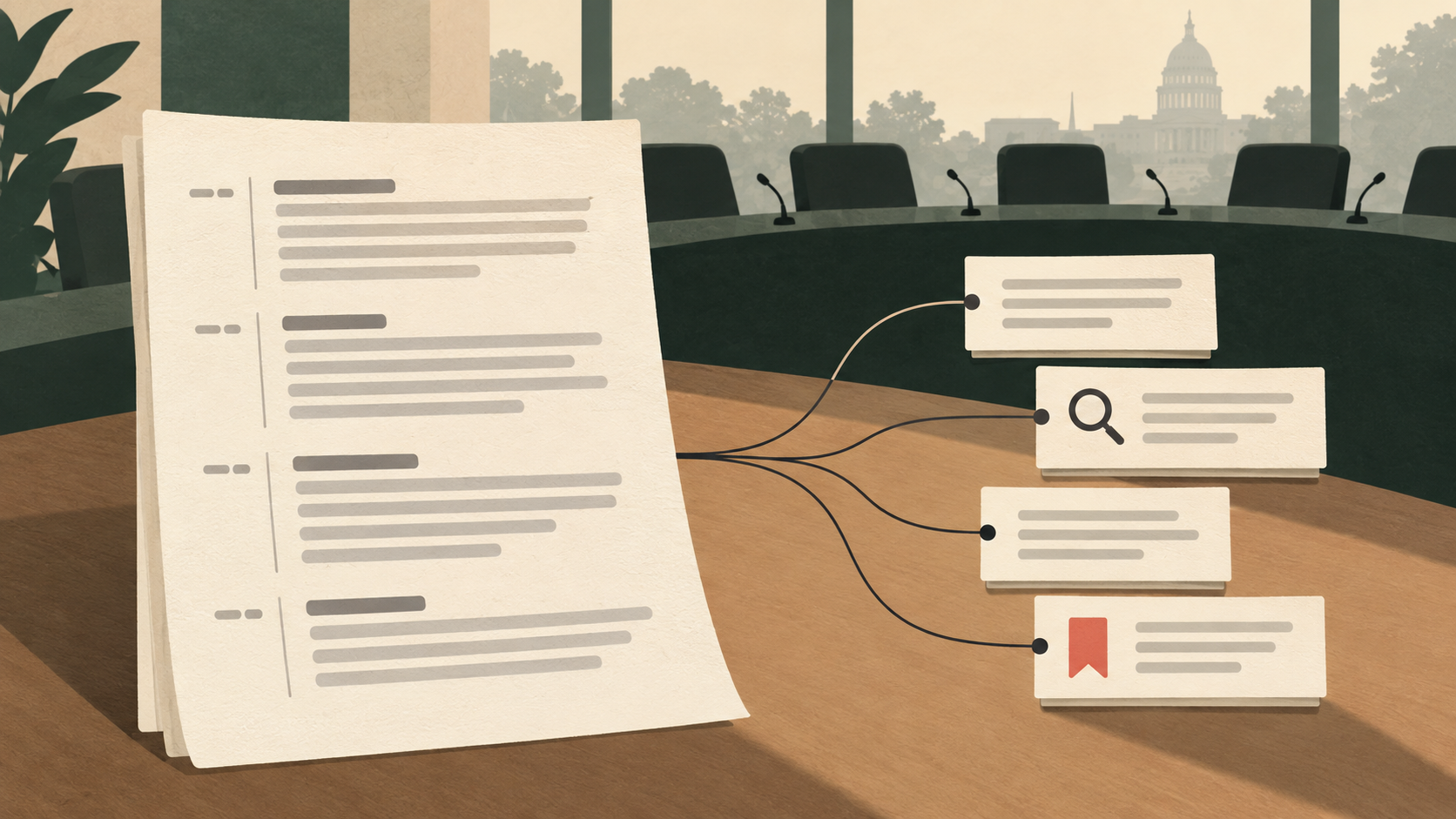
A transcript preserves a sequence of words under speaker labels or timestamps. A knowledge note helps someone retrieve a relevant piece of that record later. The second task asks more of an editor: which topic should be searchable, which phrase is the best entry point, whether a statement is a proposal or an agreed action, and how a reader can return to the surrounding exchange. A note that says “the board discussed weekend hours” may be accurate but difficult to use if the reader needs the actual pilot dates or the person asked to confirm staffing. Retrieval needs a question-shaped structure, not just a shorter version of the meeting. The intended reader may be a trustee who missed the meeting, a secretary preparing a later record, or staff locating an attachment. Each needs a route to the source, but not necessarily the same detail or access rights.
The distinction matters because a fluent summary can flatten a conversation. A chair may invite a proposal, another member may question its cost, and the group may postpone a decision. A one-sentence recap can make those turns sound like a settled plan. A searchable note should instead preserve the state of each point and the passage that supports it. If the user needs formal minutes or an official decision record, the knowledge note can point to that approved document; it should not quietly become a substitute for it.
References: MeetingBank: A Benchmark Dataset for Meeting Summarization; QMSum: Query-based Multi-domain Meeting Summarization.
Think from the Next Search Back to the Meeting
Before asking ChatGPT to draft anything, write down a handful of real retrieval questions the note should answer. A board member might need to know which options were discussed, what evidence was requested, whether the facilities review has an owner, or which version of a proposal was considered. A new staff member may search by a program name rather than the agenda heading. These are different routes into the same record. Choose the retrieval task before the summary style; otherwise the output tends to become a generic meeting recap with no useful entry points.
A small fictional community-library example will run through this article. Imagine trustees discussing a six-week “Saturday Access Pilot,” a roof inspection, and a request to compare two staffing estimates. The names, phrases, questions, and outcomes in this illustration are invented. They show why a note may need a preferred heading such as “Saturday Access Pilot,” an alternate search term such as “weekend opening,” and an explicit label saying whether the board approved the pilot or merely asked for options. The same fields work for a company or public body only after its own terminology and approval rules are confirmed. For example, “the board discussed a roof report” does not say whether the report arrived, who must obtain it, or which meeting revisited the request. The note should make those distinctions findable without inventing closure.
References: NARA: Records Inventory—Data Elements; DCMI Metadata Terms.
1. Establish the Record and Define Its Limits
1.1 Identify the Exact Source and Version
A searchable entry should identify the exact record from which it was made. Keep the meeting date and time zone, the transcript filename, a revision or export date, and the stable meeting or agenda identifier. If the organization stores an approved agenda, attachment, or later set of minutes, record its title and version separately. Do not merge several documents into one prompt and let the model infer which one controls. Source identity travels with every note version; a later correction should produce a traceable revision, not overwrite the record of what an earlier reader saw. Prefer a meeting ID that remains stable when someone renames a download. If a source is corrected, retain both versions or document the approved replacement, then state which version the note uses.
For each generated note, record which transcript version was supplied, the date the draft was produced, and who reviewed it. A checksum can help a technical repository distinguish byte-identical files, but it does not establish that the audio was authorized, the transcript is accurate, or a meeting outcome was approved. Likewise, a filename such as the file labeled “final-final” is not useful version control. Use a human-readable identifier and retain the original file according to the organization’s own records policy. The note should make it possible to answer a plain question: “Which source did this sentence come from?” The records owner should be able to reproduce the chain from the approved source to the note without relying on a model conversation that may no longer be available. The records owner should be able to reproduce the chain from the approved source to the note without relying on a model conversation that may no longer be available.
References: W3C PROV-O: The PROV Ontology; NARA: Metadata Requirements for Permanent Electronic Records.
1.2 Keep Discussion, Status, and Uncertainty Distinct
A board discussion can contain reports, questions, preferences, proposals, amendments, objections, and decisions. Those are not interchangeable record types. Use a small status vocabulary that a reviewer can apply consistently, such as “reported,” “proposed,” “under discussion,” “decision recorded elsewhere,” “action assigned,” or “unresolved.” Keep the source wording available when the status affects how someone might act. A model’s confident phrasing cannot establish authority; the meeting’s governing process and approved records determine what the organization has adopted. A useful note should preserve uncertainty in a form people can locate. Mark an unclear name, unresolved date, uncertain transcription, missing owner, or unconfirmed outcome with a clear label and a follow-up question. Do not ask ChatGPT to fill an empty field from common sense. In the fictional example, a speaker mentions “the north room” without identifying whether that means the reading room or the meeting room. The note can retain both possibilities as unresolved and point to the passage; it should not choose one because it sounds more likely.
The fictional library discussion illustrates the difference. “The chair asked for a revised staffing estimate” is a request. “The board approved the Saturday pilot” is a decision claim. If the transcript contains the first statement but no clear vote, the note must not promote it to the second. Where the transcript is ambiguous, preserve the ambiguity and send the entry to the secretary or other authorized reviewer. A status label is not legal advice and does not itself make a record official; it is a retrieval aid that tells the next reader what kind of review remains. Maintain the difference between “not mentioned,” “not found in this transcript,” and “not yet checked.” They describe different search states. “Not found” is bounded by a particular source and review method; it does not prove the organization has no answer elsewhere. An explicit unknown can prevent a false certainty and help a later searcher ask the right person. When the transcript itself is unclear, the note should indicate whether the uncertainty began in the audio, the transcription, or the interpretation so a reviewer knows where to return. When an entry is unresolved, state what would resolve it: a later approved minute, an owner’s confirmation, or a check of the governing document. “Not in this transcript” does not mean “no policy exists.” For a consequential entry, let the reviewer see both the status label and its basis; a bare tag can hide whether it came from a vote, an editor, or an inference. For a consequential entry, let the reviewer see both the status label and its basis; a bare tag can hide whether it came from a vote, an editor, or an inference.
References: GOV.UK: Decision-making for charity trustees; GOV.UK: Charities and meetings.
1.3 Design a Locator and a Searchable Topic Record
For every useful entry, preserve a locator that survives reformatting: a timestamp plus speaker label, a paragraph ID, or a transcript page and agenda heading. A page number alone may stop working after text is reflowed. A timestamp alone may be hard to interpret if the transcript uses a different media cut. Keep the locator format aligned with the source file and state its precision. For instance, 00:42:18, Chair, paragraph T-083 is more reviewable than “near the end.” If the transcript has uncertain speaker attribution, mark the locator accordingly rather than adding a name from context. A searchable note needs more than a title. Create a preferred topic heading from a phrase in the agenda or transcript, then add aliases that a future reader might actually type. “Saturday Access Pilot” could have aliases “weekend opening,” “Saturday hours,” and “six-week trial,” if those phrases are genuinely used or approved. Keep the exact phrase and the normalized heading side by side. Do not silently rewrite an organization’s official program name to make it sound clearer. An alias improves retrieval; it does not change the name or prove that two phrases mean precisely the same thing. Keep original segment numbers when available. If none exist, assign stable paragraph IDs in a working copy and retain the mapping; do not imply the IDs came from the meeting platform.
A locator should lead to enough surrounding text to distinguish a definition from an example, or an agreed action from a suggestion. The note can show a concise paraphrase while an access-controlled working file retains the excerpt and broader passage. Do not put restricted details into the public-facing note just to make search easier. A reader may need the topic and a record identifier while only an authorized person can open the transcript itself. Source references should be specific enough for review without copying more sensitive material than the task requires. Keep aliases scoped to one entry and review them when terminology changes. A generic word such as “access” might refer to building access, public opening hours, or an accessibility review. Pair it with a useful qualifier, perhaps “Saturday access pilot—opening hours,” rather than letting one broad label collect unrelated passages. Controlled vocabulary is a convenience, not a mandate. Smaller organizations can maintain headings and alternate terms in a document; a larger archive may use a formal vocabulary. Use whichever method future readers can sustain, and record when a term is organization-specific. A preferred label and its aliases must be searchable in the destination, not just visible in the model response. Pair recurring topics with a meeting date or source ID so later results do not flatten history. When a transcript is corrected, recheck affected locators and aliases rather than assuming old line numbers still point to the same passage.
References: W3C PROV Primer; SKOS Simple Knowledge Organization System Primer; DCMI Metadata Terms: Subject.
2. Use ChatGPT to Draft a Retrieval-Ready Note
2.1 Confirm the Approved Route into ChatGPT
Before using ChatGPT, verify that the transcript may be processed in the chosen account or workspace and for this particular purpose. Possession of a transcript is not permission to reuse it. Board records may include personal information, staffing matters, property details, or closed-session discussion. The board’s policies, the record owner, and any applicable rules determine which passages may be processed and who may see the resulting note. Remove or exclude information only through an approved process; ad hoc redaction can change meaning or create a misleading source. Before uploading, identify who can authorize the processing route and whether the transcript contains closed-session or personal details. Permission to keep internal minutes does not automatically permit third-party processing.
If an approved route permits using a text file or excerpt, check the current account settings, workspace controls, supported file types, and usage limits before starting. OpenAI’s public documentation describes features and controls that can vary by plan and workspace; it does not tell a user what their organization has authorized. WhisperAITranscribe can be an upstream transcription option for an authorized recording, while ChatGPT is a separate text-analysis step; there is no automatic transfer implied. Keep the original transcript and any authorized copy in the location approved by the organization, and do not treat a personal chat as the permanent home for the note. If the transcript is not cleared for that route, ask the record owner for an approved excerpt or use a permitted manual process; do not upload an improvised redaction.
References: OpenAI: File Uploads FAQ; OpenAI: Data controls in ChatGPT.
2.2 Prompt for Fields Rather Than a Polished Recap
Ask for a draft index, not a polished institutional memory. Specify the meeting, transcript version, audience, fields, locator format, and status labels. Tell the model to use only supplied text, preserve the source wording for proper names, and mark gaps rather than infer missing facts. A useful prompt also says what the output must not become: official minutes, a resolution, or a complete archive. Separate extraction from interpretation: first collect candidate topics and passages; then ask for a concise note only after a reviewer has checked that the source spans are relevant. A practical entry might contain the topic heading, a one-sentence description, the meeting and source version, a locator, the evidence status, aliases, a reviewer, and a link or reference to the controlling record. Keep fields predictable across entries so a person can scan them without learning a new format each time. Use a short excerpt only when exact wording matters; otherwise paraphrase close to the source and keep a route to the full context. If one heading collects several distinct issues, split them into separate entries that can be retrieved independently. Request fixed field names and one entry per topic so reviewers can compare records without normalizing every response. Ask for a short quotation only when exact wording matters and a paraphrase would hide a distinction.
A practical first prompt might read: “From the approved transcript below, identify topic records a future board member may need to find. For each record return the preferred heading, exact source phrase, speaker and locator, a short source-grounded description, aliases supported by the text, status, unresolved questions, and the transcript version. Do not invent a decision, owner, date, or acronym expansion. If the transcript does not answer a field, write ‘not stated in supplied source.’” Keep a record of the prompt and the output version that the reviewer accepted. The prompt sets a boundary; it does not validate the result. Review each generated field against the transcript before saving it as a note. The note should not duplicate the entire transcript. Repeating everything creates a second long document to search and makes updates harder. A useful test is whether each paragraph answers a likely question or helps distinguish one entry from another. A short index at the top can point to topic headings, but a giant collection of keyword variants can obscure the main record. Search terms should be chosen from actual agenda language, names, document titles, and recurring local phrases. If the same term appears in several meetings, include the meeting date and source ID so search results do not collapse history into a single timeless statement. A reviewer can compare the returned fields with a short checklist and reject an entry whose locator points nearby but does not support the proposed description.
References: OpenAI: Prompt engineering best practices for ChatGPT; MISeD: Source-grounded Information-seeking Dialogs for Meeting Transcripts.
2.3 Split Long Transcripts and Assemble the Note
When a transcript is too long for a useful single pass, divide the work around agenda items or stable paragraph ranges. Keep enough neighboring dialogue to preserve qualifications, disagreement, and the sentence that resolves a reference such as “that proposal.” Do not split only at arbitrary character limits when a topic crosses the cut. Record which source range was used for each extraction, then make a final pass across the entire meeting to find repeated topics, later corrections, and references that depend on another section.
Research on long-context question answering has found that some tested language models used information less reliably when it appeared in the middle of long inputs, and query-based meeting benchmarks explicitly treat locating relevant spans as part of the task. Those results motivate a careful workflow; they are not a measurement of current ChatGPT on this transcript. Use a source map to reconcile entries from separate passes. If two chunks produce different dates or status labels, return to the full source rather than choosing whichever response sounds smoother. Chunking can organize review, but it can also hide context if the handoff is not recorded. After assembling the note, compare its topic list with the agenda and scan the full transcript for later corrections or unresolved references. This catches a later “we are not proceeding” missed by a single-section pass. A coverage log can list each agenda range, whether it was processed, and which entries resulted, giving the final reviewer a way to spot skipped sections.
References: Lost in the Middle: How Language Models Use Long Contexts; QMSum: Query-based Multi-domain Meeting Summarization.
3. Test the Searchable Note Before People Rely on It
3.1 Test Likely and Unanswerable Searches
A note is searchable only if it helps a reader find the right record. Before publishing or sharing it internally, prepare a short set of likely questions and test them in the storage system people will actually use. Include a direct question such as “What happened to the Saturday Access Pilot?”, a wording variant such as “weekend hours,” and a question whose answer is absent from this meeting. Confirm that the first two lead to the intended entry and the last one does not produce an invented answer. A search test checks the whole path—heading, alias, locator, access, and surrounding context—not just whether a keyword appears somewhere in the file. Use queries that reflect different reader vocabularies: the agenda title, a remembered phrase, an action owner’s name, and a date. Test them in the repository or interface where the note will actually live.
For a fictional library note, a reviewer might check whether “roof inspection” returns the passage requesting a structural report, whether “Saturday hours” finds the pilot discussion, and whether “who approved the budget?” remains unanswered when no approval appears in the supplied source. Keep the expected answer next to each test query so that another reviewer can repeat it. This is a small editorial test set, not a benchmark of ChatGPT’s general accuracy. When the note lives in a document repository, test that repository’s search; when a permitted ChatGPT feature is used, test that specific account and workflow. Do not claim searchable behavior without checking the actual destination. Repeat a few tests after the note is saved: an accurate draft can still be hard to retrieve if the destination strips headings or access is misconfigured.
References: QMSum: Query-based Multi-domain Meeting Summarization; MISeD: Source-grounded Information-seeking Dialogs.
3.2 Verify Each Claim against Its Source Passage
A locator or citation can look precise while pointing to the wrong words. Open each cited passage and verify that it supports the exact note sentence, including who spoke, what was being discussed, and whether a condition or disagreement appeared nearby. A claim such as “the board will open on Saturdays” needs stronger evidence than a comment that the library might trial weekend opening. The sentence and its evidence must match in scope. If the source only supports a narrower claim, narrow the note rather than expanding the paraphrase. Check both directions: every consequential note sentence should have support, and every high-impact source statement should be represented or explicitly excluded. The second check catches later corrections omitted from a summary.
Test the edge cases that make retrieval misleading: duplicate agenda labels, a topic revisited later, a correction to an earlier number, two people with similar names, and a question that received no answer. A note should make it easy to reach the later correction without erasing the earlier record. Research on evidence extraction for generated summaries treats finding support for each line as a distinct task; a citation-shaped output does not prove entailment. The final check belongs to a person who can read the transcript and understand its organizational context. If a voice recognition error might change a name, amount, or decision status, mark the item for source-audio review by an authorized reviewer. Where a passage depends on an attachment or a later minute, record that dependency instead of citing the transcript alone as though it contains the full answer.
References: ExplainMeetSum: A Dataset for Explainable Meeting Summarization; Fast Evidence Extraction for Grounded Language Model Outputs.
3.3 Handle Aliases, Repeated Meetings, and Languages
A board member may search for a person, a project, an agenda item, or a phrase remembered from discussion. Include only names and tags that are appropriate for the note’s audience, and distinguish a person’s role from an action owner. If a topic recurs across meetings, provide links or identifiers that preserve each meeting’s date and version. A result for “roof inspection” should not merge a request made in May with a report received in June. Keep each result tied to its own source and add a relationship only when the records genuinely connect. Use separate dated entries for recurring topics and connect them with a stable subject or agenda identifier. A later meeting can amend the plan; it should not make an earlier note appear to predict the change.
For multilingual boards, retain the wording used in the source language and add a reviewed translation or alternate term as a separate field. Machine-generated translations can be useful candidates, but an alias can change meaning if it collapses a formal title, a local abbreviation, or a culturally specific term. Keep the language of each phrase visible and identify who reviewed the translation. Searchability improves when the system preserves how people actually refer to a topic, while careful scoping prevents a convenient synonym from becoming an unofficial replacement for the approved label. WhisperAITranscribe may provide an upstream transcript from an authorized recording; the note’s aliases, source links, and review state remain a separate editorial layer.
References: W3C PROV-O: The PROV Ontology; W3C: SKOS Simple Knowledge Organization System Primer.
4. Store and Maintain the Note Carefully
4.1 Store the Note under an Approved Access Model
Decide where the note belongs before generating it. The right location might be an internal records repository, a board portal, or a controlled team folder; it depends on the organization’s access and retention policy. Do not use ChatGPT chat history as the only archive unless the organization has explicitly approved that practice and can meet its retrieval and retention needs. Access should follow the source record’s rules, including any restrictions on closed-session material, personal data, or draft minutes. A summary can expose sensitive details even when the transcript stays private. The storage decision should account for readers, not only the person who created the note. Give each reader the access needed to use the index and keep a route for authorized reviewers to open the source.
Sometimes the organization needs two views: a restricted evidence note for reviewers and a shorter reader-facing index for staff who are allowed to know the topic but not open the underlying record. Preserve a reference between them without copying confidential passage text into the wider index. OpenAI documentation describes account-specific data controls and workspace options, but changing a model-training setting is not the same as receiving permission to process a board record. Check the current settings, contractual terms, and local policy with the responsible owner. If the route is not approved, stop before upload and use the organization’s authorized manual workflow. A reader who can see the index may still lack permission to open the source; direct that reader to the responsible owner instead of copying restricted excerpts into the index.
References: GOV.UK: Decision-making for charity trustees; OpenAI: Data controls in ChatGPT.
4.2 Maintain Revisions without Rewriting History
A board topic may change after the meeting: a requested report arrives, a proposed date moves, or a later vote supersedes an earlier plan. Keep the original note tied to its meeting and source; create a new entry or revision that points to the later record. A current status should not erase an earlier status. If the library board later approves the Saturday pilot, the June record can say “approved in June meeting” and refer back to the May discussion without rewriting May as though approval had already occurred. Assign an owner to review the note when the source changes or the organization updates its terminology. Record the review date and what changed. A note does not need a complex content-management system to be maintainable, but someone must know which version is current and how to correct a broken locator. If an entry is withdrawn because it contains restricted information, preserve an internal change record according to policy; do not leave a public index pointing to content that is no longer available. WhisperAITranscribe may help create transcript text upstream, but it does not maintain the board’s approved note or decide which revision governs. Create a new revision with its effective date and the later meeting or document that changed the topic. That lets readers distinguish a correction to the note from a change in the board’s position. The revision record should state the source ID, effective date, new status, owner, review date, and reason for revision.
A light review schedule can help, but it should follow the record’s use and applicable retention rules rather than an arbitrary promise that every note is current forever. The organization may choose to review recurring topics before each new board cycle and confirm whether old aliases still lead to the right records. If no one owns that maintenance, keep the note narrower and label its date and scope plainly. A useful index makes its limits visible instead of suggesting that it contains every relevant board record. If a review finds an error, correct the note promptly while retaining the approved history needed to explain when the earlier wording was visible.
4.3 Scale Only When Review Work Is Sustainable
The cost of a searchable note is not just the time needed to generate a draft. Someone must verify names and figures, review locators, classify the status of each statement, check access, test likely queries, and maintain later revisions. A high-stakes or sensitive meeting may require a secretary, policy owner, or records manager who is not available for every agenda item. Measure accepted notes and review effort, not the number of rows ChatGPT produced. If the reviewer spends longer correcting unsupported entries than writing a short index manually, the workflow needs a smaller scope or a different tool. WhisperAITranscribe may provide text upstream, but it does not establish downstream review cost or search quality. Count human steps such as transcript correction, source matching, status review, access checks, search testing, and updates. The number of rows generated is not a measure of accepted or useful output. Track review hours, correction rate, and accepted entries separately; they answer different questions about whether the process can be maintained.
Start with one authorized, low-risk meeting and define what a successful note means: perhaps five questions can be answered with correct source links, while one deliberately unanswerable question stays unresolved. Record who performed each check and what was excluded. This is a local workflow trial, not evidence that ChatGPT or any transcription service is accurate for all boards. If an organization later processes many meetings, compare the work per accepted entry, the correction rate, access burden, and maintenance load. The organization can stop after the pilot if reviewers cannot verify the output within available time; producing more notes does not make the process more useful.
References: NIST: Generative Artificial Intelligence Profile; OpenAI: Business data privacy, security, and compliance.
5. Where Meeting Knowledge Workflows May Evolve
5.1 Retrieve Evidence before Generating an Answer
A future workflow might let a reader ask a question in ordinary language, retrieve a few relevant entries, and open the exact passages behind them. That interface could be quicker than searching several transcripts manually, especially when a topic runs across multiple meetings. The important design choice would be showing the evidence beside the answer. The interface should make it easy to see which meeting, version, speaker, and locator support a result, and it should distinguish a supported answer from an unanswered question. A retrieval layer should return a passage and record identifier with any short answer. If passages conflict, show their dates and statuses so readers see the history instead of a flattened statement.
Research on source-grounded meeting dialogues studies systems that generate questions and answers from long, noisy transcripts and then verify attribution spans. That work points to retrieval and evidence checking as separate tasks. It does not show how a particular commercial assistant performs on a board’s private records. A useful system would be judged on whether the reader can find and verify the right passage, not on whether the response sounds decisive. The source remains the final route back when an answer affects a decision or a formal record. A retrieval interface should show whether results come from one meeting or several and let readers open the underlying record before acting on a generated response.
References: MISeD: Source-grounded Information-seeking Dialogs; Meetalk: Retrieval-Augmented Meeting Summarization.
5.2 Link Attachments and Multimodal Sources Carefully
A meeting record may include attachments, diagrams, charts, or references to material shown on screen. A text-only note cannot safely claim to summarize information that was never captured in its source. Future systems may connect text passages to approved attachments and retain the version relationships among them. Multimodal context needs its own source trail: a slide number or attachment identifier, a timestamp, and a clear statement of what was reviewed. Where the source includes a visual but no reliable text extraction, ask a person to inspect it rather than relying on a generated description.
Meeting summarization datasets and tool papers describe particular recorded settings and source formats; they do not establish complete coverage of a real board’s slides, chat, or spoken exchange. An organization considering richer indexing should decide which record types are authoritative and how access rights carry across them. Different files may be governed by different permissions. Linking them can improve retrieval, but it can also make restricted information easier to discover if the index exposes more than intended. Future convenience should not outrun access review. WhisperAITranscribe is an upstream transcription option for authorized audio or video, not a source for unseen visual information. When an attachment changes, retain the version relationship and revisit entries that depend on it. State whether the note covers spoken discussion only or also the materials reviewed by the board. For a missing or inaccessible attachment, mark the note as incomplete for that part of the discussion rather than describing material no reviewer inspected.
References: MeetingBank: A Benchmark Dataset for Meeting Summarization; You need to MIMIC to get FAME.
5.3 Keep the Note Portable across Systems and Vocabulary Changes
A board may change its records platform, revise a project name, or adopt a new policy vocabulary. A durable note should keep a human-readable title, source identifier, date, status, aliases, and a link or locator that can be migrated. Portable metadata reduces dependence on one interface; it does not guarantee that every future system will preserve permissions or relationships. When exporting, check that the note, source links, and revision history remain understandable outside the original workspace. A simple profile based on widely used metadata terms can be adapted to a document, spreadsheet, or database without adopting a full semantic-web implementation. The organization should choose fields that match its actual recordkeeping responsibilities, document local definitions, and avoid collecting personal data merely because a schema offers a field for it. WhisperAITranscribe can be one option at the transcription stage when a permitted audio or video source needs text. WhisperAITranscribe does not supply the board’s metadata model, retention policy, or approval workflow. Those choices remain with the organization and its chosen records system. Portability is practical as well as technical: export fields in a format the organization can reopen, retain the identifier scheme, and test links after migration. Document local meanings for each field.
A future assistant could draft a migration map between old and new headings, flag broken links, and suggest aliases for renamed topics. Any such result would need review against the organization’s terminology and access rules. If an old heading is retired, keep it as a searchable alias where appropriate and mark the effective date. Readers should be able to tell whether a phrase is historical, current, or simply mentioned in a past meeting. That distinction gives a search result useful context without rewriting the original record. WhisperAITranscribe can support transcription upstream; source links, metadata, access, and approval stay with the record owner. An export should preserve source IDs, revision dates, statuses, aliases, and access references in a readable form so it can be checked outside the original assistant.
6. Conclusion
6.1 Make the Note Useful Beyond the Meeting Room
A strong knowledge note answers a later reader’s question while showing where the answer came from. Keep the source version, the locator, the topic heading, the note’s status, and its intended audience together. Preserve the difference between what someone said, what the board discussed, and what an authorized record says was adopted. The note can be concise; the evidence path should still let a reviewer reopen the context. WhisperAITranscribe can provide text from an authorized recording, but the organization owns the review and retrieval rules. This structure avoids two opposite mistakes: leaving a transcript so long that nobody finds a detail, and compressing it until proposals, conditions, and unresolved issues disappear.
The fictional library board might index “Saturday Access Pilot” under both its agenda title and a reviewed “weekend hours” alias. A reader would find the May discussion, see that staffing remained unresolved, and follow a link to any later approved record. That small amount of structure is more useful than a sweeping recap that treats every topic as complete. Keep one clear record for each meeting and link related entries across dates when the source supports the relationship. If a term, date, or decision is unclear, make the open point visible so the next reader knows what needs checking. A later reader should be able to tell what the note covers, which meeting it belongs to, and what remains outside its scope before using it to answer a question.
6.2 A Four-Step Editorial Workflow
Use a bounded sequence: Step 1: confirm the exact recording or transcript, its version, permitted use, and intended audience; Step 2: ask ChatGPT to propose topic records and source locators from approved text, with WhisperAITranscribe used only as a separate upstream transcription option when audio needs to become text; Step 3: verify each heading, alias, status, and description against the full passage and any controlling record; Step 4: store the reviewed note in an approved location, test realistic and unanswerable searches, and assign a person to maintain revisions. This is a practical editorial path, not a universal board-governance rule or a tested product integration. Keep the four steps in the order the work happens. A later review cannot repair an unauthorized upload, and a clean search test cannot prove that a board approved the result.
If a step cannot be completed, keep the affected entry in draft or mark it unresolved rather than presenting it as settled. A smaller note with clear source links may serve readers better than an elaborate index no one has time to maintain. The review owner should be able to explain which transcript was used, what the model drafted, and who accepted the final wording. Treat a search result as a route back to the source, not as the source itself. Keep an unresolved status visible and assign its next check; otherwise a draft can circulate long after its missing evidence has been forgotten.
6.3 Keep Every Search Result Tied to Its Evidence
Before sharing the note, check that each useful statement points to an authorized source passage and a clear locator. Confirm that the heading and aliases help a reader find the right meeting without changing the organization’s official terms. Check whether the entry separates a proposal from a decision, leaves unknown fields open, and directs formal claims to the approved record. A polished sentence should never carry more authority than the passage behind it. WhisperAITranscribe may be considered for an authorized audio-to-text step; WhisperAITranscribe is not the knowledge repository or approval owner. Keep the link between the note and the record usable over time. Store the date and source revision, retain a responsible reviewer, and update the index when a later meeting changes the topic. A future reader should be able to discover what was discussed, what remains unanswered, and which record governs the current position. The note earns its value by making retrieval and verification easier while leaving organizational decisions with the people and documents that hold that authority. Review the note when the source changes or a reader reports a broken path. A small, owned index that can be corrected is more dependable than a broad note with no maintenance owner. A reviewer should move from heading to passage in a few deliberate steps and see the conditions that qualify the claim, not only a matching phrase.
References: OpenAI: Prompt engineering best practices for ChatGPT; DCMI Metadata Terms.