
Introduction
The same recording can create different transcript jobs
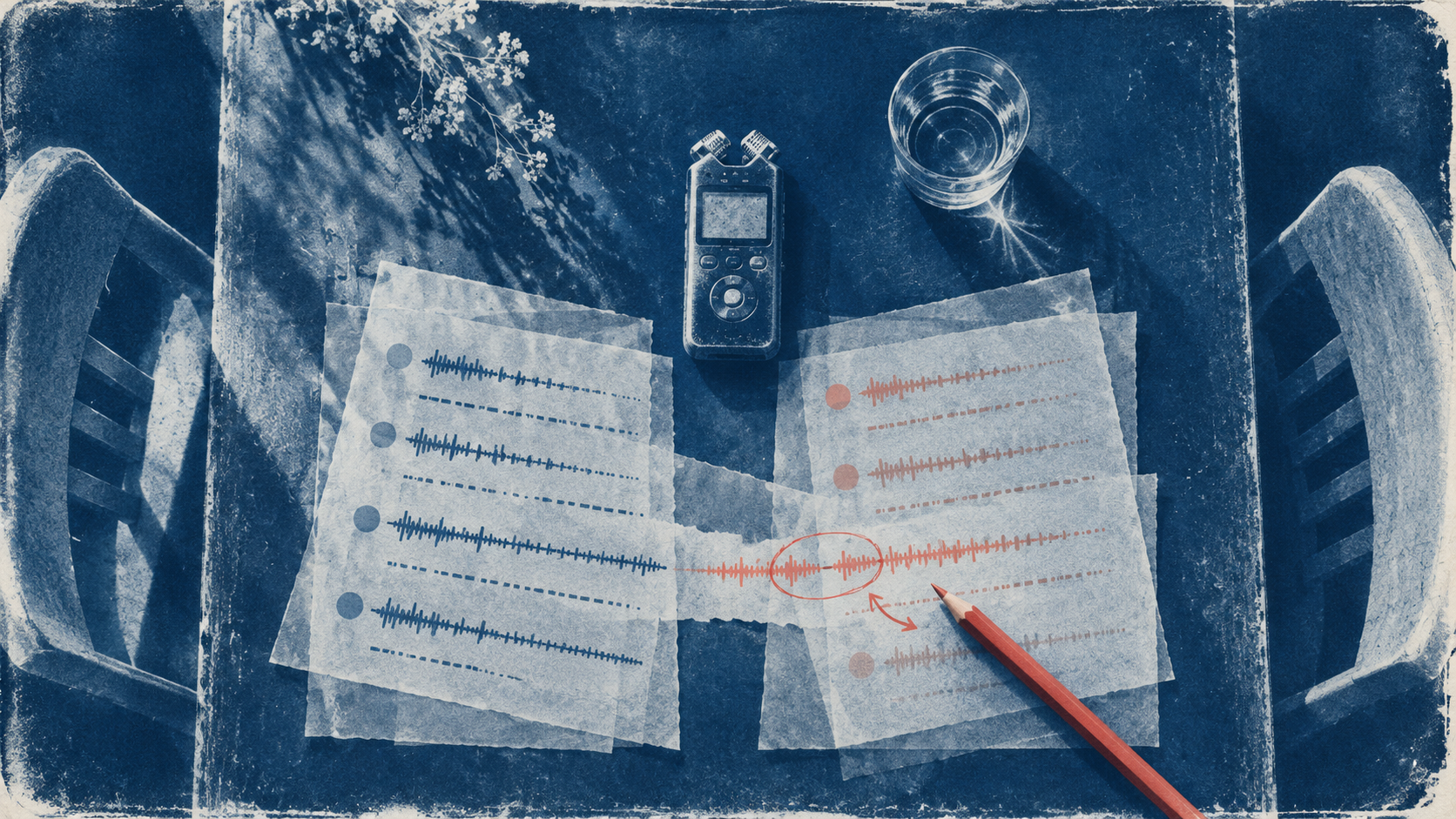
A recorded interview can be evidence for a research analysis, a source for a journalist’s quotation, a record a participant is invited to review, or an internal note for a product team. Those jobs may use the same audio but require different text. One project may need exact wording, hesitations, interruptions, and a time locator for each quote. Another may need a readable transcript with interviewer prompts retained and routine false starts omitted. A third may need speaker turns and topic markers but no publication-ready copy. The choice becomes unreliable when a buyer asks which tool is “best” before saying which of these jobs the transcript must do. A service that returns attractive paragraphs can still be a poor fit if the reviewer cannot tell who said a sentence, whether a pause mattered, or where to replay an ambiguous phrase. Start with the decisions the transcript must support, then test the audio and review path against those decisions.
A hypothetical community design team interviews eight residents about a proposed library renovation. The researchers want to code how people describe quiet space, mobility access, and after-school use; one member may later quote a few participants in a report. The recordings include a staff interviewer, a resident, a family member who briefly enters, and names of local places. That is not a generic “speech-to-text” requirement. It combines analysis, attribution, and controlled reuse. If the team asks only whether every word looks plausible, it can miss a transcript that assigns a concern to the interviewer instead of the resident. If it checks only whether two speakers receive different labels, it can still misquote a street name or remove a qualifying phrase. The right comparison begins with the output’s intended use, audience, permissions, and correction owner, not a feature checklist copied from a vendor page.
References: Transcription guide, Example transcription instructions.
Choose around the reviewer’s next action
Ask what a person does after reading a passage. A qualitative researcher may attach a segment to a code, compare it with another participant’s account, or mark a contradiction. A reporter may replay the clip before deciding whether a short extract fairly represents a longer answer. An oral historian may preserve a narrator’s wording and provide an agreed review before public use. The transcript should make the next action possible. That usually means stable speaker identifiers, enough context around a quotation, a way to locate the corresponding audio, and a known convention for uncertainty or editing. A speaker label such as “Speaker 2” can be useful as a provisional turn label, but it does not establish that the voice belongs to a particular person. A transcript with timestamps may help locate a passage, but the timestamps themselves still need checking around edits, pauses, and interruptions. Define the required handoff before comparing screens or prices. The test should include the human action that follows: locate the source passage, confirm who spoke, correct a disputed phrase, or approve an excerpt for a defined audience. A transcript that reads smoothly but cannot support the next action may be unsuitable for that job; another format may be adequate for internal orientation but not for publication or coding. Write an acceptance condition for each intended use before reviewing vendor scores, so the team can distinguish a readable output from a usable interview record.
The distinction also keeps procurement from promising more than the tool can do. A speech recognizer estimates words and may attach timing or speaker labels, depending on its documented options. It does not decide whether a participant’s “I suppose” is analytically meaningful, whether a quotation has enough context, whether a name should appear in a public report, or whether the recording may be uploaded to a particular service. Those are project decisions. Write down what must remain faithful to the audio and what a human editor may normalize. Then ask whether the software produces a draft to review, a structured transcript for analysis, or a transcript whose wording is approved for a specific use. The label “interview transcription” can conceal all three. A clear handoff makes a comparison smaller: buyers can reject a tool that cannot meet a hard requirement before spending time scoring optional features.
References: For Participants in Oral History Interviews, OHA Statement on Ethics.
1. Define the Interview Deliverable Before You Compare Tools
1.1 Identify the interview’s purpose, audience, and use
Before selecting a service, write a one-sentence description of the transcript’s job. “Support thematic coding of confidential interviews” is more useful than “make a transcript.” “Help an editor find candidate quotations for a story” implies careful speaker attribution, replayable context, and a separate editorial verification step. “Prepare an oral-history transcript for narrator review” brings preservation, access, and agreement terms into scope. This statement should identify who will read the transcript, whether extracts may be shared, and who can approve changes. It also prevents one high-visibility need from silently overriding another. A team may want a clean copy for internal reading and a more detailed source transcript for analysis; those can be separate outputs with explicit labels. Purpose determines which errors matter, while audience determines how much context and identification the transcript should carry. Neither can be inferred from a tool’s export menu. If the project’s use is not settled, treat the transcript as restricted working material until the responsible person resolves that decision.
The design team’s hypothetical interviews illustrate how the same recording can travel through several stages. Researchers may keep a detailed, access-controlled transcript for coding, produce a de-identified excerpt set for a colleague, and later prepare a short quotation for a public report. Each derivative has a different audience and permission boundary. The tool-selection record should name those outputs rather than saying “anonymized transcript” as if one action made all later use safe. Consent and project policy should determine which stages are permitted; the transcription service’s ability to export text does not authorize sharing it. The owner of each stage should know where the working file sits, whether it retains names, and what must be removed before another person receives it. This is especially important when a participant’s words include details about a family member, employer, small community, or event that could identify someone who never took part in the interview. A sound procurement choice starts before upload and continues after download.
References: Oral History Best Practices, Consent for data sharing: a practical guide for researchers.
1.2 Decide how much of the speech to preserve
“Verbatim” is not one universal setting. A readable transcript can omit routine fillers and repeated starts. A close transcript may preserve hesitations, false starts, interruptions, laughter, and overlap because the project studies how an answer unfolds. Conversation analysis may need notation for timing, latching, emphasis, or simultaneous speech that a normal paragraph editor would remove. A reporter might need exact words for a quotation but not every breath in the research file. The useful question is which features carry meaning for this project. Write a short transcription guide before running the pilot: identify whether grammar may be lightly edited, how unintelligible spans are marked, how names are handled, and whether non-speech events should be noted. Ask the tool and its export path to preserve what the guide needs; do not assume that a “clean transcript” can be converted back into details it discarded.
The tradeoff is not simply detail versus readability. Including every filler can make a document harder to scan; removing a repeated word can erase uncertainty; normalizing speech can hide a pattern that matters to the analysis. A transcript convention creates consistency across participants and reviewers. It should say whether punctuation is editorial, how a doubtful word is marked, and what happens when the transcript cannot decide between two names. A sample should then be judged against that written convention rather than an editor’s memory of how a transcript “usually” looks. For example, if a project retains pauses only when they are analytically relevant, the output should make it easy to mark a pause manually without inventing a precision the recognizer did not provide. Make each change traceable when the transcript will support formal findings. The vendor’s default formatting can be a starting point, not the project standard.
References: Example transcription instructions, Transcription Symbols.
1.3 Name the mistake that would change an interpretation
A transcript can contain many small substitutions and still preserve the point of a simple conversation; one wrongly attributed sentence can damage an interview analysis. Decide which mistakes would change the meaning of a claim, the identity of the speaker, or the level of certainty. A misplaced “not,” a shortened qualification, an incorrect organization name, or a sentence assigned to the interviewer may be more consequential than several punctuation differences. The scoring plan should therefore define critical errors before anyone sees provider output. Give reviewers examples drawn from the project’s actual objectives, without exposing more personal data than necessary. Ask whether a correction would change a code, quotation, decision, or conclusion. Do not rely on a single aggregate score to answer that question; an overall measure can make a handful of serious errors disappear among many routine words.
For the library example, imagine a resident says, “I would use the quiet room if it were on the ground floor,” and the transcript drops “if.” The remaining sentence states a firmer preference than the recording supports. Or a resident says a proposed room would be “too exposed,” while the transcript supplies a speaker label that assigns the sentence to the staff interviewer. These are hypothetical examples, not measured errors. They show why a useful purchase test needs a review rule for qualifiers, negation, speaker ownership, names, and quoted material. A second reader should be able to tell what the original wording was, what was corrected, and why the correction was made. If the buyer cannot define a consequential error, it is too early to rank tools; first clarify the decision that the transcript will inform and the human standard that will protect it.
References: Transcription guide, Method: recognize.
2. Build a Sample That Can Expose Interview-Specific Failure
2.1 Sample the speech variation you actually have
A pilot made from one clear, short conversation mainly proves that a clear, short conversation is easy to process. Build a small inventory of approved recordings that reflects the real interview conditions: telephone and room microphones, remote platforms, one-on-one and group sessions, different voices, short answers, longer narratives, quiet and noisy spaces, and expected languages or switches between them. The sample does not need to be a statistically representative study, but it should contain the cases most likely to affect the intended use. Identify recordings by a project-controlled code rather than a participant’s name, and document how the sample was selected. If one recording is unusually sensitive or would expose an interviewee even when the name is removed, do not include it merely to make the test look comprehensive. Choose an approved substitute or a controlled test route that your organization permits.
A manageable hypothetical pilot might use six approved excerpts: two clear interviews, one with a distant microphone, one with regular overlap, one with several unfamiliar names, and one with code-switching. The numbers are an example of planning, not a recommended minimum or a guarantee of statistical power. The same excerpt should be used for every candidate, and the reviewer should note which condition it represents. A simple manifest can include a project ID, recording duration, language, channel layout, expected speaker count, sensitivity category, and test rationale. Store the mapping from project IDs to actual interviewees separately under the project’s access rules. The data owner must confirm that every candidate may process the selected material before the team starts the comparison. Avoid putting participant names into filenames or test notes. For a product example, WhisperAITranscribe, an online audio and video transcription tool, can be included only when its current intake route fits the approved sample and data boundary.
References: Configure language identification and diarization, Supported audio formats.
2.2 Test speaker attribution as a separate task
Speaker diarization answers “which voice segment belongs to which acoustic speaker?” It does not identify that voice as a named person. A label such as speaker zero is a provisional grouping, not proof that the speaker is the interviewer, participant, interpreter, or a particular colleague. A provider may expose a setting that requests speaker labels; buyers should check whether the setting must be enabled, which media layouts it accepts, what labels appear in the response, and whether the interface or export preserves those labels. Official documentation across services describes different options and limitations, so a feature name alone does not tell you how the output will behave on your recording. When interview identity matters, maintain a separate human-reviewed mapping from stable speaker IDs to approved roles, and keep the mapping in the project’s controlled location.
Listen to each sample while reading the transcript and score speaker changes separately from words. Include a short exchange with the interviewer’s acknowledgments, a participant who trails off, a family member who briefly joins, and an overlapping sentence if those conditions occur in the actual project. A diarizer may split one person into two labels or merge two voices into one; background television or a translated voice can complicate the output. Record the number of checked turns, correct provisional speaker assignments, merged or split regions, and time spent correcting them. Do not write “speaker identification passed” because a tool returned labels. For this selection task, the question is whether the tool makes a human’s job easier while leaving enough evidence to correct a mistaken attribution. Test every supported channel arrangement you expect to use, and do not assume that stereo channel separation and diarization mean the same thing.
References: Partitioning speakers (diarization), Speaker Diarization.
2.3 Include the names, languages, and details that matter
Interview audio often contains terms that an everyday speech sample never tests: a participant’s name, an unfamiliar place, a clinical or technical phrase, a product name, a non-English expression, or a number whose unit changes the meaning. Before running the pilot, prepare a small list of project terms using material the team is allowed to disclose. Decide whether the list can be shared with a vendor or entered as a custom vocabulary; do not upload confidential participant information just to improve recognition unless the project has approved that use. Include code-switching only if it is present in the expected work, and check whether the tool supports the languages and configurations required for the recording. A language label or automatic detection option is not a substitute for checking the actual utterances that matter.
The design team might include a neighborhood name, a mobility-access term, and a phrase participants use to describe feeling observed. A transcript could normalize the name into a common word or replace a less familiar term with a plausible one. The reviewer should mark such cases against the reference and record whether the correction is easy to make without losing the original audio location. The sample should also include contextual detail that could expose a speaker, such as a rare job role or a unique sequence of events. A project can test language coverage with a consent-cleared excerpt, an authorized synthetic sample, or a recording explicitly approved for evaluation; it should not silently expand an individual’s consent. In the scorecard, keep recognition errors and disclosure concerns in separate columns. A tool that handles the words well can still be unsuitable if its processing route conflicts with the project’s rules.
References: Anonymisation for text data, Consent for data sharing: a practical guide for researchers.
3. Compare Output Against a Human-Checked Reference
3.1 Make the reference transcript fit the project
The comparison needs a reference transcript prepared under the same convention that reviewers will expect in use. It should identify the speakers consistently, mark uncertain audio in a defined way, and preserve any information your analysis requires. Have a person with access to the recording check the reference; do not treat a transcript from another recognizer as ground truth. For a small pilot, two reviewers can independently resolve difficult passages and record why they selected one wording. If the project allows a participant to review an oral-history transcript, that approval process is separate from the tool’s output score. The reference should not reveal more identifying information than the test needs, and the team should maintain the source audio and transcript according to the approved permissions.
A disagreement should remain visible until it is resolved. If one reviewer hears a proper name and another hears a common noun, the reference can mark the span as uncertain and explain what evidence would settle it, such as replaying a higher-quality channel or checking an authorized project glossary. It is misleading to force a confident answer simply to calculate an error rate. Write the convention for contractions, punctuation, fillers, false starts, and speaker turns before scoring. Otherwise, one tool may look worse because it retains disfluencies while another smooths them away. Preserve a short adjudication note for high-impact cases so a later reviewer knows whether the reference itself was uncertain. The purpose is not to build an elaborate research instrument for every purchase; it is to create a dependable baseline for the few distinctions that determine whether the transcript is useful.
References: ASR Metrics, Example transcription instructions.
3.2 Run each candidate under controlled settings
Freeze the test conditions before submitting audio. Record the candidate name, service path, model or configuration when visible, language choice, speaker-label setting, vocabulary options, upload date, audio format, and any post-processing applied. Use the same approved recording for every candidate and avoid changing settings after seeing one output unless the comparison explicitly tests a second configuration. A product may have several routes, such as a consumer upload page, an API, or a human-reviewed service; those are separate candidates because they can differ in workflow, permissions, cost, and output. Where a provider’s current documentation gives a setting or limitation, verify that it applies to your account and region. Documentation explains a possible configuration; it is not a measurement of your own interview sample.
Keep the original recording read-only during the test and retain a record of the exact input file used. When audio has multiple channels, note whether the channels contain separate speakers or the same room mix. If the project can only provide a mono file, do not score an imaginary channel-separated workflow. Store the raw output and a copy used for review so that an edit does not overwrite the result being assessed. A consistent filename convention based on project codes helps match audio, transcript, reviewer, and configuration while reducing exposure of names. If a candidate fails to process a sample, mark it as a failed attempt and record what happened; do not quietly substitute a different file. The fair test is not necessarily the most complicated one. It is the same test applied to each approved route with the changes, exceptions, and review work made visible.
References: Create a batch transcription, Transcription endpoint reference.
3.3 Use word error rate as one signal, not the verdict
Word error rate is commonly expressed as substitutions plus deletions plus insertions divided by the number of words in the reference. It gives a repeatable summary when the reference and output have been normalized consistently. That can help compare candidate transcripts on the same excerpt, but it does not tell the whole story of an interview. A punctuation difference, a disfluency, or a slightly different treatment of an abbreviation can affect the count without changing what the participant meant. A single omitted negation or incorrectly attributed statement can matter greatly even when the overall percentage looks small. Report the denominator, normalization choices, and unresolved spans with the score; do not use a bare WER figure to claim that one tool is accurate for all interviews.
Pair the metric with a critical-error review that tags words or turns whose correction could change the interpretation, attribution, or quotation. Review names, negatives, dates, quantities, uncertainty, terms of art, and passages where people interrupt each other. Then report errors by category and speaker condition instead of only averaging the whole sample. If one of six interviews is unusually difficult, show that result rather than letting five clear recordings hide it. This remains a buyer-side pilot, not a public benchmark. An internal result such as “the team corrected fewer critical name and speaker errors on these six excerpts” is bounded to that sample, setup, reviewers, and date. It should not become a universal statement about a provider or a product. Keep quality and usability scores separate so a convenient interface cannot mask a transcript that needs more fact-sensitive editing. If WhisperAITranscribe is shortlisted, report its results on the same sample-specific basis as every other candidate; its category does not predict word or speaker accuracy.
References: ASR Metrics, Transcription guide.
4. Evaluate What a Reviewer Can Verify and Correct
4.1 Keep a quotation connected to its source
An interview transcript is often a route back to a passage of audio. Test whether the output makes that route clear enough for a researcher or editor to confirm the words, speaker, and surrounding context. A timestamp can point to a rough location; a word-level offset may be more precise; a paragraph without a locator may still be acceptable for internal reading but less useful when a quotation must be checked. Record whether the candidate supplies time offsets, speaker labels, or both, and then inspect them on the same sample. Some official APIs document speaker labels as optional request settings and attach them to segments or words. That says what the service can return under its documented configuration, not whether those labels or offsets are reliable on your audio. Keep the recording as the evidence and the transcript as a navigation aid.
A quotation should be reviewed with enough context to avoid changing its meaning. Before publishing or circulating an extract, replay the clip before and after the cited words, check whether another speaker overlaps, and confirm that an editor has not removed a qualification that alters the claim. For research, keep the participant’s source identifier and the quote’s locator in the restricted project record; create a separate display version when the quote must be de-identified. A confidence number does not replace this step, especially if the project’s own requirements ask for a human to verify the wording. Apply the same recording-to-quote check to every shortlisted candidate, and verify locator behavior directly rather than infer it from a product category. Count how many reviewed quotations can be found quickly, how many require manual audio searching, and how many remain ambiguous after replay.
References: WordInfo and speakerLabel fields, Speaker diarization.
4.2 Measure correction effort and not only output quality
A transcript can be technically readable and still create a heavy editing burden. Track the time required to review each excerpt, the number of material corrections, the number of speaker-turn changes, unresolved phrases, and the time spent reopening audio. If one tool has a slightly lower word error count but makes the reviewer work harder to locate a doubtful passage, the difference matters to a team that verifies quotations. If another tool formats a transcript cleanly but merges the interviewer and participant, a person may need to rebuild the dialogue before coding it. Include the human step in the evaluation plan rather than adding it later as an invisible allowance. A practical scorecard reports raw observations by excerpt and condition before showing any average. When WhisperAITranscribe is in the shortlist, time the same correction tasks on its output rather than inferring reviewer effort from a product description.
Keep reviewer conditions comparable. Ask the same person to evaluate each output where practical, rotate the order to reduce fatigue, and define what counts as a correction before timing begins. Do not let one vendor receive a custom glossary or carefully edited sample while another receives raw audio unless that asymmetry is the point of the test. If the interviewer already knows the recording, that knowledge may make a wrong phrase seem more obvious than it would to a new reviewer. Note that limitation. Treat every candidate’s time-saving and quality claims as open questions until a reviewer has measured them on approved samples. For sensitive projects, include the effort required to restrict and document access as part of the workflow, because a fast transcript is not useful if it is then stored or shared outside the approved process.
4.3 Confirm the export survives the next handoff
A tool’s transcript view is only one step in the workflow. Check whether the team can retain the speaker labels and timestamps in the file type needed by its editor, qualitative analysis application, archive, or reporting process. A formatted document may be easy to read but awkward to compare; a structured JSON result may preserve offsets but require software to display; a caption file may be designed for synchronized playback rather than an interview analysis. Open the export in the destination application and compare a few passages with the tool’s own view. Verify that punctuation, apostrophes, Unicode characters, speaker names, timing, and paragraph breaks survive the transfer. If a proprietary export is necessary, ask how the project can recover its data later and whether the export can be retained without maintaining the original account. For WhisperAITranscribe, inspect the actual downloaded file alongside the project’s downstream editor; do not infer export behavior from its category.
If a team keeps both a working transcript and a de-identified sharing copy, make the relationship between versions clear without placing the identity key in an uncontrolled file. Preserve the date, convention, correction history, source locator, and reviewer for edits that can change interpretation. Avoid relying on color alone to distinguish speakers: colors may disappear in plain-text or print views. A stable label such as interviewer or participant can be clearer when the mapping is confirmed, while provisional numeric labels should remain explicitly provisional. For a journalistic quotation, keep the short excerpt linked to a controlled source record rather than pasting a long raw transcript into a public document. The practical comparison is whether a reviewer can export, locate, correct, and hand off the transcript without silently losing information or moving it into a less protected location.
References: Model transcription template, WebVTT: The Web Video Text Tracks Format.
5. Check Consent, Identifiers, and Data Handling Before Upload
5.1 Confirm the proposed processing is permitted
Before placing an interview recording in any service, check the project’s approved information sheet, consent language, ethics review, contract, and organization rules. Ask whether participants were told that a third party may process the audio, whether the transcript will be reviewed or shared, how long the raw recording will remain, and whether future reuse was described. A service’s terms and an organization’s settings cannot replace those project decisions. If the recording contains a person who did not consent to participate, or an interviewee has asked that a topic remain restricted, do not treat transcription as a harmless technical step. Pause and ask the project owner how the restriction applies. Requirements differ by context and jurisdiction; this article is not legal advice, and a responsible owner should resolve the applicable obligations.
Documentation for research data collection emphasizes describing what is recorded, who may process it, how outputs will be used, and which future sharing or reuse is planned. Oral-history guidance likewise recommends communicating project aims and access plans, recording informed consent, and avoiding promises that cannot be kept. Translate those principles into questions for each vendor: what data moves to the service, which account and region process it, who can access the files, which storage or retention controls apply, how deletion works, and what the organization can verify. The answers should be tied to the actual plan and configuration under review. A general webpage is not proof that a specific account or contract meets the project’s requirements. Keep a dated record of the document and setting checked, and ask the responsible privacy, security, or ethics contact when the answer is unclear.
References: Data controls in the OpenAI platform, NIST SP 800-122.
5.2 Treat names and context as separate disclosure risks
Replacing a name with a participant code is useful, but it does not automatically make an interview anonymous. A rare job title, a specific location, a distinctive life event, a family relationship, or a recognizable voice can still identify someone to a colleague or community member. Before choosing a transcription route, decide whether the service receives the raw audio, a minimized copy, or a different sample approved for testing. Removing a name from an audio file does not remove the voice. Generalize or mask direct identifiers only when doing so is consistent with the research question and the participant agreement. Keep a pseudonym key separately when the project needs to reconnect records, and treat that key as identifying information.
Review both the transcript and the audio workflow. A transcript may contain direct identifiers that a text filter can find, but spoken names can still be present in the source recording and copied into a transcript through recognition. Automatic anonymization can miss contextual combinations or replace a word that is analytically important. Have an authorized reviewer inspect names, roles, employers, precise locations, and references to third parties before sharing. If a full verbatim transcript would preserve speech patterns that identify a narrator, an edited transcript or a restricted-access version may better fit the project, subject to the project’s methods and consent. Anonymization should be treated as a contextual judgment with a documented reviewer, not as a checkbox. A service category does not establish anonymization or privacy behavior; verify any specific capability directly before relying on it. If WhisperAITranscribe is under consideration, confirm the exact data route and approved purpose before any participant audio is sent.
References: Anonymisation for text data, OHA Statement on Ethics.
5.3 Verify retention, access, and deletion on the actual route
A useful privacy review follows the recording through upload, processing, output storage, reviewer access, download, deletion, and backup. For every stage, identify the account owner and the person who can confirm whether files remain. Ask whether provider documentation distinguishes content used to generate a result from logs, service state, or stored outputs. Do not assume that clicking a delete control removes every copy immediately, or that a local download is automatically removed from a browser or shared drive. Record the setting, plan, region, and date you checked. If the vendor cannot answer a requirement that the project treats as mandatory, it is a reason to stop or choose a different route rather than to treat the unknown as a pass. If WhisperAITranscribe is shortlisted, record the exact route, account, plan, and date before interpreting retention language. Any conclusion about WhisperAITranscribe retention or deletion should point to the current policy and controls visible to the account that will actually be used.
A retention question should be concrete. The project might require that raw audio be available to two authorized reviewers through the correction period and removed from the service afterward, while the final transcript is stored in a restricted research repository. Another project may need the audio preserved as an archival source under a signed agreement. Those plans are different. For any candidate, check the relevant privacy or data-control documentation and confirm the account settings with the organization; do not transfer one provider’s policy to another product or infer a setting from a general API guide. A service can be convenient and still be unsuitable if it cannot support the project’s approved access plan. Likewise, a secure environment cannot fix an overly broad consent statement. A record of data flow and deletion is part of the tool evaluation, not paperwork to complete after purchase. If WhisperAITranscribe were one of the candidates, the project would need to verify those requirements against the exact current route rather than assume that downloading a transcript ends retention.
6. Conclusion
6.1 Choose the candidate that fits the project’s hard requirements
The best interview transcription tool is not necessarily the one with the most features, lowest quoted rate, or strongest aggregate score. First remove any candidate that fails a hard requirement: permission to process the recording, the expected language, a required speaker or timing format, a mandatory export path, or the ability to let a reviewer correct and trace a passage. Among the remaining options, compare representative accuracy, task-specific errors, correction time, speaker attribution, review controls, export reliability, access conditions, and total cost. Keep the evidence beside each score. A number from a vendor page, a product demo, a test on your own approved sample, and a live production observation are different kinds of evidence and should be labeled separately. For example, WhisperAITranscribe can be evaluated as an online audio and video transcription candidate only after its present input route and terms are checked against those hard requirements. Treat the first pass as a gate, not another weighted score. A candidate that cannot satisfy consent or export requirements should not recover its position by scoring well on price or readability. For candidates that pass, set weights before reviewing results and retain raw observations beside scores. Separate fixed fees, usage fees, transcript cleanup, speaker-attribution correction, quotation verification, and time spent moving files into the team’s repository. The goal is a transparent comparison, not a universal price ranking. If requirements change—for example, the project later needs a different storage region or a separate interviewer and participant channel—rerun the gate instead of carrying forward the old score.
An online audio and video transcription tool may be one candidate for a project if its current input path and operating terms fit the approved workflow. That description does not establish interview accuracy on a particular recording, correct attribution when people overlap, quote traceability, privacy settings, or export behavior. The same standard should apply to cloud APIs, desktop applications, transcription vendors, and human services. If a candidate’s documented feature seems promising, verify the current plan and test the actual output. If it fails a hard requirement, do not use a strong result on a different criterion to average that failure away. A short list with evidence is more useful than a universal winner that cannot be defended when a project changes.
6.2 Use a four-step interview pilot
Step 1: write the interview’s purpose, approved uses, transcript convention, intended audience, required languages, expected speakers, and data-handling boundary. Step 2: select a small set of recordings that your project has authorized for this exact test; include WhisperAITranscribe only if its current intake route fits the approved sample and data boundary, then create a checked reference with stable IDs, documented uncertainties, and the terms that matter. Step 3: run the same audio through each candidate under recorded settings; compare words, critical errors, speaker turns, quote locators, export behavior, access controls, and the human time needed to correct the result. Step 4: remove candidates that fail a hard requirement, calculate total cost for the human-reviewed transcript you can actually use, and write a dated decision with exceptions and an owner for rechecking changed terms or settings. Keep the sample small enough to review carefully, not so small that it ignores the project’s difficult voices.
The pilot record should state what it did not test. If it used six consent-cleared excerpts, it cannot establish performance for every interview, language, microphone, or speaker count. If a human corrected a passage, the stored result should distinguish the tool output from the edited transcript. If an approved sample did not include sensitive topics, do not claim that the workflow is suitable for them. If one provider changed its interface, model, or storage terms after the pilot, note which parts of the decision need rechecking. Include a stop condition: for example, a tool leaves the shortlist when speaker attribution or a critical qualifier exceeds the review threshold set by the project. The threshold itself should come from the project’s intended use and reviewer capacity, not from a claim that every interview can be reduced to one score.
6.3 Buy a transcript your team can stand behind
A transcript becomes useful when its reader can tell what was said, who said it, what was edited, and where to return to the recording. That standard may lead one project to an online tool, another to a configured speech service, and another to a human transcriber or a mixed workflow. The decision should follow the approved use, evidence from the project’s own sample, review effort, and data conditions. It should not follow a feature name or a single aggregate score. Keep the raw recording, reference transcript, output, corrections, and access notes linked by project-controlled identifiers. Assign someone to revisit the decision if the participant group, language, recording method, vendor settings, or permitted reuse changes. For a final shortlist, compare each option with the same interview-focused checks and the same written convention. WhisperAITranscribe can be considered as an online audio and video transcription tool within that process; the name alone does not tell you how it will perform on a specific interview. WhisperAITranscribe should remain subject to the same sample, reviewer, and permissions review as any other candidate. If none meets the non-negotiable requirements, the correct decision may be to retain a human workflow, restrict use to non-sensitive excerpts, or revise the project plan before selecting software. A careful choice is one whose limits are clear enough for another person to understand later, even after the interviewer, reviewer, or service has changed.
References: Oral History Best Practices, Prepare your data collection for deposit.