Blog
-

How to Get a Transcript from a Public YouTube Video
Find an existing YouTube transcript or create a new authorized draft, then review wording, speakers, visual context and timing before reuse.
-
Free Transcription Preview: What You Can Check Before Upgrading
Learn what a free transcription preview can reveal about accuracy, speakers, timestamps and correction work, and which access and export checks remain.
-

How to Transcribe a Video to Text Without Losing Context
Learn how to transcribe video to text online, select the right audio track, preserve visual context, verify speakers and timing, and review your final…
-

How to Transcribe Audio to Text Online: Accuracy and Review
Turn a recording into text you can review, search and deliver.
-
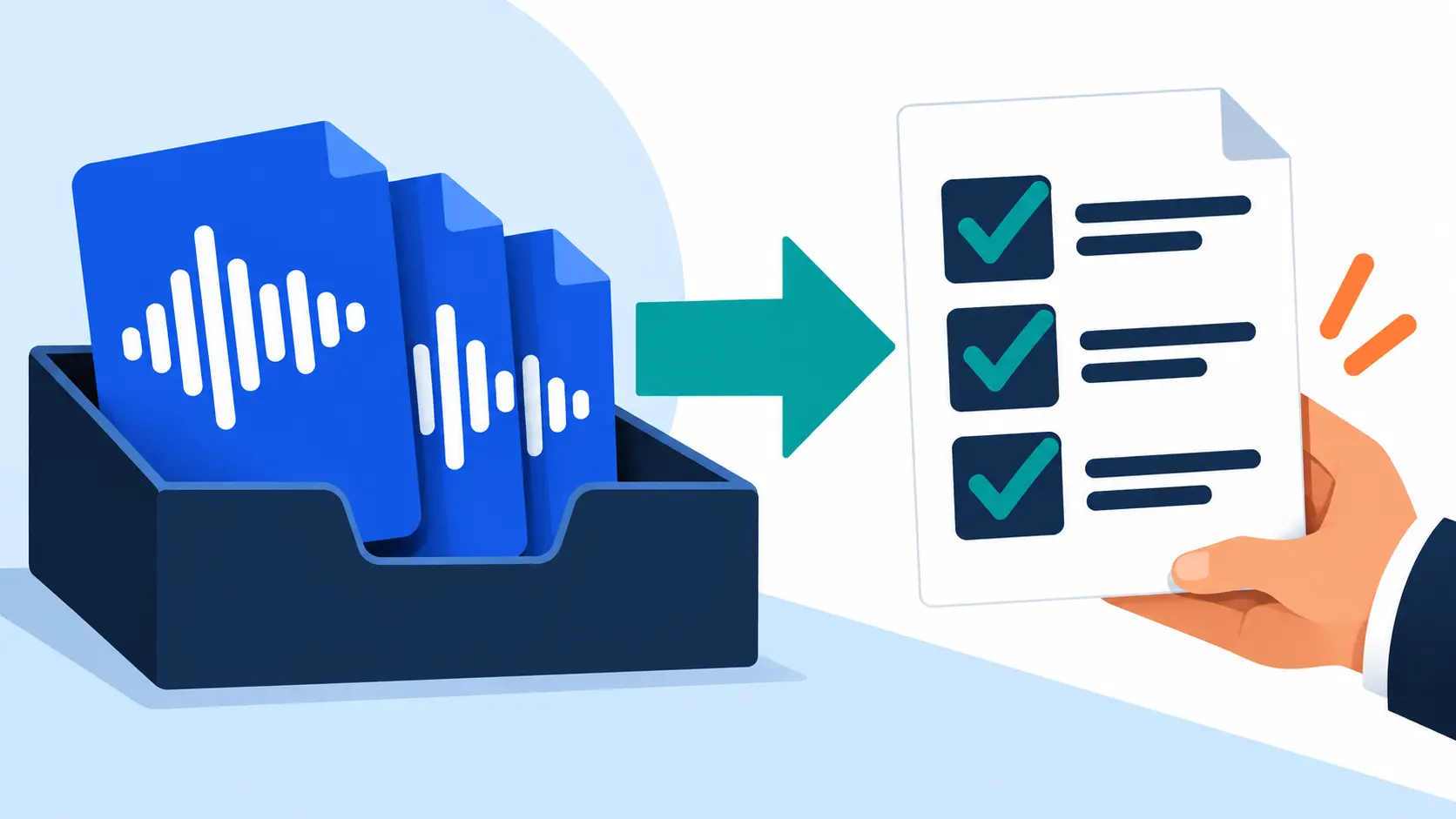
Batch Transcription Handoffs: File Manifests, Export Checks and Honest Automation Boundaries
Batch transcription handoffs require source identity, artifact versions, expected files, export checks, transfer evidence, destination testing and human acceptance. File-transfer guidance separates checking a…
-

Planning Transcription Capacity: Media Minutes, Rework and Cost per Accepted Output
Transcription capacity planning must separate unique media minutes, processing attempts, human review, accepted outputs, queue delay, service limits and total operating cost. A large…
-

Human Review Operations for Transcripts: Risk Triage, Escalation and Completion Evidence
Human transcript review needs defined scope, risk triage, qualified reviewers, source access, escalation, accepted versions and completion evidence. A review checkbox records an action,…
-

Media Provenance for Transcription: Originals, Checksums and Documented Transformations
Media provenance connects source files, checksums, technical characteristics, transformations, working copies, transcript versions and handoff evidence. A matching checksum supports byte-level continuity with a…
-

Public Media URL Transcription: Access Checks, Source Changes and Reliable Inputs
Public media URL transcription depends on authorization, actual access, complete addresses, link lifetime, media identity, source coverage and output verification. A video visible in…
-

Transcript Version Control: Corrections, Derived Notes and Recoverable Source Records
Transcript version control preserves source identity, raw output, reviewed text, change reasons, derived artifacts, release state and recovery evidence. A newer file is not…
-

Transcript Retrieval and Chunking: Context Windows, Evidence Spans and Boundary Tests
Transcript chunking connects retrieval units, evidence spans, speaker context, source locators, overlap, context budgets and boundary tests. Dividing a recording into searchable text can…
-

Auditing Transcript Summaries: Claim Support, Contradictions and Missing Qualifications
Transcript-summary auditing examines claim support, contradictions, speaker attribution, time relationships, qualifications, coverage and revision history. Fluency is useful, but it does not prove faithfulness…
-

Action Items from Meeting Transcripts: Ownership, Deadlines and Unassigned Work
Meeting action items require more than an action verb: they need scope, ownership, acceptance, timing, dependencies, status and completion evidence. Research treats action detection…
-

Meeting Decision Logs: Proposals, Conditions and Evidence of Agreement
Meeting decision logs should connect proposals, scope, conditions, rationale, agreement evidence, review status and later changes. A conversation about a choice does not necessarily…
-

Searching Webinar Transcripts: Retrieval Units, Metadata and Answer Verification
Webinar transcript search should connect a user's question to relevant passages, context boundaries, source metadata, language analysis, time locators, ranking evaluation and answer verification.…
-

How to Turn a Lecture Recording into Study Notes You Can Actually Use
Turn a lecture recording into reviewed study notes with checked terminology, visual context, worked examples and questions that support deliberate practice.
-

Transcripts for Qualitative Coding: Analytic Units, Corrections and Reflexive Review
Qualitative coding requires more than attaching labels to sentences. A defensible process connects research purpose, analytic approach, transcription detail, contextual units, interpretive decisions, revision…
-

Oral History Transcription: Voice, Editorial Conventions and Archival Provenance
Oral history transcription should preserve a relationship among recorded voice, editorial conventions, narrator participation, historical context, source identity, access conditions and long-term stewardship. A…
-

Journalistic Quote Review from Recordings: Attribution, Context and Source Accuracy
Quote review is an evidence task before it is a polishing task. A defensible workflow connects recorded wording, speaker attribution, interview conditions, surrounding context,…
-

Text-Based Video Editing: Transcript Corrections, Cut Decisions and Timeline Integrity
Text-based video editing connects written dialogue to media, but a dependable workflow must distinguish transcript correction, editorial removal, source time, sequence time, semantic continuity,…
-

Podcast Show Notes from Transcripts: Quote Selection, Topic Navigation and Listener Value
Podcast show notes are an editorial resource, not a transcript pasted beneath an episode. Episode descriptions, topic summaries, chapter navigation, and selected quotations serve…