Blog
-

When Speech Refers to Visuals: Transcript Gaps, Descriptive Context and Reviewer Boundaries
Spoken visual references can leave a faithful transcript incomplete for a reader who cannot see the source. Expressions such as this curve, that control,…
-

Accessible Lecture Transcripts: Captions, Document Structure and Learning Tasks
Accessible lecture transcripts should support the information and tasks a learner needs, not merely reproduce words in a long page. Captions, document headings, visual…
-

TTML and IMSC Caption Interchange: Profiles, Conversion and Information Loss
Caption interchange is not simply replacing one extension with another. TTML structure, IMSC profiles, timing expressions, and presentation features define different constraints that a…
-

WebVTT Sidecar Metadata: Cue Identifiers, Language Labels and Reliable Media Association
WebVTT sidecars separate timed text from media, which makes reuse convenient and association errors easy. Cue identifiers, language labels, track kinds, and media versions…
-

Non-Speech Information in Captions: Sound Cues, Speaker Context and Accessibility
Non-speech caption information supplies auditory context that words alone may omit. Meaningful sounds, music changes, speaker context, and vocal events can explain why an…
-

Caption Line Breaks: Linguistic Units, Visual Constraints and Readable Delivery
Caption line breaks shape how viewers receive a sentence, not merely how a text box looks. Linguistic units, negation, names, and visual constraints can…
-

Caption Reading Speed: Cue Duration, Speech Density and Viewer Comprehension
Caption reading speed describes text load over time, but a number alone does not establish comprehension. Cue duration, speech density, linguistic segmentation, and visual…
-

Transcript Timestamp Drift: Edited Media, Offsets and Stable Evidence Locators
Timestamp drift can arise from incorrect alignment, but it can also reflect a mismatch between the transcript and the media being played. Leading trims,…
-

Verbatim and Clean-Read Transcripts: Editorial Policies, Omissions and Traceability
Verbatim transcription and clean-read editing serve different purposes, but neither label is a complete policy. Decisions about fillers, repetitions, self-corrections, and non-speech information can…
-

Punctuation in AI Transcripts: Sentence Boundaries, Speaker Intent and Editorial Judgment
Transcript punctuation is an interpretation of speech structure, not an audible sequence of commas and full stops. Sentence boundaries, questions, pauses, and speaker changes…
-

Text Normalization for Speech Transcripts: Readability Without Changing the Record
Text normalization changes representation, but not all representation changes are harmless. Converting spoken numbers, standardizing character sequences, restoring capitalization, or choosing display punctuation can…
-

Domain Context in Speech Recognition: Prompting, Adaptation and Unsupported Assumptions
Domain context can help explain why a recognizer chooses one plausible word over another, but it is not a single universal feature. Prompting, phrase…
-

Low-Resource Language Transcription: Coverage, Evaluation and Human Expertise
Low-resource language transcription is a question of usable evidence, not merely whether a language appears in a menu. Training coverage, dialect fit, recording conditions,…
-
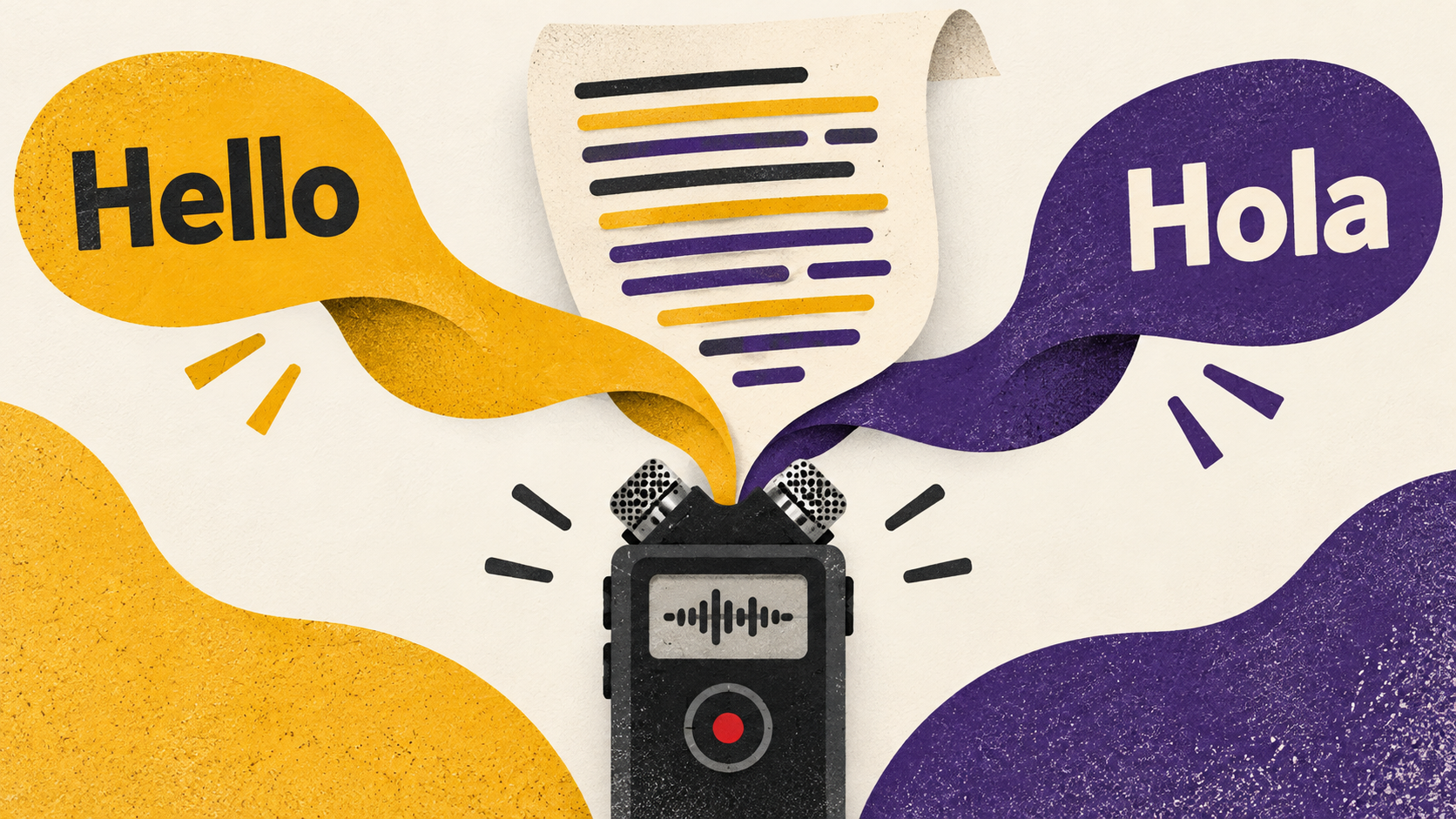
How to Transcribe Mixed-Language Recordings Without Losing the Switches That Matter
Transcribe mixed-language recordings with clear language and script conventions, tested settings, switch-point review and checked speaker continuity.
-

Speaker Labels and Real Identity: Evidence Requirements for Naming Interview Participants
An anonymous label is a useful organizing device, not a person's verified name. Speaker diarization, identity mapping, and publication permission answer different questions, even…
-

Overlapping Speech in Transcripts: Attribution, Turn Boundaries and Honest Uncertainty
Overlapping speech is not simply a noisy version of ordinary conversation. Two contributions occupy the same time, so word recovery, speaker attribution, and turn…
-

Multitrack Interview Transcription: Channel Maps, Synchronization and Editorial Handoffs
Multitrack recording preserves separate sources, but a dependable transcript still requires channel mapping, timeline alignment, clock verification, overlap review, version control, export checks and…
-

Microphone Placement for Interviews: Distance, Room Sound and Recording Decisions
Microphone placement shapes the evidence available to a transcription workflow before any recognition begins. Distance, orientation, room reflections, speaker movement, clothing noise, wind protection…
-

Measuring Transcript Post-Editing Effort: Time, Error Severity and Acceptance Criteria
Post-editing effort is the work required to turn a transcription draft into an accepted deliverable. It includes listening, correction, verification, timing review, exception handling,…
-

Building a Transcription Test Set: Sampling, Reference Quality and Leakage Control
A trustworthy transcription test set represents the work a team intends to deliver, not simply the recordings easiest to score. Its design must document…
-

Transcription Confidence Scores: Calibration, Abstention and Human Review
A confidence score is useful only when its meaning, evaluation population and failure behavior are understood. Calibration differs from error ranking, and both differ…